
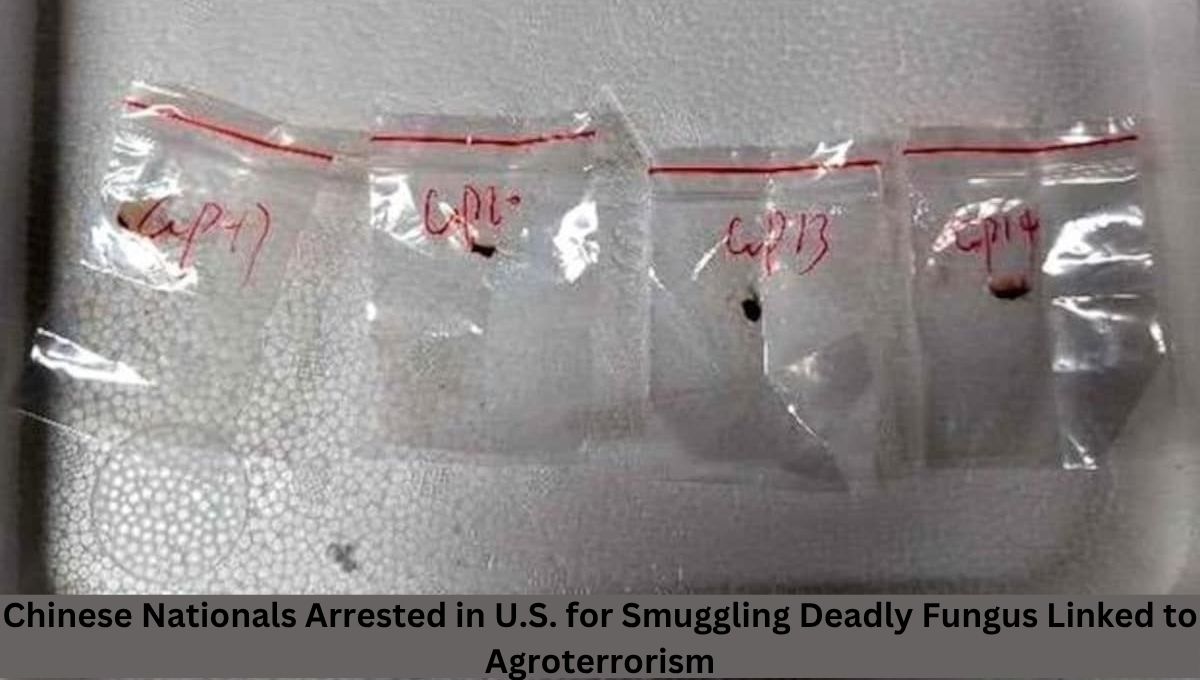
In a shocking development two Chinese Nationals Arrested in U.S. for Smuggling Deadly Fungus Linked to Agroterrorism. Despite growing tensions between the United States and China, two Chinese nationals have been arrested and charged for allegedly smuggling a dangerous biological pathogen into the country. The fungus, Fusarium graminearum, has been classified as a potential agroterrorism weapon, raising deep concerns over national security and bio-threats to the U.S. agricultural system.

Chinese Nationals Arrested in U.S. for Smuggling Deadly Fungus Linked to Agroterrorism
Who Are the Accused?
The FBI identified the individuals as Yunqing Jian, 33, and Zunyong Liu, 34. Jian, reportedly affiliated with the Chinese Communist Party (CCP), was working at a University of Michigan laboratory when the events unfolded.
Liu, her boyfriend and a researcher based in China, smuggled the fungus into the United States during a visit to Jian in July 2024. According to FBI Director Kash Patel, both suspects are being charged with conspiracy, smuggling goods into the U.S., false statements, and visa fraud.
What Is Fusarium graminearum?
Fusarium graminearum is a toxic fungus that causes a disease known as “head blight” in wheat, barley, maize, and rice. Not only does it devastate crops, but its toxins can cause severe health issues such as vomiting, liver damage, and reproductive defects in both humans and livestock.
According to the U.S. Department of Justice (DOJ), this pathogen causes economic losses worth billions of dollars globally each year, making it a strategic threat when weaponized earning it the label of a potential agroterrorism agent in scientific literature.
FBI and DOJ Sound Alarm
The arrest was a result of a joint investigation by the FBI and U.S. Customs and Border Protection (CBP). FBI Special Agent Cheyvoryea Gibson emphasized that the pair’s actions posed an “imminent threat to public safety”, accusing them of exploiting U.S. laboratory access to further their mission.
FBI Director Patel added that the case is a “sobering reminder” of how CCP-linked operatives are attempting to infiltrate American institutions to target the U.S. food supply chain, potentially leading to widespread food insecurity and economic instability.
Electronic Evidence and CCP Links
The criminal complaint filed in federal court revealed that electronic communications between Jian and Liu confirmed their knowledge and intent. Authorities also found funding links between Jian’s research and the Chinese government.
Jian’s devices allegedly contained pro-CCP material, further solidifying suspicions that this was not just an academic endeavor but possibly an act of biological espionage.
Trump Administration Reacts
This development comes days after the Trump administration vowed to aggressively revoke visas of Chinese students and researchers, especially those linked to the Chinese Communist Party or studying sensitive fields such as biotechnology and agriculture.
Secretary of State Marco Rubio reiterated that future Chinese visa applicants would face increased scrutiny, citing this case as a textbook example of why such vigilance is essential.
University of Michigan Responds
In a statement issued to the BBC, the University of Michigan clarified that it had not received any Chinese government funding related to the accused individuals’ research. The university pledged full cooperation with law enforcement and strongly condemned any activity that threatens public safety or national security.
A Global Concern: What Is Agroterrorism?
Agroterrorism refers to the use of biological agents to intentionally damage or destroy agricultural resources, including crops and livestock. It’s a low-cost but high-impact form of terrorism that can cripple economies, destabilize societies, and disrupt food supply chains.
There is no robust international legal framework to criminalize biological attacks against non-human targets, making agroterrorism a growing but under-addressed threat.
India’s Agroterrorism Experience
The U.S. incident has brought renewed focus to agroterrorism, with parallels being drawn to similar threats in India. In 2016, Magnaporthe oryzae Triticum, a wheat-blast-causing fungus, emerged in West Bengal, likely introduced from neighboring Bangladesh.
The Indian government had to ban wheat cultivation in affected districts and near border areas to contain the spread.
In 2015, Pakistan’s cotton crops were hit by a devastating whitefly infestation and cotton leaf curl virus, causing losses of up to $670 million. Some experts speculated that the virus may have originated from experimental cotton plants maintained in Pakistani research facilities.
A New Frontier in Warfare?
The latest case serves as a stark reminder that farm fields may well become the next battlefield. Agriculture, being vital yet vulnerable, is a soft target for enemies seeking to cripple a nation economically and psychologically.
With over 17% of India’s GDP and 55% of its population dependent on agriculture, and with many border-sharing agricultural states, India too remains at significant risk.
Conclusion: A Wake-Up Call
The arrest of two Chinese nationals for smuggling an agroterrorism weapon into the U.S. has brought to light the looming threat of biological warfare on agriculture. The fungus Fusarium graminearum is not just a scientific specimen it is a tool that can cripple food security, devastate economies, and endanger lives.
This case underscores the need for stronger international laws, stricter academic research protocols, and constant vigilance against such covert threats. As the U.S. government proceeds with its prosecution, other nations especially those like India must take cues to fortify their biosecurity infrastructure.
Also Read: China Expert Warns: “Something Worse Than COVID Is Coming” Amid Wave of Biological Smuggling Arrests
Also Read: How deadly is the fungus that 2 Chinese nationals tried to smuggle into US?
Related Posts:
- China Expert Warns: “Something Worse Than COVID Is…

- 5 Alarming Revelations as FBI Foils Halloween Terror…

- In 8 Moves, EU Targets China-Linked Refineries and…

- Afghanistan–Pakistan War 2025: Inside the 48-Hour Ceasefire

- 7 Powerful Measures: Trump Sanctions Russian Oil…

- Trump’s 20-Point Gaza Peace Plan Gains Urgent Global…
