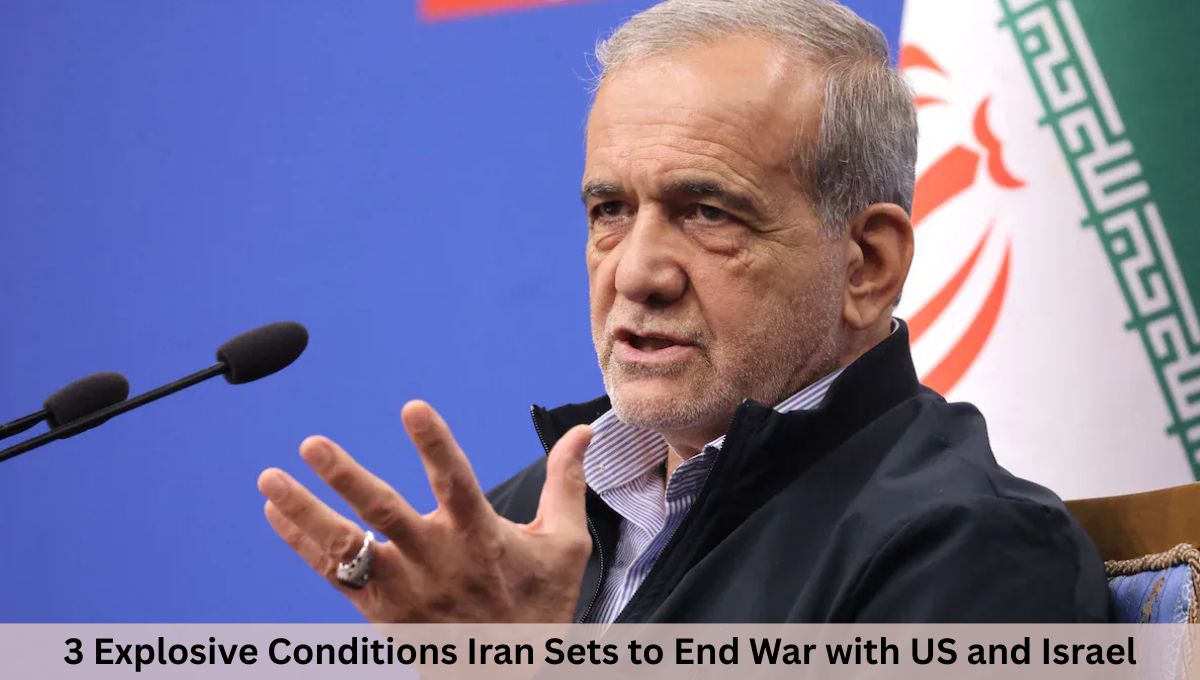
3 Explosive Conditions Iran Sets to End War with US and Israel amid escalating geopolitical crisis. Tensions across the Middle East remain extremely high as the ongoing war involving Iran, the United States and Israel continues to escalate. Missile strikes, air raids, and threats of further military operations have kept the region on edge, while global powers worry about the possibility of a much wider regional conflict.
Thank you for reading this post, don't forget to subscribe!Amid this intense geopolitical crisis, Iran has now publicly laid out the conditions under which it says the war could end. Iranian President Masoud Pezeshkian has announced that Tehran would consider ending the conflict only if three key demands are fulfilled.
These conditions include recognition of Iran’s rights, payment of reparations for damage caused during the war, and strong international guarantees that Iran will not face similar attacks in the future.
According to Iranian officials, these demands are not just about ending the current fighting but about establishing long-term security and stability in the region. However, whether the United States and Israel are willing to accept such terms remains uncertain.
As the war enters its second week, both sides continue to exchange strikes while global leaders attempt to find diplomatic solutions.
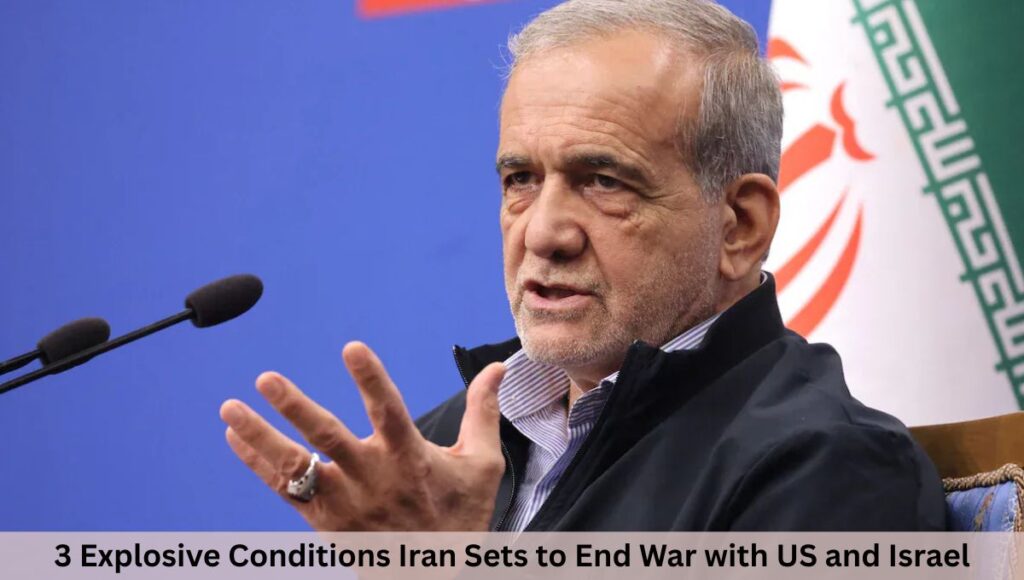
3 Explosive Conditions Iran Sets to End War with US and Israel
Iran Outlines the Only Path to Ending the War
Iran’s leadership says the conflict cannot be resolved through military pressure alone.
Instead, it argues that the war must end through a political settlement that addresses the root causes of the crisis.
President Masoud Pezeshkian outlined Tehran’s position in a message posted on the social media platform X after speaking with leaders from Russia and Pakistan.
In the message, he emphasized that Iran remains committed to peace but believes that the responsibility for ending the war lies with the countries that initiated the attacks.
According to Pezeshkian, the conflict began after military operations carried out by the United States and Israel targeted Iranian infrastructure and military assets.
“The only way to end this war—ignited by the Zionist regime and the US—is recognising Iran’s legitimate rights, payment of reparations, and firm international guarantees against future aggression,” he wrote.
This statement marks one of the clearest outlines of Tehran’s diplomatic position since the war began.
While Iran’s military continues to launch retaliatory strikes, the political leadership appears to be signalling that negotiations may still be possible under specific conditions.
Iran’s Three Conditions to End the War
Iran has identified three key requirements that must be met before the conflict can end. These demands are focused on political legitimacy, financial accountability and long-term security guarantees.
1. Recognition of Iran’s Legitimate Rights
The first and most important demand is international recognition of Iran’s legitimate rights.
Tehran argues that any peace agreement must acknowledge the country’s sovereignty and political standing in the region.
Iranian officials say that for years they have faced sanctions, military threats and diplomatic isolation.
From Iran’s perspective, recognising its rights would mean accepting its role as a major regional power and respecting its national security concerns.
Iranian leaders believe that without such recognition, any ceasefire agreement would only be temporary and could lead to further conflicts in the future.
They insist that the international community must treat Iran as an equal participant in regional security discussions rather than as a target of military pressure.
2. Payment of Reparations for War Damage
The second demand focuses on compensation for the destruction caused during the war.
According to Iranian officials, airstrikes and missile attacks have damaged cities, destroyed infrastructure and caused civilian casualties across the country.
Iran argues that those responsible for the attacks must pay reparations to help rebuild damaged infrastructure and compensate victims of the conflict.
The scale of the destruction is believed to be significant. Several industrial facilities, residential buildings and transport networks have reportedly been damaged during the military campaign.
Reconstruction could take years and cost billions of dollars.
Tehran says financial compensation is necessary not only to repair physical damage but also to restore economic stability after years of sanctions and war.
3. International Guarantees Against Future Attacks
The third condition involves security guarantees. Iran says it needs firm international assurances that it will not face similar military attacks in the future.
These guarantees, according to Tehran, should come from global powers or international institutions capable of enforcing them.
Iranian officials argue that previous diplomatic agreements have failed to prevent military escalation in the region.
Therefore, they believe that stronger international commitments are required to ensure lasting peace.
Without such guarantees, Tehran says it would have little reason to trust any ceasefire agreement.
Iran Signals Openness to Diplomacy
Despite the ongoing military conflict, Iranian officials have repeatedly stated that the country remains open to diplomatic solutions.
President Pezeshkian’s statement suggests that Tehran is attempting to present a potential path toward de-escalation.
However, analysts say Iran’s conditions may be difficult for the United States and Israel to accept, especially the demand for reparations and political recognition.
For Washington and Tel Aviv, agreeing to such terms could be interpreted as acknowledging responsibility for the conflict.
As a result, negotiations may face significant obstacles even if both sides eventually show interest in talks.
Iran Issues Strong Warning Over Possible Port Attacks
While presenting its peace conditions, Iran has also issued a strong warning to its adversaries.
Iranian military officials say that any attack on the country’s ports or maritime infrastructure could trigger a much wider regional conflict.
Abolfazl Shekarchi, spokesperson for Iran’s armed forces, warned that Tehran would respond aggressively if its ports were targeted.
“If our ports and docks are threatened, all ports and docks in the region will be our legitimate targets,” he said in a statement to Iranian state media.
According to Shekarchi, Iran’s military possesses the capability to strike strategic economic hubs across the Persian Gulf.
He also warned that the country’s armed forces could launch more powerful operations if the conflict intensifies.
“We will carry out a heavier operation than what we have done so far,” he said.
These comments highlight the risk that attacks on maritime infrastructure could quickly escalate into a broader regional war.
Regional Countries Face Growing Pressure
Iran’s warning has also raised concerns among neighbouring countries in the Persian Gulf.
Several Gulf states host American military bases or maintain security partnerships with the United States.
Iranian officials have urged these countries to reconsider their cooperation with Washington. Shekarchi called on regional governments to expel American forces from their territory.
“We call on the countries of the region to expel the Americans from their lands,” he said.
Such statements have increased tensions in a region already struggling with security concerns and economic uncertainty.
Israel Unsure Whether War Will Lead to Regime Change
Despite intense military pressure on Iran, Israeli officials reportedly believe that the conflict may not lead to the collapse of the Iranian government.
According to reports from international news agencies, internal discussions among Israeli authorities suggest there is little evidence that Iran’s political system is close to falling.
Even after significant airstrikes targeting military infrastructure and senior commanders, there have been no large-scale protests against the government.
Analysts say the lack of a widespread uprising may be due to several factors.
First, ongoing airstrikes and security concerns may discourage people from gathering in public spaces.
Second, Iran’s security forces maintain strict control over demonstrations. Finally, many citizens may be reluctant to protest during a foreign military campaign.
These factors have made regime change an uncertain outcome of the war.
Heavy Losses for Iran’s Military Leadership
The war has already caused significant losses for Iran’s leadership.
Several senior military commanders have reportedly been killed in targeted strikes. Military facilities, missile sites and defence installations have also been heavily damaged.
At the same time, civilian casualties and destruction of residential areas have increased public anger inside the country.
Despite these losses, Iran’s political leadership remains firmly in control of the state apparatus.
Experts believe that political change in Iran is unlikely to happen quickly, even under sustained military pressure.
Economic Crisis Deepens as War Continues
Beyond the battlefield, the conflict is also worsening Iran’s already fragile economy.
Years of international sanctions had already placed enormous pressure on Iran’s financial system before the war began.
Now, military operations and damage to infrastructure are further weakening the economy.
Airstrikes have damaged factories, transport networks and energy facilities in several cities. Rebuilding these systems could require massive financial resources.
At the same time, trade disruptions and financial isolation are affecting business activity across the country.
Rising Inflation and Public Hardship
Ordinary Iranians are also facing severe economic challenges. Inflation has surged, the national currency has weakened and many essential goods have become more expensive.
Job losses are increasing as businesses struggle to operate during the conflict. Before the war began, Iran had already experienced protests linked to rising living costs and economic hardship.
The current conflict could deepen those frustrations if economic conditions continue to deteriorate.
However, analysts say that wartime nationalism and strict security measures may limit public protests for now.
Strait of Hormuz Crisis and Global Oil Shock
One of the most significant global consequences of the war has been disruptions around the Strait of Hormuz.
This narrow waterway is one of the most important shipping routes in the world, carrying roughly 20 percent of global oil supplies.
As tensions escalated, attacks on shipping and threats from Iran have caused serious concerns for global energy markets.
Oil prices surged sharply after the conflict began, rising from around $65 per barrel to more than $100 at certain points.
Iran has even warned that prices could potentially reach $200 per barrel if shipping through the strait is completely blocked.
Such a scenario could have major economic consequences for countries around the world.
Global Energy Markets Feel the Impact
The surge in oil prices has already begun affecting economies across the globe. Higher fuel prices increase transportation costs and raise the price of goods and services.
Countries that depend heavily on imported oil could face inflation and slower economic growth.
To stabilize markets, some governments and international organisations have discussed releasing oil from emergency reserves.
However, it remains unclear whether such measures will be enough to offset potential disruptions in the Persian Gulf.
Conflicting Messages From the United States
While Iran has outlined conditions for peace, the United States has sent mixed signals about how the war may end.
US President Donald Trump has repeatedly suggested that the conflict could end soon.
He has claimed that American and Israeli forces have already achieved many of their objectives and that Iran’s military capabilities have been significantly weakened.
At the same time, Trump has also said that the United States intends to “finish the job,” indicating that military operations may continue.
These conflicting messages have created uncertainty about Washington’s long-term strategy.
Israel Signals No Time Limit for War
Israel’s position appears more determined to continue the campaign.
Israeli Defence Minister Israel Katz has said that the military operation could continue for as long as necessary to achieve its goals.
These goals reportedly include dismantling Iran’s missile capabilities and preventing the country from developing nuclear weapons.
Israeli officials say the war will not stop until these objectives are fully achieved. This stance suggests that negotiations may still be far away.
Global Calls for De-Escalation
As the war continues, international leaders are increasingly calling for restraint and diplomatic solutions.
Countries in the Middle East, Europe and Asia have urged both sides to avoid actions that could escalate the conflict further.
Diplomatic channels involving Russia, Pakistan and several Gulf states are attempting to reduce tensions and encourage negotiations.
However, the path toward peace remains uncertain. Both sides continue to carry out military operations, and political differences remain significant.
Is an End to the War in Sight?
Iran’s announcement of its three conditions may represent the first outline of a possible path toward ending the war. However, the demands themselves are complex and politically sensitive.
For the United States and Israel, accepting Iran’s conditions could carry significant strategic and political implications.
At the same time, continuing the war could deepen economic damage and increase the risk of a broader regional conflict.
For now, the fighting continues across the Middle East, with no immediate sign of a ceasefire.
Whether diplomacy can eventually succeed may depend on how much pressure each side is willing to endure before considering compromise.
Also Read: 12 Explosive Claims as Donald Trump Says Iran War Could End Soon but Vows to “Finish the Job”
Also Read: Oil tankers burn after being hit by explosive-filled Iranian boats as Tehran threatens $200 a barrel
Related Posts:
- 10 Explosive Signals Trump Says Iran War Could End…
- 10 Explosive Warnings as Donald Trump Calls Iran…
- 7 Powerful Facts About Ayatollah Ali Khamenei’s…
- 9 Explosive Claims as Trump Says US Winning Iran War

- 10 Explosive Signals: Trump Rates Iran War “15/10”…
- 10 Powerful Revelations from the Trump–Putin Call on…