

12 Shocking Escalations After Iran Attacks Ship Bound for India in Strait of Hormuz, putting global trade at risk. The intensifying conflict between Iran, the United States, and Israel has entered a dangerous new phase, with commercial shipping now directly caught in the crossfire.
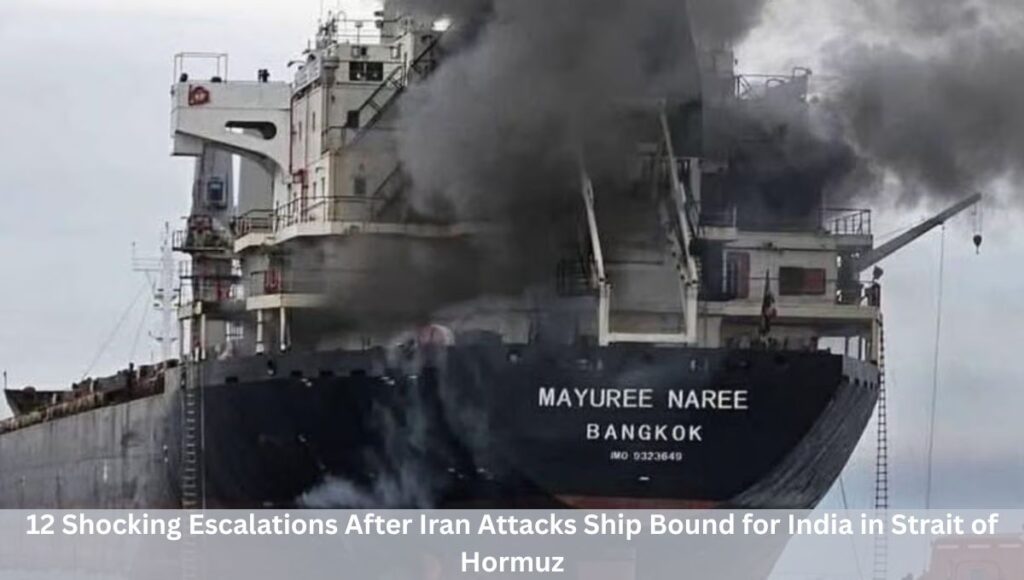
In one of the most alarming incidents yet, a Thai-flagged cargo vessel sailing toward India was attacked near the Strait of Hormuz — one of the world’s most strategically vital waterways. The attack triggered a fire aboard the ship, forced the evacuation of its crew, and left several sailors missing, while thick black smoke rose from the vessel’s hull.
The event has further escalated fears that the war could destabilize global trade, energy markets, and international shipping routes. As tensions surge across the Middle East, the incident highlights how rapidly the conflict is expanding beyond military targets and into critical civilian infrastructure.
Below are the 12 most shocking developments surrounding the attack and the widening maritime crisis.
12 Shocking Escalations After Iran Attacks Ship Bound for India in Strait of Hormuz
1. India-Bound Cargo Ship Attacked in Strategic Waterway
The vessel involved in the attack is the Mayuree Naree, a Thai-flagged bulk carrier owned by shipping company Precious Shipping.
The ship had departed from Khalifa Port in the United Arab Emirates and was en route to Kandla Port in Gujarat, India, when it came under attack.
According to maritime reports, the vessel was struck while transiting the Strait of Hormuz, a narrow maritime corridor linking the Persian Gulf with the Gulf of Oman.
The waterway is considered one of the most important shipping lanes in the world because nearly one-fifth of global oil trade passes through it every day.
The attack occurred roughly 11 nautical miles off the coast of Oman, placing the ship in one of the most heavily monitored maritime regions on Earth.
2. Explosion and Fire Forced Crew to Abandon Ship
Following the strike, a fire broke out aboard the cargo vessel, damaging its engine room and forcing the crew to abandon ship.
Images released by the Thai navy show:
- Thick black smoke rising from the vessel
- Flames engulfing parts of the ship
- Lifeboats floating nearby as crew evacuated
The ship’s operator confirmed that 20 of the 23 crew members were rescued, while three sailors remain missing.
Officials fear the missing crew members may have been trapped inside the engine room when the projectile struck.
The Omani Navy launched a rescue operation and evacuated the survivors to safety.
3. Iran Claimed Responsibility for the Attack
Shortly after the incident, Iran’s Islamic Revolutionary Guard Corps (IRGC) reportedly acknowledged that its forces had fired upon the vessel.
Iranian authorities have increasingly warned that commercial shipping in the region could become a target if the United States and Israel continue their military operations against Iran.
The Iranian military has repeatedly threatened to shut down the Strait of Hormuz entirely.
In recent statements, Iranian officials said:
“Not a single litre of oil will leave the region if attacks against Iran continue.”
Such warnings have dramatically increased tensions across the global shipping industry.
4. At Least 16 Ships Have Been Attacked Since War Began
The Mayuree Naree incident is not isolated.
Since the war between Iran and the US-Israel coalition began on February 28, maritime authorities say at least 16 ships have been attacked or damaged in the Gulf region.
These include:
- Bulk carriers
- Oil tankers
- Container ships
- Fuel vessels
Several ships were struck by unknown projectiles, while others were attacked by drones or explosive boats.
The United Kingdom Maritime Trade Operations (UKMTO) center has issued repeated warnings urging ships to exercise extreme caution in the area.
5. Strait of Hormuz Shipping Traffic Has Nearly Collapsed
The attacks have severely disrupted shipping in the Strait of Hormuz.
Major shipping companies are now refusing to send vessels through the corridor due to the extreme risk.
Hundreds of ships are currently waiting outside the passage, unwilling to sail through the dangerous route.
As a result:
- Cargo shipments have slowed dramatically
- Oil exports from the Gulf have been severely disrupted
- Insurance premiums for ships entering the region have skyrocketed
This disruption is now being described by analysts as the worst maritime crisis since the 1970s oil shocks.
6. Global Oil Prices Are Surging
The conflict has already sent shockwaves through global energy markets.
Oil prices surged above $100 per barrel, with Iranian officials warning the price could reach $200 per barrel if the conflict escalates further.
Energy analysts say the Strait of Hormuz blockade could trigger a global economic crisis.
The waterway normally carries:
- 20% of global oil supply
- massive volumes of liquefied natural gas (LNG)
- refined petroleum products
Any prolonged disruption could push energy prices dramatically higher worldwide.
7. The United Nations Demands Iran Stop Attacks
The escalating maritime crisis has triggered urgent international action.
The United Nations Security Council passed a resolution demanding Iran halt its attacks on Gulf countries and commercial shipping.
The vote passed 13-0, although Russia and China abstained, arguing the resolution did not address the root causes of the conflict.
Several Gulf states strongly condemned the attacks, warning that regional stability is under severe threat.
Bahrain’s UN ambassador stated that the attacks represent:
“A serious threat to global energy security and international trade.”
8. Attacks on Infrastructure Across the Gulf Intensify
The maritime strike occurred alongside a wave of attacks across the Middle East.
Recent incidents include:
- Drone strikes near Dubai International Airport
- A massive fire on Bahrain’s Muharraq Island
- Attacks on Iraq’s Basra oil port
- Drone launches toward cities in Iraqi Kurdistan
These incidents suggest Iran is expanding its strategy to target infrastructure across the region.
The aim appears to be creating economic pressure on the United States and Israel by destabilizing energy supplies.
One of the most alarming developments in the maritime conflict is the use of explosive naval drones.
Security analysts say Iran may be deploying unmanned surface vessels — essentially remote-controlled explosive boats — to attack ships.
These weapons can carry large explosive payloads and strike ships below the waterline.
Maritime experts warn that such attacks could:
- immobilize tankers
- ignite massive fires
- sink vessels in key shipping lanes
Even a single successful strike could block the Strait of Hormuz entirely.
10. India Condemns Attack on Ship Bound for Gujarat
India reacted strongly to the attack on the Thailand-flagged ship heading toward its western coast.
The Indian Ministry of External Affairs (MEA) condemned the targeting of commercial vessels and warned that innocent lives were being endangered.
In a statement, India said:
“Targeting commercial shipping and endangering civilian crew members must be avoided.”
Indian officials also noted that Indian citizens have already died in earlier maritime attacks linked to the conflict.
The government has urged all parties to protect freedom of navigation.
11. US and Israel Continue Military Strikes on Iran
Meanwhile, US and Israeli forces have continued large-scale military operations against Iran.
Their stated objectives include:
- destroying Iran’s naval capabilities
- crippling its missile infrastructure
- limiting its regional military influence
US officials claim dozens of Iranian ships have already been destroyed during the conflict. However, Iran has responded with missile and drone attacks across the region.
12. Global Trade Routes Face Historic Disruption
The widening maritime conflict threatens to disrupt global supply chains.
The Strait of Hormuz is not only crucial for oil shipments but also for:
- chemicals
- fertilizers
- industrial goods
- container cargo
If the waterway remains unsafe, companies may be forced to reroute shipments around Africa — a journey that adds weeks of travel time and billions in costs.
Economists warn that prolonged disruption could trigger:
- higher energy prices
- supply shortages
- inflation across global markets
A Growing Global Crisis
The attack on the Mayuree Naree cargo vessel illustrates how quickly the conflict between Iran, the United States, and Israel is spilling into civilian domains.
What began as a military confrontation is now threatening global trade routes, international energy markets, and the safety of commercial shipping.
With more ships under attack and tensions rising across the Gulf, the Strait of Hormuz has become one of the most dangerous flashpoints on the planet. Whether diplomatic efforts can prevent further escalation remains uncertain.
For now, the world is watching anxiously as one of the most critical arteries of global commerce faces unprecedented danger.
Also Read: 10 Explosive Updates: US Destroys 16 Iranian Mine-Laying Ships in Strait of Hormuz Crisis
Related Posts:
- 9 Explosive Impacts After US Submarine Sinks Iran’s…
- 7 Powerful Facts About Ayatollah Ali Khamenei’s…

- 3 Explosive Conditions Iran Sets to End War with US…

- 10 Explosive Warnings as Donald Trump Calls Iran…

- 10 Explosive Strikes: Israel Bombs Tehran Oil Depots…

- 7 Key Details About Deadly UPS Cargo Plane Crash in Kentucky
