10 Explosive Updates: US Destroys 16 Iranian Mine-Laying Ships in Strait of Hormuz Crisis, a key global oil route. The escalating war in the Middle East reached a dangerous new phase this week after the United States military announced it had destroyed 16 Iranian mine-laying vessels near the strategic Strait of Hormuz, one of the world’s most important energy corridors.
Thank you for reading this post, don't forget to subscribe!The operation came amid growing fears that Iran had begun deploying naval mines in the narrow waterway that connects the Persian Gulf to global shipping lanes. Roughly one-fifth of the world’s oil supply passes through the Strait of Hormuz each day, making any disruption to the route a potential shock to global energy markets.
The strikes followed a dramatic warning from U.S. President Donald Trump, who demanded that Iran immediately remove any mines placed in the shipping channel. “If Iran has put out any mines in the Hormuz Strait, we want them removed immediately,” Trump said in a social media post, warning that failure to do so could trigger military consequences “at a level never before seen.”
The U.S. military later confirmed the destruction of multiple Iranian vessels in an operation designed to prevent the mining of the strait and protect international shipping. The incident highlights the growing risk that the ongoing conflict between the United States, Israel, and Iran could expand into a global energy crisis.
Here are 10 explosive updates explaining what happened, why the Strait of Hormuz matters, and what could happen next.
10 Explosive Updates: US Destroys 16 Iranian Mine-Laying Ships in Strait of Hormuz Crisis
1. US Military Destroys 16 Iranian Mine-Laying Vessels
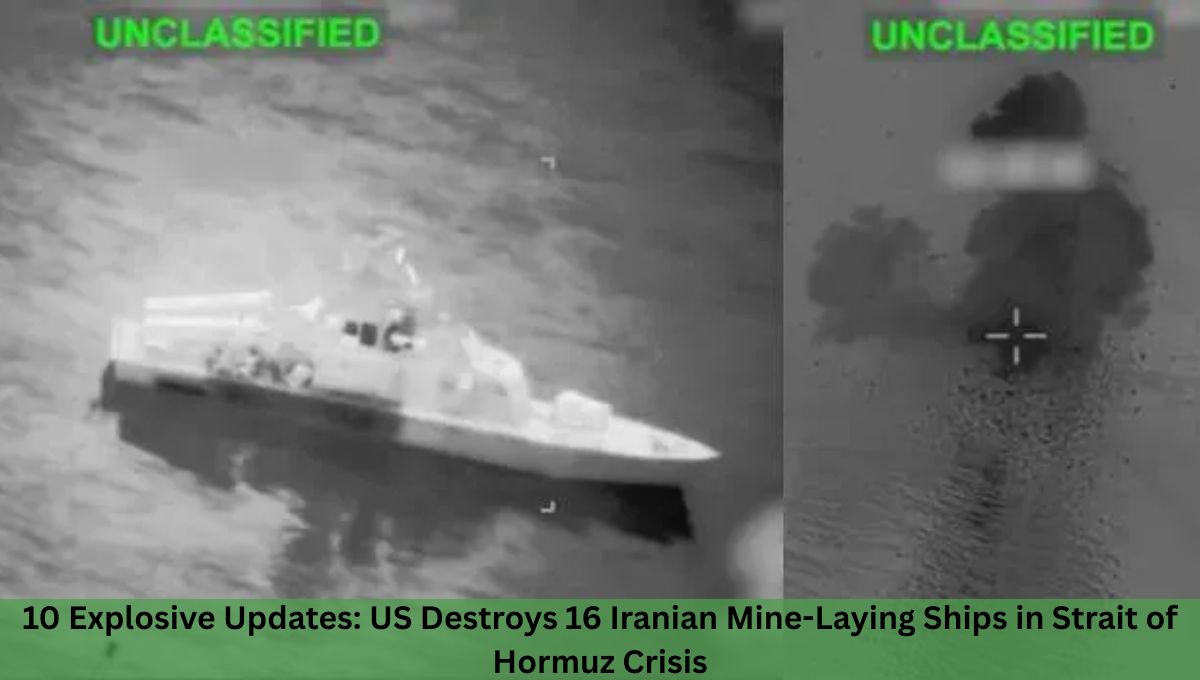
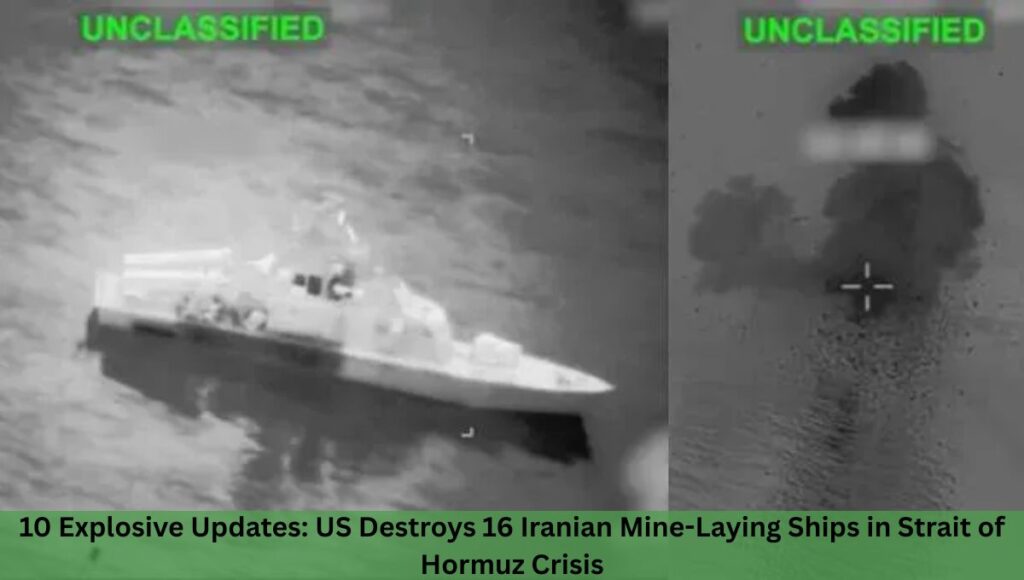
The U.S. military said Tuesday that it had eliminated multiple Iranian naval vessels, including 16 ships capable of deploying naval mines, near the Strait of Hormuz.
The strikes were carried out by forces under the command of United States Central Command, commonly known as CENTCOM.
In a statement posted on social media, the command said:
“U.S. forces eliminated multiple Iranian naval vessels, including 16 minelayers near the Strait of Hormuz.”
The announcement was accompanied by video footage showing explosions and strikes on several vessels.
Earlier in the day, President Trump had claimed that 10 mine-laying boats had already been destroyed, adding that “more would follow.”
The Pentagon later confirmed that the final number had reached 16 vessels.
2. Intelligence Reports Suggest Iran Has Begun Mining the Strait
The U.S. strikes followed intelligence reports suggesting that Iran had begun deploying naval mines in the Strait of Hormuz.
According to sources cited by CNN, Iran had placed a few dozen mines in the waterway in recent days.
Although the deployment was described as limited, intelligence officials warned that Iran retains most of its mine-laying boats and small craft, giving it the capability to deploy hundreds more mines if it chooses.
Experts say even a small number of mines could severely disrupt shipping.
Naval mines are difficult to detect and remove, meaning that clearing the waterway could take weeks or even months.
3. Trump Warns Iran of Severe Military Consequences
President Donald Trump issued a stark warning to Iran following the intelligence reports.
In a post on his Truth Social platform, Trump said the United States had no confirmed reports that Iran had mined the strait, but demanded that any devices be removed immediately.
He warned that if mines were deployed and not removed:
“The military consequences to Iran will be at a level never seen before.”
Trump also suggested that removing any mines would represent “a giant step in the right direction.”
The warning signaled that Washington views the potential mining of the Strait of Hormuz as a major escalation in the ongoing conflict.
4. Strait of Hormuz Carries About 20% of the World’s Oil
The Strait of Hormuz is one of the most strategically important waterways on Earth.
Located between Iran and Oman, the narrow channel connects the Persian Gulf to the Gulf of Oman and the Arabian Sea.
About 20 percent of global oil consumption passes through the strait each day.
In 2025 alone, roughly 13 million barrels of crude oil per day moved through the route, along with millions of barrels of refined fuels.
Major oil exporters that rely on the strait include:
- Saudi Arabia
- Iraq
- Kuwait
- the United Arab Emirates
- Qatar
Because the strait is only about 34 kilometers wide at its narrowest point, even small disruptions can halt shipping traffic.
5. Iran Threatens to Block Oil Exports
Iran’s leadership has threatened to block oil shipments from leaving the Persian Gulf if attacks against the country continue.
A spokesperson for the Islamic Revolutionary Guard Corps warned that Iran would not allow “even a single liter of oil” to reach its enemies.
The IRGC shares control of the strait with Iran’s conventional navy and has previously warned that ships passing through the waterway could become targets.
Iran has also suggested that it could attack oil pipelines and tankers operating in the region.
These threats have raised fears that the conflict could disrupt energy supplies across the world.
6. Oil Markets Swing Wildly Amid Shipping Crisis
The threat to the Strait of Hormuz has caused extreme volatility in global oil markets.
Oil prices surged to nearly $120 per barrel earlier in the week as investors feared a major disruption to supply.
Prices later dropped below $90 per barrel after news of U.S. military operations aimed at protecting the waterway.
The fluctuations highlight the sensitivity of global energy markets to developments in the strait.
Even rumors about the status of shipping routes have triggered dramatic swings in oil prices.
7. Shipping Industry Faces Rising Risks
The possibility of naval mines in the Strait of Hormuz has alarmed the global shipping industry.
Several shipping companies have begun rerouting vessels away from the region due to security concerns.
Insurance costs for tankers operating in the Persian Gulf have also surged to record levels.
In some cases, maritime insurers have refused to provide coverage for vessels traveling through the waterway.
Industry experts warn that if the strait remains blocked, global trade could face severe disruptions.
8. US Considers Escorting Oil Tankers
To protect shipping, the United States is considering deploying naval forces to escort commercial vessels through the Strait of Hormuz.
Trump said the U.S. Navy could begin escorting tankers “as soon as possible” if the situation worsens. However, the idea carries significant risks.
Escorting ships through a mined waterway could expose naval forces to attack from mines, missiles, drones, or small boats.
For now, U.S. officials say they are evaluating multiple options to ensure safe passage for commercial vessels.
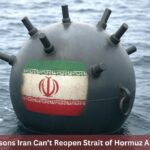
Naval mines are among the most dangerous and cost-effective weapons used in maritime warfare.
Some mines cost as little as $1,500, yet they can destroy ships worth hundreds of millions of dollars.
Mines can contain anywhere from 100 pounds to more than 2,000 pounds of explosives.
There are several types of naval mines, including:
Moored Mines
Attached to the seabed by a cable and triggered by contact with a ship.
Drifting Mines
Floating freely on the water’s surface and carried by currents.
Bottom Mines
Placed on the seabed and triggered by a ship’s magnetic or acoustic signature.
Limpet Mines
Attached directly to a ship’s hull using magnets.
Because mines can remain hidden underwater, they pose a long-term danger to shipping.
10. Clearing Mines Could Take Months
If Iran has deployed large numbers of mines, removing them could become a long and complex process.
Mine-clearing operations involve specialized ships, underwater drones, and divers.
Cormac McCarry, a maritime security expert with Control Risks, warned that clearing mines in the Strait of Hormuz could take months.
Even the threat of mines can have significant economic consequences. Ships may avoid the route entirely, forcing longer and more expensive shipping routes.
For global oil markets, that could mean higher fuel prices and economic instability.
The Strait of Hormuz: A Strategic Chokepoint
The Strait of Hormuz has long been considered one of the most vulnerable energy chokepoints in the world.
The shipping lanes within the strait are extremely narrow—only about 3.2 kilometers wide in each direction.
This makes it easier for naval mines or missile systems to disrupt traffic.
During the Iran-Iraq War in the 1980s, Iran deployed mines in the Persian Gulf as part of what became known as the “Tanker War.”
One such mine severely damaged the U.S. Navy frigate USS Samuel B. Roberts in 1988. The incident nearly triggered a broader military confrontation between the United States and Iran.
Iran’s military strategy relies heavily on asymmetric warfare.
Instead of competing directly with the superior naval power of the United States, Iran focuses on tactics designed to disrupt shipping and raise costs for its adversaries.
These tactics include:
- naval mines
- fast attack boats
- drones
- coastal missile batteries
Iran also operates fleets of small boats capable of rapidly deploying mines across the strait.
Military analysts say these tactics could create a “gauntlet” of threats for ships attempting to pass through the waterway.
Global Economic Stakes
The stakes surrounding the Strait of Hormuz extend far beyond the Middle East.
Any prolonged disruption to the waterway could affect global energy supplies and economic stability.
Countries in Europe, Asia, and North America all depend on oil shipments that pass through the strait.
Major energy producers such as Saudi Arabia and Kuwait have limited alternatives for exporting their oil if the strait is closed.
If shipping through Hormuz stops entirely, global oil prices could surge dramatically. Some analysts warn prices could rise toward $200 per barrel in a worst-case scenario.
What Could Happen Next?
The destruction of Iranian mine-laying vessels may temporarily reduce the threat to shipping in the Strait of Hormuz.
However, the broader conflict between the United States, Israel, and Iran shows no signs of ending soon.
Iran still retains a large fleet of small boats and mine-laying capabilities. At the same time, the United States has deployed significant naval forces to the region.
This creates a highly volatile situation in which even a small incident could trigger a major escalation.
Conclusion
The destruction of 16 Iranian mine-laying vessels near the Strait of Hormuz marks one of the most dramatic naval operations since the current Middle East conflict began.
The incident highlights how the war is increasingly centered on control of the world’s most important energy shipping route.
With oil markets already reacting sharply to the crisis, the situation in the strait will remain a major focus for governments, energy companies, and global markets.
Whether the waterway remains open—or becomes the center of a wider confrontation—could determine not only the outcome of the conflict but also the stability of the global economy.
Also Read: 10 Explosive Signals Trump Says Iran War Could End Soon While Warning Tehran Over Oil
Also Read: Iran begins laying mines in Strait of Hormuz, sources say