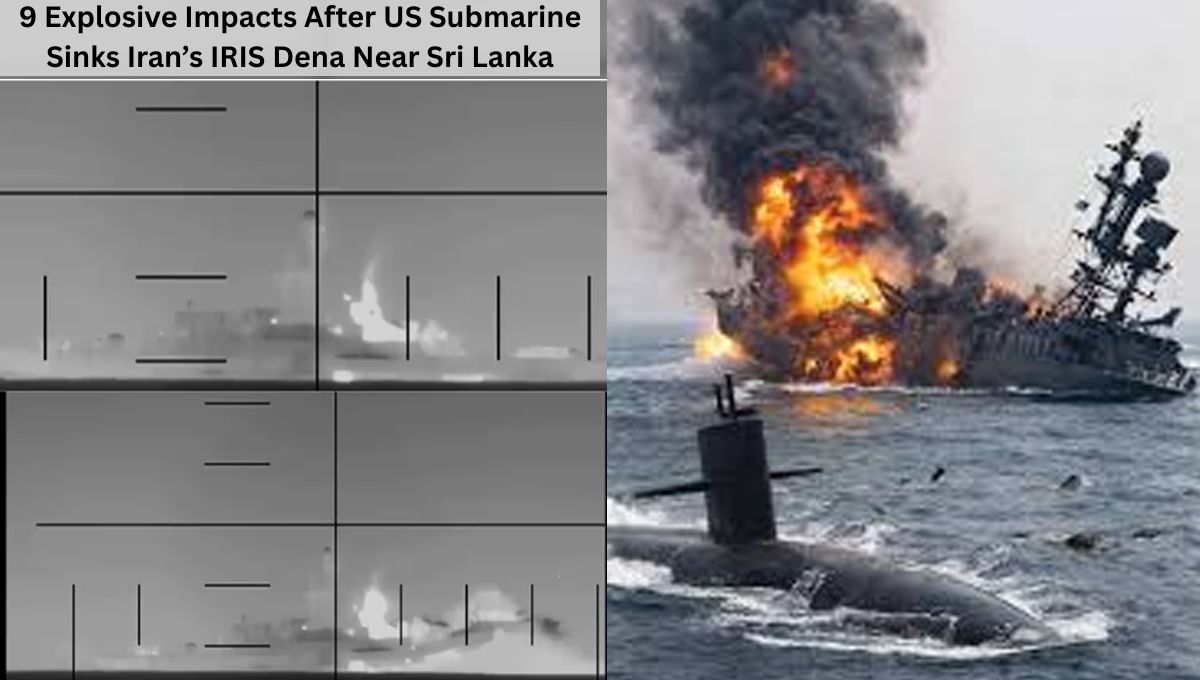
9 Explosive Impacts After US Submarine Sinks Iran’s IRIS Dena Near Sri Lanka, expanding the US-Iran war into the Indian Ocean. The sinking of an Iranian warship by a United States submarine near Sri Lanka has dramatically expanded the geographic scope of the escalating conflict involving Iran, the United States and Israel. The incident, which occurred in the Indian Ocean just south of Sri Lanka’s coastline, has raised alarm across South Asia and prompted warnings that the war’s ripple effects could soon reach the region.
Sri Lankan authorities confirmed that the Iranian frigate IRIS Dena was struck by a torpedo fired from an American submarine in international waters. The attack killed dozens of sailors and triggered a large-scale rescue operation involving Sri Lanka’s navy and air force. The event has quickly become one of the most significant naval incidents of the widening war between Iran and US-backed forces.
Sri Lankan lawmaker Namal Rajapaksa warned that the sinking is not merely a naval engagement between distant powers but a development with potential consequences for the security of the entire Indian Ocean region — including India.
9 Explosive Impacts After US Submarine Sinks Iran’s IRIS Dena Near Sri Lanka
A Warship Sunk in the Indian Ocean
The Iranian frigate was reportedly sailing through the Indian Ocean on its return journey from India when it was targeted. The vessel had recently taken part in multinational naval exercises hosted by the Indian Navy.
According to Sri Lankan officials, the warship issued a distress call early Wednesday morning before disappearing beneath the waves.
Sri Lanka’s navy dispatched rescue vessels and aircraft after receiving the emergency signal. When rescuers arrived, the warship had already sunk.
Only oil slicks, floating debris and life rafts remained. Naval personnel soon began pulling survivors from the water. Bodies were also discovered drifting in the ocean.
Sri Lankan authorities confirmed that 87 sailors were killed and 32 were rescued, while around 60 crew members remain missing. Many survivors were transported to hospitals in the southern port city of Galle.
Survivors Treated in Sri Lankan Hospital
The rescued sailors were taken to the National Hospital in Galle, where they were treated for injuries ranging from shock to trauma sustained during the sinking.
Doctors and nurses described scenes of exhaustion and confusion among the survivors. Hospital officials said the majority of the rescued sailors suffered minor injuries and were expected to recover.
However, at least one sailor remained in critical condition. Bodies recovered from the sea were transported to the Karapitiya hospital complex, where they were placed in a temporary morgue.
Sri Lankan police and military personnel guarded the hospital as medical teams processed the casualties.
The rescue operation continued for hours as naval vessels searched the surrounding waters for additional survivors. Authorities said the search could last several days.
Sri Lanka Warns of Wider Security Implications
Sri Lankan Member of Parliament Namal Rajapaksa said the attack highlights how the war involving Iran is beginning to spill into the Indian Ocean.
He warned that the development could affect several countries across South Asia.
“This is a serious concern for Sri Lanka and also the Indian Ocean, and I’m sure for India as well,” Rajapaksa said in remarks to NDTV.
He noted that although the core fighting has taken place thousands of kilometres away in the Middle East, military movements connected to the war are now appearing much closer to Sri Lanka’s shores.
Rajapaksa said the incident demonstrates how conflicts between major powers can directly affect smaller nations located along important maritime routes.
The Indian Ocean hosts some of the world’s busiest shipping lanes, and instability in the region could have global economic consequences.
Questions Raised for the Sri Lankan Government
Rajapaksa also called for transparency from the Sri Lankan government regarding the attack. He questioned whether authorities in Colombo had advance knowledge of the US military operation.
According to Rajapaksa, the government must clarify whether it had been informed beforehand that an Iranian naval vessel would be targeted so close to Sri Lanka’s waters.
“I think the government must answer to the people of Sri Lanka and to the rest of the world whether they were aware of this particular attack,” he said.
If the government had been informed, Rajapaksa argued that officials should explain how they responded to the situation.
If not, he said Sri Lanka should seek explanations from the United States. The incident occurred within Sri Lanka’s search-and-rescue zone, though technically outside the country’s territorial waters.
Call for Regional Dialogue
Rajapaksa also urged South Asian nations to discuss the security implications of the attack.
He said countries including India, Sri Lanka, Bangladesh and Pakistan should collectively examine the situation.
The region’s maritime stability, he argued, could be threatened if the conflict continues to spread. “This is about the national security of the Indian Ocean,” Rajapaksa said.
He stressed that international law and national sovereignty must be respected. Regional dialogue, he suggested, may be necessary to prevent further escalation.
Pentagon Confirms Submarine Attack
The United States confirmed that an American submarine carried out the strike.
US Defense Secretary Pete Hegseth described the operation as part of a broader military campaign against Iran.
Speaking at a Pentagon briefing, Hegseth said the Iranian warship had believed it was safe in international waters. Instead, he said, it was destroyed by a torpedo.
“An American submarine sank an Iranian warship that thought it was safe in international waters,” Hegseth said. “Instead, it was sunk by a torpedo.”
He described the attack as a decisive blow to Iran’s naval capabilities. The strike was part of Washington’s wider strategy to weaken Iran’s military infrastructure during the ongoing war.
Rare Submarine Kill
The sinking of the IRIS Dena is notable for another reason.
According to US officials, it represents one of the few instances since World War II in which a submarine has sunk an enemy warship with a torpedo.
The Pentagon later released video footage that appeared to show the moment the vessel was struck.
The footage showed a powerful explosion erupting beneath the warship. The blast lifted the stern of the vessel out of the water before it began sinking.
Within minutes the ship had disappeared beneath the surface.
Ship Had Recently Visited India
The incident has also drawn attention because the warship had recently participated in a major multinational naval exercise hosted by India.
The Iranian vessel took part in the MILAN 2026 naval exercise in the Bay of Bengal. The drill brought together dozens of navies from around the world.
The Iranian frigate also attended the International Fleet Review in the Indian port city of Visakhapatnam. India’s Eastern Naval Command had earlier welcomed the ship in a social media post.
The visit was presented as part of broader maritime cooperation between countries participating in the exercise. However, within weeks of leaving Indian waters, the vessel became part of a major wartime incident.
Iran Condemns the Attack
Iran strongly condemned the sinking of the warship. Iranian Foreign Minister Seyed Abbas Araghchi described the attack as an “atrocity at sea.”
He accused the United States of targeting the vessel without warning. Araghchi also noted that the ship had recently been a guest of the Indian Navy.
According to Iranian officials, the vessel was carrying roughly 130 sailors when it was attacked. Iran warned that the United States would regret setting such a precedent.
The Iranian government has vowed retaliation for the broader US-Israeli campaign against its military and political leadership.
Part of a Wider War
The sinking of the IRIS Dena occurred amid a rapidly escalating conflict involving Iran, Israel and the United States. The war began after a series of airstrikes targeted Iranian leadership and military infrastructure.
One of the most dramatic developments was the killing of Iran’s Supreme Leader Ali Khamenei during the initial phase of the conflict.
The attack triggered missile and drone strikes by Iran against US and Israeli targets across the Middle East.
Countries including Bahrain, Kuwait and Qatar have reported attacks or security threats linked to the conflict.
The war has already killed more than a thousand people in Iran and dozens elsewhere across the region.
Conflict Spreads Across Middle East
As the naval incident unfolded near Sri Lanka, fighting continued across the Middle East. Iran launched missiles toward Israel and several US bases in the region.
Air raid sirens sounded in cities including Tel Aviv and Jerusalem. Israel responded with strikes on targets in Lebanon, including areas associated with the militant group Hezbollah.
Military analysts say the conflict is expanding geographically. The sinking of the IRIS Dena in the Indian Ocean represents one of the clearest signs that the war’s impact is no longer confined to the Middle East.
Oil and Shipping Markets on Edge
The widening conflict has already begun affecting global markets. The Persian Gulf and nearby waterways carry a large share of the world’s oil shipments.
Disruptions caused by missile attacks and naval incidents have raised fears about the security of these routes. Oil prices have surged amid concerns that the conflict could disrupt energy supplies.
Shipping companies have also begun reconsidering routes through high-risk areas. Some vessels have already diverted away from regions where military activity has intensified.
Strategic Concerns for India
The destruction of the IRIS Dena has also drawn attention in India. The ship had been hosted by the Indian Navy only weeks earlier during the MILAN exercise.
India has not issued an official statement regarding the attack. However, analysts say the incident highlights the increasingly complex security environment in the Indian Ocean.
India has long viewed the region as a critical strategic space. New Delhi has invested heavily in naval capabilities to maintain stability and safeguard maritime trade routes.
The appearance of major-power conflict in the area could complicate those efforts.
A Reminder of Fragile Maritime Stability
The sinking of the Iranian frigate illustrates how quickly diplomatic engagements can transform into wartime confrontations.
Only weeks earlier, the ship had been participating in multinational naval diplomacy. Within days, it had become a casualty of a rapidly expanding war.
For many observers, the incident highlights the fragility of maritime stability in a period of growing geopolitical rivalry.
The Indian Ocean — long viewed primarily as a commercial corridor — is increasingly becoming a stage for military competition.
What Happens Next
The rescue operation near Sri Lanka continues as authorities search for missing sailors. At the same time, diplomatic tensions are rising between Iran and the United States.
Regional governments are closely monitoring the situation. Security experts warn that if the conflict continues to expand, naval confrontations could become more common.
For countries around the Indian Ocean, the sinking of the IRIS Dena is a stark reminder that global conflicts rarely remain confined to a single region.
Also Read: 11 Stark Warnings: Why the US Could Run Low on Missiles if the Iran War Continues
Also Read: Second Iranian warship near Sri Lanka, crew fears another US attack
Related Posts:
- 3 Explosive Conditions Iran Sets to End War with US…

- 10 Explosive Signals: Trump Rates Iran War “15/10”…

- 10 Explosive Warnings as Donald Trump Calls Iran…

- 9 Explosive Claims as Trump Says US Winning Iran War

- 10 Explosive Signals Trump Says Iran War Could End…

- Sri Lanka’s Ex-President Ranil Wickremesinghe…