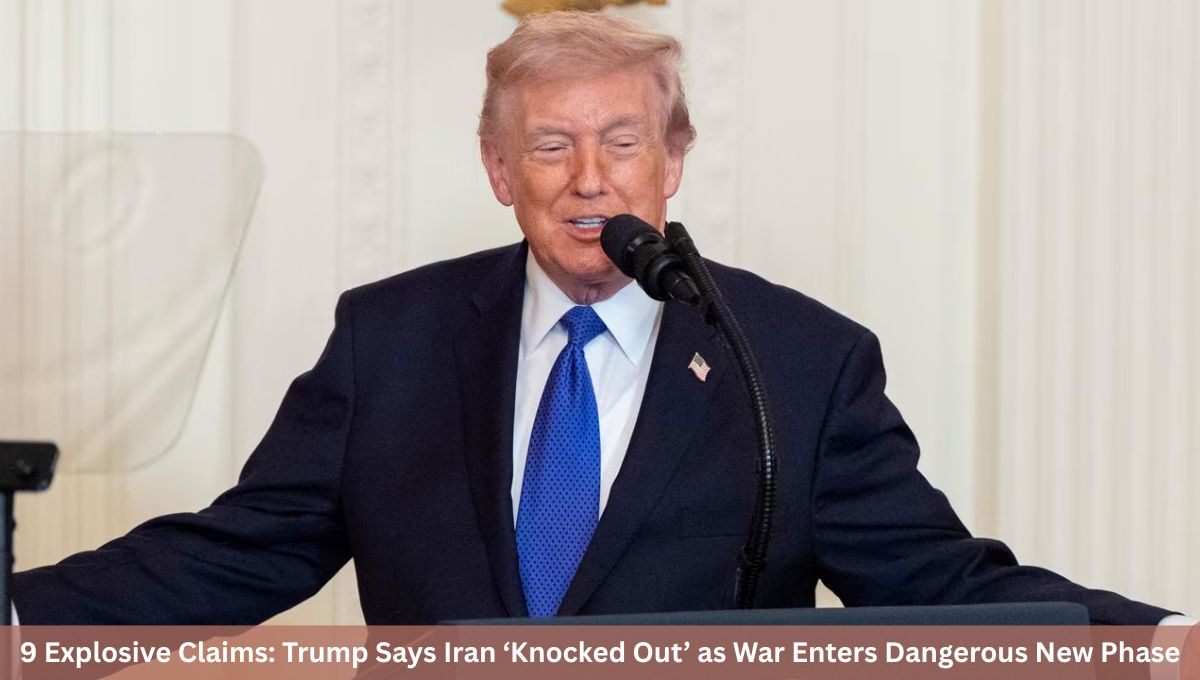
9 Explosive Claims: Trump Says Iran ‘Knocked Out’ as War Enters Dangerous New Phase, hinting at a looming third wave of attacks. The war between the United States, Israel, and Iran has entered one of its most volatile phases in decades, marked by sweeping military claims, leadership assassinations, and rapidly escalating regional retaliation.
At the center of the storm is former US President Donald Trump, who has declared that Iran’s military capabilities and leadership structure have been effectively dismantled following coordinated US-Israeli strikes.
Speaking at the White House alongside German Chancellor Friedrich Merz, Trump asserted that “just about everything has been knocked out” in Iran — from its navy and air force to radar systems and air defenses. These remarks come days after an unprecedented strike that killed Iran’s Supreme Leader Ayatollah Ali Khamenei, plunging the Islamic Republic into political uncertainty and the Middle East into renewed chaos.
What follows is a comprehensive breakdown of Trump’s claims, the military campaign known as Operation Epic Fury, Iran’s retaliation, internal contradictions within the US administration, and what the conflict could mean for global security, energy markets, and diplomacy.
9 Explosive Claims: Trump Says Iran ‘Knocked Out’ as War Enters Dangerous New Phase
A War That Redefined the Region Overnight
The joint US-Israeli operation against Iran marked a historic turning point. For the first time since the 1979 Islamic Revolution, Iran’s supreme leader was killed in a direct foreign military strike.
The operation targeted naval bases, missile installations, air defense systems, and senior leadership figures believed to be involved in Iran’s nuclear and regional military strategy.
Trump described the opening phase as devastating.
“They have no navy — it’s been knocked out. They have no air force — that’s been knocked out. Their air detection and radar systems are gone. Just about everything’s been knocked out.”
According to Trump, the operation’s goals were clear:
neutralize Iran’s nuclear ambitions, cripple its missile capabilities, and remove what he described as a regime that had “exported terror for decades.”
The Death of Khamenei and the Power Vacuum in Tehran
The killing of Ayatollah Ali Khamenei sent shockwaves through Iran and the wider Muslim world. For nearly four decades, Khamenei was the ultimate authority in Iran’s political and military hierarchy.
His death has left Tehran scrambling to establish a new leadership structure amid relentless bombardment. Trump openly speculated about Iran’s succession crisis.
“Most of the people we had in mind are dead,” he said, referring to potential future leaders. “Now we have another group. They may be dead also, based on reports.”
While Trump dismissed the idea of restoring Iran’s monarchy through exiled figures, he suggested that a leader emerging from within Iran might be “more appropriate,” raising questions about whether Washington is quietly shaping Tehran’s political future.
‘Everything’s Been Knocked Out’: Military Claims and Reality
Trump’s sweeping assertions paint a picture of near-total Iranian military collapse. He claimed Iran’s navy, air force, radar systems, and leadership had all been neutralized within days.
However, Iran’s retaliatory strikes suggest a more complex reality.
Despite heavy losses, Iran has launched missile and drone attacks against Israel and US targets across the Gulf, including bases in Bahrain, Kuwait, and the UAE.
Iranian-backed groups, most notably Hezbollah, have also entered the conflict, opening a northern front against Israel.
The discrepancy between Trump’s claims and Iran’s continued operational capacity has fueled debate among analysts about the true extent of the damage.
Conflicting Justifications: Why Did the US Go to War?
One of the most controversial aspects of the conflict has been the US administration’s shifting explanation for entering the war.
Secretary of State Marco Rubio initially suggested that Washington acted after learning Israel was preparing to strike, fearing Iran would retaliate against American forces.
Trump later contradicted that account.
“Based on the way the negotiation was going, I think they were going to attack first,” Trump said. “I didn’t want that to happen. So if anything, I might have forced Israel’s hand.”
This divergence has raised questions about intelligence assessments, decision-making processes, and whether the conflict was truly pre-emptive or strategically opportunistic.
Operation Epic Fury: A Campaign With No Clear End
Operation Epic Fury, the codename for the US-Israeli military campaign, has already entered its fourth day with no signs of de-escalation.
Trump warned that a “third wave” of strikes was likely, suggesting the most intense phase of the operation may still be ahead.
“The big-scale hitting goes now,” he said. “They’re going to be in for a lot of hurt.”
US officials have indicated the campaign could last four to five weeks, though Trump has stated the military has the capacity to continue far longer if necessary.
Iran’s Retaliation and Regional Fallout
Iran’s response has expanded the conflict beyond its borders. Missile and drone strikes have targeted Israel, Gulf energy infrastructure, and US diplomatic facilities.
Shipping lanes in the Strait of Hormuz — through which a fifth of the world’s traded oil passes — have come under threat, rattling global markets.
Energy prices surged as Qatar temporarily halted liquefied natural gas production, and European gas prices spiked sharply amid fears of prolonged disruption.
The war has also shattered the perception of Gulf cities like Dubai as safe havens, with incoming fire highlighting the region’s vulnerability.
Diplomacy Dead or Just Delayed?
Before the war erupted, US and Iranian envoys had met in Geneva for talks mediated by Oman.
While Iran described the discussions as “positive,” US officials later accused Tehran of stalling and refusing to abandon uranium enrichment.
Trump dismissed the possibility of renewed talks.
“They want to talk. I said, ‘Too late.’”
Iran’s ambassador to the United Nations echoed skepticism, saying negotiations were unlikely “for the time being.”
Israel’s Role and Trump’s ‘Forced Hand’ Remark
Trump’s assertion that he may have “forced Israel’s hand” was particularly striking, given long-standing claims that Israel drives US policy on Iran.
Israeli Prime Minister Benjamin Netanyahu has defended the strikes, insisting Iran was rebuilding underground nuclear facilities and that action was unavoidable.
Yet critics, including conservative commentators in the US, have questioned whether Washington entered a “war of choice” largely shaped by Israeli strategic priorities.
Global Reaction and European Fractures
Trump used the moment to lash out at European allies, praising Germany while criticizing the UK and Spain for their reluctance to support military operations.
His remarks underscored growing divisions within NATO over the Iran conflict, with some governments fearing escalation and others quietly backing Washington’s hard-line approach.
The Wall Street Journal published opinion pieces both praising and questioning Trump’s strategy, reflecting the broader global debate over whether the war will ultimately stabilize or further destabilize the Middle East.
Human Cost and the Risk of a Wider War
Beyond geopolitics, the human toll continues to mount. Hundreds have been killed in Iran, Israel, Lebanon, and the Gulf states. Civilian infrastructure, including schools and residential areas, has been damaged, fueling outrage and grief.
Trump’s warnings to Iranian dissidents to avoid protests during the bombing highlight fears of internal unrest colliding with external war — a volatile mix that could push Iran toward prolonged instability or fragmentation.
What Comes Next?
As the conflict intensifies, several critical questions remain unanswered:
- Can Iran sustain its retaliation despite heavy losses?
- Will a new leadership emerge in Tehran — and if so, on whose terms?
- Can global energy markets withstand prolonged disruption?
- And most importantly, is there any viable off-ramp from a war that now spans multiple countries?
For now, Trump remains defiant, confident in US military supremacy and dismissive of diplomatic alternatives.
“Something had to be done,” he said. “It’s been 47 years.” Whether history will view this moment as decisive or disastrous remains to be seen.
What is clear is that the Middle East — and the world — is entering a period of profound uncertainty.
Also Read: 9 Explosive Signals: Trump say’s US–Iran War Could Last 4–5 Weeks
Also Read: Trump says Iran navy, air force destroyed, Germany ‘helping out’
Related Posts:
- 12 Explosive Claims as Donald Trump Says Iran War…
- 11 Explosive Warnings as Trump Vows to ‘Knock the…

- 10 Explosive Warnings as Donald Trump Calls Iran…
- 3 Explosive Conditions Iran Sets to End War with US…
- 10 Explosive Signals: Trump Rates Iran War “15/10”…
- 10 Explosive Signals Trump Says Iran War Could End…