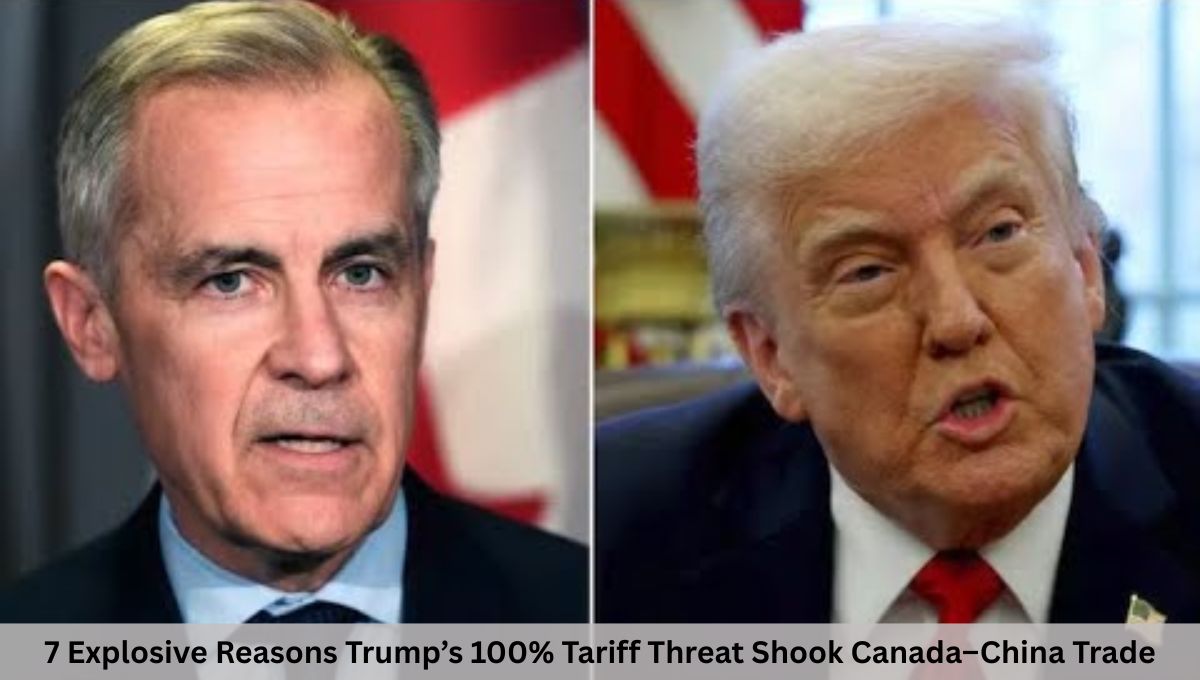
7 Explosive Reasons Trump’s 100% Tariff Threat Shook Canada–China Trade and the future of USMCA.Canadian Prime Minister Mark Carney has drawn a firm line under Ottawa’s China policy, publicly ruling out any pursuit of a free trade agreement with Beijing after U.S. President Donald Trump threatened to impose sweeping 100 percent tariffs on Canadian goods.
Thank you for reading this post, don't forget to subscribe!The comments come amid one of the most volatile periods in modern Canada–U.S. relations, marked by escalating rhetoric, trade brinkmanship, and growing unease over China’s role in global supply chains.
While Carney insists Canada is merely stabilizing existing trade disputes with China, Washington sees a strategic risk:
that Canada could become a backdoor for Chinese goods into the American market.
The dispute now threatens to spill into the upcoming review of the United States–Mexico–Canada Agreement (USMCA), injecting fresh uncertainty into North America’s deeply integrated economy.
7 Explosive Reasons Trump’s 100% Tariff Threat Shook Canada–China Trade
Trump’s 100% Tariff Threat: What Sparked the Clash
The confrontation intensified over the weekend after President Trump issued a series of incendiary posts on his Truth Social platform, warning Canada against deepening economic ties with China.
Trump said Canada would face “immediate” and “severe” consequences if it followed through on what he characterized as a trade deal with Beijing.
Chief among those consequences:
a 100 percent tariff on all Canadian goods entering the United States.
“If Governor Carney thinks he is going to make Canada a ‘Drop Off Port’ for China to send goods and products into the United States, he is sorely mistaken,” Trump wrote.
In another post, Trump went further, claiming China would “eat Canada alive,” destroying its businesses, social fabric, and way of life.
The president repeatedly accused Ottawa of allowing Beijing to exploit Canadian markets as a staging ground for flooding the U.S. with low-cost Chinese exports.
Although Trump’s rhetoric later softened slightly toward Canada and shifted more aggressively toward China itself, the tariff threat remained unmistakable.
Carney’s Response: No Free Trade Deal With China
Speaking to reporters on Sunday, Prime Minister Carney sought to defuse the situation by making his government’s position unequivocally clear.
Canada, he said, has “no intention” of pursuing a free trade agreement with China or any other non-market economy.
“We have commitments under CUSMA not to pursue free trade agreements with non-market economies without prior notification,” Carney said. “We have no intention of doing that with China or any other non-market economy.”
Carney emphasized that recent engagement with Beijing was narrowly focused on resolving specific tariff disputes that had emerged over the past two years, not on opening the door to unrestricted trade or broader market access.
“What we have done with China is to rectify some issues that developed in the last couple of years,” he added, stressing that the steps taken were fully consistent with Canada’s obligations under USMCA, known as CUSMA in Canada.
What the Canada–China Agreement Actually Covers
Despite political messaging from Washington, the agreement reached between Ottawa and Beijing earlier this month falls well short of a comprehensive free trade deal.
Instead, it represents a limited, tactical de-escalation following a tit-for-tat tariff war that escalated in 2024.
Tariffs on Electric Vehicles
Last year, Canada mirrored the United States by imposing a 100 percent tariff on Chinese electric vehicles, alongside 25 percent tariffs on Chinese steel and aluminum.
Beijing retaliated with steep duties on Canadian agricultural exports, including canola oil, pork, seafood, and peas.
During a January visit to China, Carney’s government agreed to modify that stance. Under the new framework:
- Canada will allow 49,000 Chinese electric vehicles per year to enter the market.
- These EVs will face a preferential tariff of 6.1 percent, far below the previous 100 percent rate.
- The cap will gradually rise to around 70,000 vehicles over five years.
- The quota represents roughly 3 percent of Canada’s annual vehicle sales, according to Carney.
Agricultural Relief for Canada
In exchange, China agreed to roll back punitive tariffs on Canadian agricultural exports:
- Tariffs on canola oil and seed oil will drop to around 15 percent by March 1, down from as high as 84–85 percent.
- Duties on canola meal, lobsters, crabs, peas, pork, and seafood will be suspended until at least the end of 2026.
- China will also allow visa-free entry for Canadian visitors.
Carney framed the deal as a stabilization measure designed to protect Canadian farmers and exporters rather than a strategic realignment toward Beijing.
Why Washington Is Alarmed
For the Trump administration, the concern is not the scale of the deal but its implications.
Treasury Secretary Scott Bessent articulated Washington’s position bluntly during an appearance on ABC’s This Week.
“We can’t let Canada become an opening that the Chinese pour their cheap goods into the U.S.,” Bessent said.
He added that while USMCA currently governs trade relations, the agreement is due for renegotiation this summer, leaving room for tougher enforcement or new conditions.
“I’m not sure what Prime Minister Carney is doing here, other than trying to virtue-signal to his globalist friends at Davos,” Bessent said.
The administration fears that even capped imports of Chinese EVs or other goods could eventually be rerouted into the U.S., undermining American trade protections and industrial policy.
USMCA Under Pressure Ahead of Critical Review
Trump’s tariff threat comes at a sensitive moment for North American trade.
The United States–Mexico–Canada Agreement is approaching its mandatory six-year review, a process that could redefine the continent’s economic framework.
Unless all three countries agree to extend the pact by 16 years, annual reviews will begin, with the agreement set to expire in 2036.
Trump has already questioned the value of USMCA, despite having championed it as a signature achievement of his first term.
“There’s no real advantage” for the U.S. in keeping the deal, Trump said earlier this month.
Economists warn that losing USMCA protections would be devastating for Canada. Exports to the U.S. represent an outsized share of Canada’s economy, and while most goods currently move tariff-free, that exemption could vanish if the pact unravels.
Analysts estimate that effective tariffs on Canadian exports could jump well beyond the current 5 to 7 percent range, severely damaging manufacturing, autos, steel, aluminum, and lumber.
Economic Stakes for Canada
Canada is uniquely exposed to trade shocks from the United States:
- Nearly $3.6 billion Canadian worth of goods and services cross the border every day.
- Canada is the top export destination for 36 U.S. states.
- The U.S. imports 60 percent of its crude oil from Canada.
- Canada supplies 85 percent of U.S. electricity imports.
- It is also a major supplier of steel, aluminum, uranium, and critical minerals vital to U.S. national security.
With business confidence already weakened by tariff uncertainty, economists warn that prolonged instability could delay investment and slow growth.
Surveys from the Bank of Canada show firms pulling back from expansion, focusing instead on maintenance spending amid fears of escalating trade conflict.
Trump–Carney Tensions Extend Beyond Trade
The tariff dispute is unfolding against a broader backdrop of political and diplomatic friction.
Relations between Trump and Carney deteriorated sharply after the Canadian prime minister delivered a high-profile speech at the World Economic Forum in Davos.
Without naming Trump directly, Carney warned of a “rupture” in the global order and urged middle powers to band together against economic coercion.
“Middle powers must act together because if you are not at the table, you are on the menu,” Carney said.
Trump responded angrily, claiming that “Canada lives because of the United States,” and later withdrew an invitation for Ottawa to join his proposed “Board of Peace.”
Trump has also repeatedly needled Canada’s sovereignty, at times suggesting it could be absorbed as America’s 51st state, language that has further inflamed public opinion north of the border.
China as Leverage—or Liability?
Some analysts believe Canada’s outreach to China, however limited, may offer Ottawa leverage in negotiations with Washington.
“There are other major trading partners that want to work with us,” said Randall Bartlett, deputy chief economist at Desjardins Group. “That potentially gives Canada a little bit of leverage.”
Others caution that the risks outweigh the benefits, particularly given Washington’s sensitivity to China-related trade issues.
Dominique Lapointe of Manulife Investment Management warned that Trump’s reaction “adds downside risks” to the upcoming USMCA negotiations, increasing volatility for businesses on both sides of the border.
What Happens Next
For now, Carney is attempting a careful balancing act: stabilizing trade with China while reaffirming Canada’s commitment to USMCA and its economic partnership with the United States.
Whether that balance holds will depend largely on Washington’s next move.
If Trump follows through on his tariff threat, the consequences would ripple far beyond Canada, disrupting North American supply chains, raising consumer prices, and straining one of the world’s most integrated trading relationships.
If cooler heads prevail, the dispute may ultimately be folded into broader USMCA negotiations, where trade-offs and compromises could yet emerge.
Either way, the episode underscores a new reality: in an era of rising protectionism and geopolitical rivalry, even longstanding allies are no longer immune from economic confrontation.
Also Read: 9 Explosive Stakes Behind Trump’s 100% Tariff Threat on Canada’s China Pivot
Also Read: No plans for China free trade deal, Carney says as Trump fixates on Canada
Related Posts:
- 9 Explosive Stakes Behind Trump’s 100% Tariff Threat…
- Can the EU and NATO Impose Tariffs on India and…

- 5 Key Takeaways from Trump–Carney Meet: Trade,…
- 7 Crucial Insights Into Trump and Xi’s High-Stakes…
- 10 Big Takeaways from Trump’s 155% Tariff Warning to China

- 7 Historic Shifts Powering Canada–China’s New…