

Trump’s 20-Point Gaza Peace Plan Gains Urgent Global Momentum as mediators push for lasting Israel–Hamas ceasefire. US special envoy Steve Witkoff and President Donald Trump’s son-in-law Jared Kushner have joined the Gaza peace plan talks in Egypt, as international mediators push to end the devastating conflict between Israel and Hamas under Trump’s proposed 20-point framework.
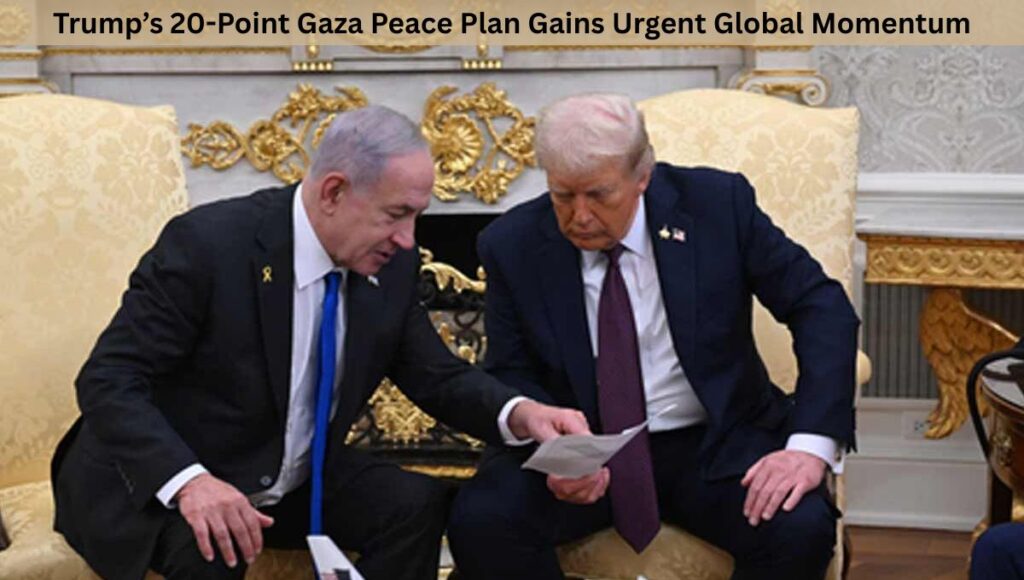
Trump’s 20-Point Gaza Peace Plan Gains Urgent Global Momentum
High-Stakes Diplomacy in Egypt
The arrival of the senior US envoys marks a significant escalation in American involvement in the peace process, which entered its third day of indirect negotiations between Israeli and Hamas delegations in the Egyptian resort city of Sharm el-Sheikh.
A senior Palestinian official familiar with the negotiations told the BBC that talks on Tuesday ended without tangible results but confirmed mediators were “working hard to narrow the gaps.”
Disagreements remain over Israeli withdrawal maps from Gaza and guarantees Hamas seeks to ensure Israel will not resume fighting after the first phase of any agreement.
Trump struck an optimistic tone during remarks marking the second anniversary of the October 7, 2023 Hamas-led attacks on Israel, suggesting that “there’s a possibility that we could have peace in the Middle East.”
Israeli Prime Minister Benjamin Netanyahu, addressing Israelis on the same day, described the period as “fateful days of decision,” while refraining from commenting directly on the talks’ progress.
Hamas Seeks Guarantees the War Will End
Hamas officials have said they are seeking guarantees from Trump and other sponsor countries that Israel will permanently end the war in Gaza and fully withdraw from the territory.
“We do not trust the occupation, not even for a second,” said Hamas negotiator Khalil al-Hayya, speaking to Egyptian state-linked Al-Qahera News.
“The Israeli occupation throughout history has not kept its promises. Therefore, we want real guarantees that the war will end once and for all.”
According to Palestinian officials, Hamas wants written commitments from the United States and international mediators that Israeli military operations will not resume once a ceasefire and prisoner exchange take effect.
The group also insists on the release of several high-profile Palestinian prisoners, including Marwan Barghouti, as part of a broader deal.
Also Read: On Gaza war anniversary, Hamas says it’s ready for deal but sets conditions
Five Key Issues Dominate Negotiations
Negotiators have identified five central issues driving the talks:
- Establishing a permanent ceasefire.
- The exchange of hostages held by Hamas for Palestinian prisoners detained by Israel.
- The withdrawal of Israeli forces from the Gaza Strip.
- Humanitarian aid arrangements and delivery guarantees.
- The post-war governance and reconstruction of Gaza.
Palestinian and Egyptian sources say progress has been made in defining the stages of Israeli withdrawal and the timing of hostage releases, though deep divisions remain. Hamas proposes a phased release of captives tied to Israel’s staged withdrawal, ensuring the last hostages are released only after a full Israeli pullout.
US and Qatari Envoys Join Mediation Efforts
Qatar’s Ministry of Foreign Affairs spokesperson Majed al-Ansari confirmed that Qatari Prime Minister Sheikh Mohammed bin Abdulrahman Al Thani will join the mediating team in Egypt alongside US representatives Witkoff and Kushner.
“We don’t go with preconceived notions to the negotiations. We develop these formulations during the talks themselves, which is happening right now,” al-Ansari told Al Jazeera, underscoring the flexibility of the mediation process.
The United States, Egypt, and Qatar, along with Turkiye, have emerged as the core sponsors of the peace process. Their joint goal is to achieve a comprehensive ceasefire that will lead to hostage releases, Israeli withdrawal, and a transition to post-war governance in Gaza.
Inside Trump’s 20-Point Peace Framework
Donald Trump’s 20-point plan is described by US officials as an ambitious multi-phase roadmap to end the war, release hostages, and rebuild Gaza.
The plan’s key provisions include:
- Immediate ceasefire between Israel and Hamas.
- Exchange of all Israeli hostages for Palestinian prisoners, including those held since October 2023.
- Phased withdrawal of Israeli forces from Gaza.
- International monitoring of disarmament and ceasefire compliance.
- Creation of a transitional governance body, called the “Board of Peace”, to oversee reconstruction.
- Technocratic Palestinian administration to manage daily affairs in Gaza, overseen by international partners.
- A massive humanitarian aid and reconstruction initiative, led by the UN and international donors.
- Establishment of a demilitarized Gaza with guarantees against renewed hostilities.
While Trump’s team hails the proposal as “historic,” critics have warned that the plan’s lack of clarity on enforcement and governance could pose long-term challenges. Hamas, while agreeing to parts of the proposal, remains concerned about security guarantees and timeline commitments.
Also Read: Trump’s Gaza Peace Plan Wins Global Backing
Disarmament and Prisoner Exchange Challenges
One of the most contentious aspects of Trump’s plan involves the disarmament of Hamas and the release of Palestinian prisoners. Hamas insists that “no one has the right to cede the weapons of the Palestinian people,” calling disarmament a violation of their right to resist occupation.
The group has reportedly demanded the release of 250 Palestinians serving life sentences and over 1,700 detainees captured during the war. Israeli sources say any prisoner swap must be sequenced with the safe return of the remaining Israeli captives—48 in total, with 20 believed to be alive.
Despite the differences, both sides have endorsed several parts of Trump’s proposal, marking the most promising step toward a ceasefire since the war began two years ago.
Israeli Position Remains Firm
Prime Minister Benjamin Netanyahu marked the anniversary of the October 7 attacks with a defiant statement. “We are in fateful days of decision,” he said, pledging to achieve the war’s objectives: “the return of all the hostages, the elimination of Hamas’s rule, and ensuring that Gaza will no longer pose a threat to Israel.”
Israel has continued its aerial and ground operations in Gaza even as talks proceed, targeting suspected militant positions in Gaza City, Khan Younis, and the central Strip. According to Palestinian officials, at least 10 people were killed on Tuesday in Israeli air strikes, adding to a toll of more than 66,600 deaths since the conflict began.
Humanitarian Crisis Deepens in Gaza
The UN Office for the Coordination of Humanitarian Affairs (OCHA) reports that despite a slight reduction in airstrikes, humanitarian access remains severely restricted.
UN Spokesperson Stéphane Dujarric said the UN and its partners are “ready to go as soon as we get the green light,” with thousands of metric tonnes of aid prepared to enter Gaza if a ceasefire is reached.
The World Food Programme (WFP) has delivered flour to bakeries that are now working up to 22 hours daily, producing 100,000 bundles of bread. Yet, northern Gaza remains nearly inaccessible, with only a fraction of kitchens still operating.
“Humanitarian access and movement across the Strip remain challenging,” Dujarric noted. “We stress the need for unimpeded and sustained access to all parts of Gaza so that aid can reach people wherever they are.”
UN Emergency Relief Coordinator Tom Fletcher announced an allocation of $9 million from the Central Emergency Response Fund (CERF) to maintain fuel supplies for hospitals and life-saving services.
UN and Global Response
The United Nations, while not formally part of the negotiations, has expressed strong support for the peace effort. UN Secretary General António Guterres called Trump’s plan a “historic opportunity” to end the war and urged both sides to agree to the proposal.
International reaction has been cautiously optimistic. The European Union, Saudi Arabia, and Jordan have welcomed the renewed diplomatic momentum, while Iran and Hezbollah have warned that any deal excluding Palestinian resistance groups will be “unsustainable.”
The United Kingdom, France, and Germany have also backed the idea of a US-led reconstruction plan, contingent on sustained peace and adherence to international law.
War’s Human Toll and Global Concern
According to Gaza’s Hamas-run health ministry, at least 67,173 Palestinians have been killed since October 2023, including more than 20,000 children. The UN considers these figures credible.
The ministry also reports that 460 people have died from malnutrition, including 182 since famine was confirmed in Gaza City in August by the Integrated Food Security Phase Classification (IPC).
The IPC says over half a million Gazans face “catastrophic” conditions marked by **starvation, destitution, and death.”
A UN commission of inquiry last month accused Israel of committing genocide in Gaza — a charge Israel has categorically rejected as “distorted and false.”
Trump’s Expanding Role in the Peace Process
Trump has increasingly positioned himself as the central mediator in the Gaza peace process, taking personal calls with regional leaders and promising to “do everything possible to make sure everybody adheres to the deal.”
He has appointed Steve Witkoff, a close ally and real estate magnate, as the US special envoy, alongside Jared Kushner, who played a major role in the Abraham Accords during Trump’s previous term.
Trump’s approach emphasizes economic incentives, infrastructure rebuilding, and regional normalization, drawing from his earlier diplomatic playbook that brought Israel closer to Gulf Arab states.
Who Will Govern Gaza After the War?
A major unresolved question is who will govern Gaza after hostilities end. Trump’s plan envisions an internationally supervised transitional authority, including Palestinian technocrats and overseen by the Board of Peace, co-chaired by Trump and former UK Prime Minister Tony Blair.
The idea has drawn skepticism from Palestinian factions and human rights groups, who say any administration imposed without Palestinian consent will lack legitimacy.
Hamas says it will not participate in post-war governance but wants reconstruction managed by a Palestinian national body. Israel and the US insist that Hamas must be excluded from future governance.
Regional Reactions
Regional powers have responded with cautious approval.
- Egypt and Qatar, key mediators, have praised the progress in negotiations.
- Saudi Arabia has reiterated its call for a comprehensive settlement that includes a path to a two-state solution.
- Jordan has expressed support for an “immediate and sustainable ceasefire.”
- Iran has accused Washington of using the talks to “legitimize occupation.”
Despite differences, regional states appear united in seeking an end to active hostilities and a massive humanitarian response to Gaza’s crisis.
Challenges Ahead
Analysts warn that even if a ceasefire deal is reached, implementation will be complex. The disarmament of Hamas, Israel’s phased withdrawal, and Gaza’s reconstruction will require continuous international oversight and billions in aid.
The UN estimates reconstruction will take at least a decade, while psychological trauma among Gaza’s youth could last generations.
“The world has a moral and humanitarian obligation to help Gaza rebuild,” said a senior UN official. “But peace must come with justice and accountability.”
Global Stakes and the Path Forward
The Gaza war has become one of the most lethal conflicts of the 21st century, with casualties surpassing those of many regional wars combined. ACLED, a US-based conflict monitor, reports that Gaza alone accounted for 14 percent of global conflict deaths over the past two years.
Despite deep mistrust between the warring parties, the Sharm el-Sheikh talks have sparked cautious hope. “Everyone’s waiting for a peace deal as the bombs continue to fall,” said Hind Khoudary, reporting from central Gaza for Al Jazeera.
As the talks resume, the presence of Trump’s senior envoys, along with Qatari and Egyptian mediators, signals that a turning point may be near. But for millions in Gaza, peace will only be real when the bombardments stop and aid begins to flow freely.
Conclusion
The ongoing peace negotiations in Egypt mark the most serious diplomatic effort yet to end the Gaza war. With Donald Trump’s 20-point plan on the table, and the active participation of US envoys, regional powers, and the UN, the world is watching closely for a breakthrough.
The road to peace remains fraught with obstacles — from disarmament and prisoner swaps to the reconstruction and future governance of Gaza. But for the first time in two years, there is a shared international momentum toward halting one of the world’s most devastating wars.
Whether this moment leads to lasting peace or another temporary pause depends on mutual trust, verifiable guarantees, and sustained global engagement. As Trump said this week, “We’re going to do everything possible to make sure everybody adheres to the deal.”
Related Posts:
- Trump’s 2025 Gaza Peace Plan Signing and Historic…

- 5 Powerful Highlights as Trump Lands Second Nobel…

- Dramatic Moments Behind Trump’s Gaza Peace Push and…

- 7 Shocking Reasons FIFA’s Peace Prize for Trump…

- Israel Awards Highest Honor to Trump in 2025 for…

- Trump’s 2025 Nobel Peace Prize Snub: Politics Over…
