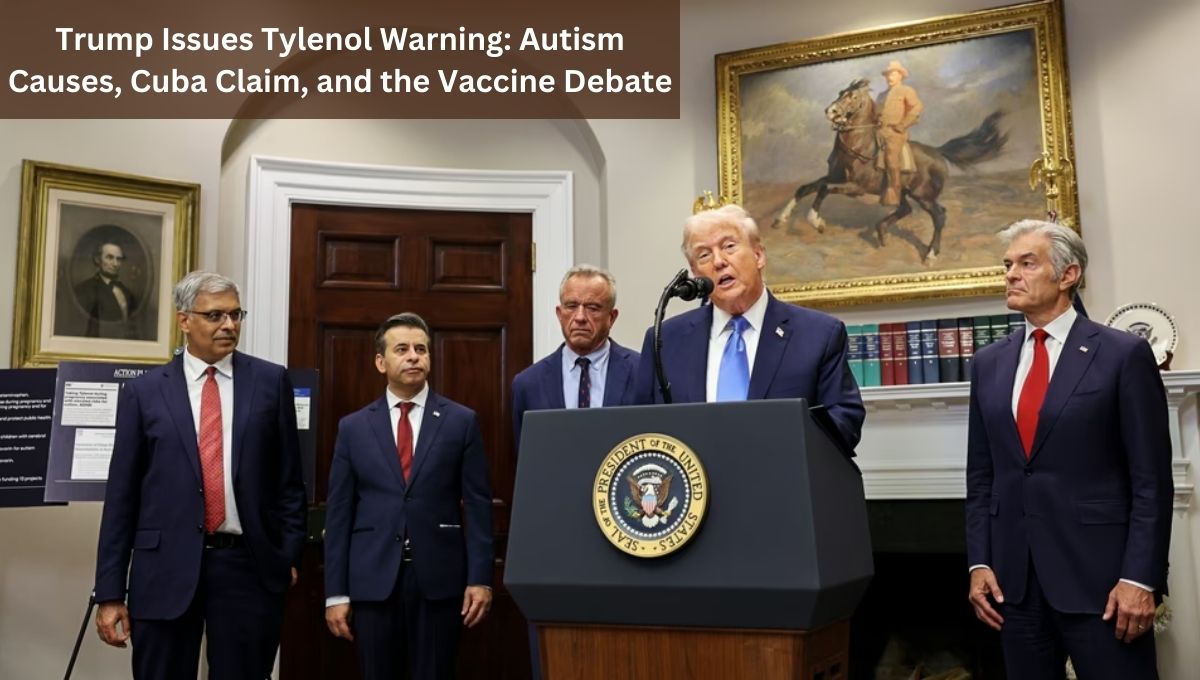
Amid experts pushback, Trump Issues Tylenol Warning: Autism Causes, Cuba Claim, and the Vaccine Debate. In a dramatic White House announcement, President Donald Trump urged pregnant women to avoid Tylenol (acetaminophen), citing an unproven link between the drug and autism. Speaking alongside Health Secretary Robert F. Kennedy Jr., Trump also questioned the safety of vaccines and claimed that Cuba has little or no autism because the country lacks Tylenol.
Medical experts immediately pushed back, warning that Trump’s comments spread misinformation about autism, pregnancy, and vaccines. This article breaks down what Trump said, what the science actually shows about autism causes, the role of acetaminophen, and whether Cuba is truly autism-free.
Trump Issues Tylenol Warning: Autism Causes, Cuba Claim, and the Vaccine Debate
What Did Trump Announce?
Trump opened the Oval Office event by calling autism a “horrible, horrible crisis,” claiming rates are rising at a historic pace.
“The meteoric rise in autism is among the most alarming public health developments in history. There’s never been anything like this,” he said.
He then outlined his administration’s plan:
- The FDA would notify doctors that Tylenol use during pregnancy may be linked to autism.
- Women were told to limit acetaminophen use unless medically necessary.
- Trump suggested the drug should only be taken for extreme fevers during pregnancy.
Trump added:
“So taking Tylenol is not good. All right. I’ll say it. It’s not good.”
He also questioned standard vaccine practices, opposing combination shots such as the MMR vaccine (measles, mumps, rubella), and said newborns shouldn’t get the hepatitis B vaccine until age 12. Finally, he claimed countries without Tylenol – such as Cuba – had virtually no autism cases.
Autism: What It Is and What Causes It
What is Autism?
Autism, or autism spectrum disorder (ASD), is a developmental condition that affects how people communicate, learn, and interact with the world. It is recognized in the US as both a form of neurodivergence and a disability under the Americans with Disabilities Act.
Common features include:
- Differences in social communication and interaction.
- Unique learning styles.
- Sensory sensitivities or repetitive behaviors.
What Causes Autism?
Scientists agree autism has no single cause. Instead, it is linked to a complex interplay of genetics and environmental factors.
Factors associated with autism risk include:
- Genetic predisposition (hundreds of genes identified).
- Advanced parental age.
- Prenatal influences such as air pollution, maternal obesity, diabetes, or immune disorders.
- Very premature birth or low birth weight.
- Birth complications leading to oxygen deprivation.
Experts emphasize: Autism is not caused by vaccines or painkillers like Tylenol.
Is Autism Really on the Rise in the US?
According to the CDC (Centers for Disease Control and Prevention), autism diagnoses have increased in recent decades:
- In 2000, 1 in 149 children were identified with autism.
- By 2022, the number rose to 1 in 31.
The condition is about three times more common in boys than girls.
Globally, the World Health Organization (WHO) estimates about 1 in 127 people live with autism. A 2022 review of 71 studies put the prevalence at roughly 1 percent worldwide.
Why Are Autism Numbers Rising?
Experts say the increase reflects:
- Better awareness among parents and teachers.
- Broader diagnostic criteria, recognizing a spectrum of traits.
- Improved screening tools, leading to earlier detection.
This means the rise in diagnoses does not necessarily mean more people are developing autism – but rather that more cases are identified and recorded.
Tylenol and Autism: What Does the Science Say?
What is Acetaminophen?
Acetaminophen (also called paracetamol) is one of the world’s most commonly used pain relievers and fever reducers. It is widely available over the counter.
Studies on Acetaminophen in Pregnancy
For more than a decade, researchers have examined whether acetaminophen use in pregnancy could be linked to autism or ADHD. Results have been mixed:
- Some studies suggested an association between prolonged use and developmental disorders.
- A 2025 Mount Sinai review flagged possible neurodevelopmental risks.
- The largest 2024 study found no link between acetaminophen use in pregnancy and autism, ADHD, or learning disorders.
Expert Consensus
Medical bodies including the Autism Science Foundation stress that the evidence is limited, conflicting, and inconsistent.
“There is no data to show Tylenol causes autism and lots of data to show that fever in pregnant women harms the fetus,” said ethicist Arthur Caplan, NYU Grossman School of Medicine.
Doctors advise pregnant women should always consult their physician before taking any medication. While unnecessary use should be avoided, treating high fever or severe pain is critical, since untreated fever can harm fetal development.
Also Read: Trump Issues Warning Based on Unproven Link Between Tylenol and Autism
Trump’s Vaccine Skepticism
Beyond Tylenol, Trump returned to a long-running theme: his doubts about vaccines.
- He questioned giving newborns the hepatitis B vaccine.
- He opposed combination vaccines, saying children should get single shots instead.
These claims echo the discredited work of Andrew Wakefield, whose 1998 study falsely linking the MMR vaccine to autism was later retracted. Multiple studies since then have proven no connection between vaccines and autism.
Public health experts warn that undermining vaccine confidence can lead to outbreaks of diseases like measles, whooping cough, and polio, which are already resurging.
The Cuba Claim: Is Cuba Autism-Free?
Trump suggested Cuba, which he claimed lacks Tylenol, has virtually no autism cases. But this is false.
Facts About Autism in Cuba
- Cuba recognizes autism spectrum disorder and has specialized schools and clinics for diagnosis and therapy.
- Paracetamol (acetaminophen) is sold in Cuban government pharmacies, just like elsewhere.
- A 2022 study estimated Cuba’s autism incidence at 2 to 4 per 10,000 children in some regions.
Rates appear lower than in the US, but experts caution this reflects limited diagnostic infrastructure and underreporting – not the absence of autism.
Why the Cuba Claim is Misleading
- Autism exists in Cuba.
- Tylenol is available in Cuba.
- Differences in prevalence reflect diagnosis and reporting gaps, not drug availability.
Inside the White House: How Trump Blew Up His Team’s Plans
According to insiders, Trump’s health team had planned a measured rollout:
- Warn of a possible association between acetaminophen use in pregnancy and autism.
- Announce $50 million in autism research funding.
- Highlight progress on a potential treatment.
But Trump seized the microphone and delivered his own version: declaring Tylenol “no good,” urging women to “tough it out,” and reviving vaccine skepticism.
Officials privately admitted the president’s sweeping assertions went far beyond the evidence they had reviewed.
Ashish Jha, dean of Brown University’s School of Public Health, called it:
“Possibly the worst public health press conference I have ever seen in my life.”
Expert Reactions
- Catherine Lord, UCLA psychiatry professor: Pregnant women must be cautious, but untreated fever also harms the baby.
- Wes Streeting, UK Health Secretary: “I trust doctors over President Trump, frankly, on this.”
- Mel Merritt, National Autistic Society: Trump is “peddling the worst myths of recent decades… dangerous pseudo-science putting women and children at risk.”
Experts stress that health guidance should be evidence-based, not driven by personal opinion or anecdote.
Autism Myths and Misinformation
Trump’s claims fit a larger history of autism myths:
- Vaccines cause autism – debunked.
- Tylenol causes autism – no proven link.
- Refrigerator mother theory (blaming cold parenting) – long discredited.
- Diet or toxins as sole cause – inconsistent evidence.
Such myths stigmatize autistic people and distract from real support needs.
Also Read: Trump Administration to Link Tylenol Use in Pregnancy to Autism, Push Leucovorin as Treatment
The Risks of Misinformation
Health officials warn that Trump’s rhetoric risks:
- Confusing parents about safe medications.
- Undermining trust in vaccines.
- Discouraging women from treating fevers during pregnancy, which can harm babies.
- Fueling stigma around autism.
Public health depends on clear, science-based communication. Misinformation can reverse decades of progress in immunization and maternal care.
Conclusion
Trump’s Oval Office announcement was meant to spotlight autism research and new guidance on Tylenol use. Instead, it became a showcase of unfounded claims and vaccine skepticism, alarming doctors worldwide.
The science is clear:
- Autism is caused by genetics and developmental factors, not vaccines or painkillers.
- Tylenol remains safe for use in pregnancy when needed, though moderation is advised.
- Cuba has autism, and Tylenol is available there.
As experts put it, health policy deserves facts, not conjecture. Pregnant women should seek advice from doctors, not politicians.