

Speaking at the American Cornerstone Institute Founder’s Dinner, Trump Says He Deserves Nobel Peace Prize for Ending ‘Seven Wars,’ Including India-Pakistan Conflict. US President Donald Trump has once again reignited debate about his foreign policy legacy, this time by insisting that he deserves the Nobel Peace Prize for what he claims was his role in ending “seven wars” around the globe.
Among those, he controversially included the India-Pakistan conflict earlier this year, a claim that New Delhi has consistently rejected. Speaking at the American Cornerstone Institute Founder’s Dinner on Saturday, Trump boasted that his administration had “forged peace agreements” and prevented conflicts from spiraling into full-blown wars.
“On the world stage, we are once again doing things that we are just respected at a level that we have never been respected before,” Trump declared. “We are forging peace agreements, and we are stopping wars. So we stopped wars between India and Pakistan, Thailand and Cambodia.”
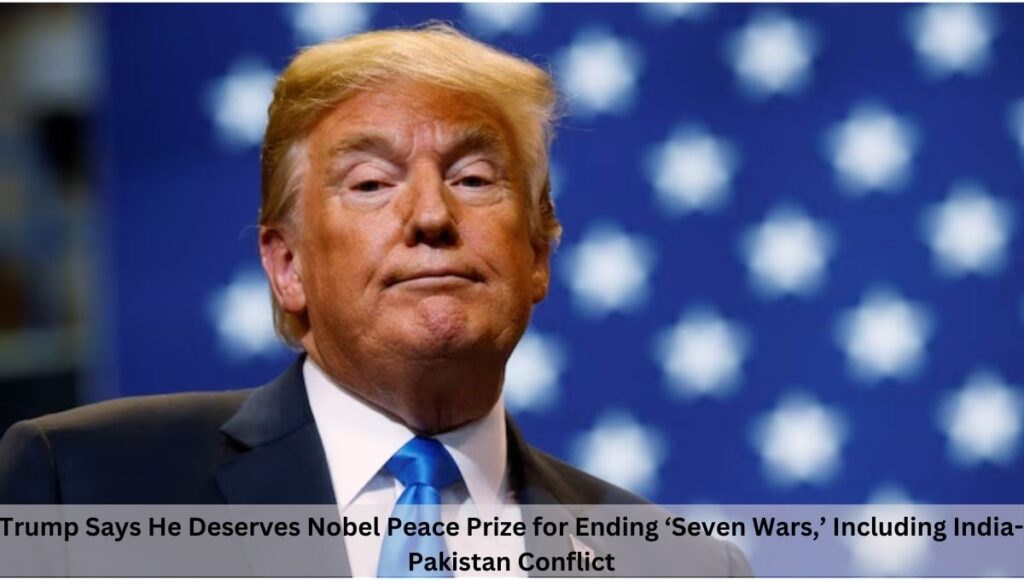
Trump Says He Deserves Nobel Peace Prize for Ending ‘Seven Wars,’ Including India-Pakistan Conflict
Trump’s Claim: “One Nobel for Each War”
At the dinner event, Trump recounted how he was told that if he managed to resolve the Russia-Ukraine war, he would be considered for the Nobel Peace Prize. But Trump argued that his diplomatic record already outshone that requirement.
“I said, ‘Well, what about the seven others? I should get a Nobel Prize for each one.’ So they said, ‘but if you stop Russia and Ukraine, sir, you should be able to get the Nobel.’ I said I stopped seven wars. That’s one war, and that’s a big one.”
The American President listed a range of conflicts he claimed to have ended or mediated, stretching across Asia, Africa, and the Middle East.
The India-Pakistan Conflict Claim
One of Trump’s most repeated assertions is that he personally stopped a potential nuclear confrontation between India and Pakistan earlier in 2025.
According to Trump:
- He told both nations that the US would withhold trade if fighting continued.
- Both sides, he claimed, agreed to back down because “they want to trade.”
- He expressed “great respect” for Indian Prime Minister Narendra Modi and Pakistani leaders, saying trade diplomacy was the key.
“Think of India and Pakistan. Think of that. And you know how I stopped that — with trade. They want to trade. And I have great respect for both leaders. But when you take a look at all of these wars that we’ve stopped.”
Trump further elaborated:
“Like with India, I said, ‘look, we’re not going to do any trade if you’re going to fight and they have nuclear weapons.’ They stopped.”
India’s Response
India has categorically rejected the idea of US intervention.
On May 10, following deadly terror attacks in Pahalgam, India launched Operation Sindoor, targeting terror infrastructure in Pakistan and Pakistan-occupied Kashmir. The operation was followed by a ceasefire agreement between India and Pakistan’s Director Generals of Military Operations (DGMOs).
India’s foreign secretary Vikram Misri emphasized that the ceasefire was strictly a bilateral decision with no foreign mediation involved:
“No foreign leader requested India to halt Operation Sindoor. The decision was taken directly between New Delhi and Islamabad.”
This directly contradicted Trump’s claims of brokering peace.
Trump’s Expanding List of Mediated Conflicts
While the India-Pakistan conflict has grabbed headlines, Trump insists it was just one of several international flashpoints he helped defuse.
Among the seven wars he claimed to end are:
- India and Pakistan (2025)
- Thailand and Cambodia (territorial dispute)
- Armenia and Azerbaijan (Nagorno-Karabakh tensions)
- Kosovo and Serbia (long-running Balkan disputes)
- Israel and Iran (skirmishes earlier this year)
- Egypt and Ethiopia (Nile River dam dispute)
- Rwanda and the Democratic Republic of Congo (border conflict)
Trump has even expanded the list to 11 conflicts, citing Congressman Byron Donalds’ post praising his record of “peace through strength.” This updated list included disputes involving Morocco, Sudan, the UAE, and Bahrain, in addition to the previous ones.
Also Read: Trump’s Nobel Peace Prize Bid: Gaza Peace Plan, 8 Wars Claim, and Global Reactions
Trump’s Longstanding Nobel Peace Prize Ambition
2019: Shinzo Abe Nomination
Trump first hinted at Nobel recognition after his 2018 summit with North Korean leader Kim Jong Un. He claimed that Japan’s then-Prime Minister Shinzo Abe had nominated him for the award.
2020: Ethiopia Dispute
In January 2020, Trump argued that he deserved the Nobel more than Ethiopia’s Prime Minister Abiy Ahmed Ali, who had received it for brokering peace with Eritrea.
2024: Pre-Election Rhetoric
Ahead of his second election victory, Trump compared himself to Barack Obama, who won the prize in 2009:
“If I were named Obama, I would have had the Nobel Prize given to me in 10 seconds.”
2025: Renewed Push
This year, Trump has repeatedly referenced his Nobel ambitions. In June, he lamented that he would never be recognized for his peace efforts in South Asia, the Middle East, or Africa.
“No, I won’t get a Nobel Peace Prize no matter what I do, including Russia/Ukraine, and Israel/Iran, whatever those outcomes may be, but the people know, and that’s all that matters to me!”
Also Read: Donald Trump wants Nobel Peace Prize for stopping India-Pakistan war: How is a winner chosen?
The Russia-Ukraine War: Trump’s “Missed Opportunity”
Despite his claims of stopping multiple wars, Trump admitted that the Russia-Ukraine conflict has been his greatest disappointment.
During his UK state visit with Prime Minister Keir Starmer, Trump said:
“Because I have a good relationship with President Putin, I thought that would be the easiest one. But well get it done one way or the other.”
He went further, accusing Putin of betraying him:
“He has let me down. I mean, he’s killing many people and he’s losing more people than he’s killing. Russian soldiers are being killed at a higher rate than the Ukrainian soldiers.”
Trump argued that the war would never have happened had he been president during 2022, when Russia launched its full-scale invasion.
Linking Peace to Trade Diplomacy
A recurring theme in Trump’s speeches is his belief that trade deals are the ultimate tool for peace.
He often claims that “60% of wars were stopped because of trade,” citing examples like:
- India-Pakistan: threatened suspension of US trade if they fought.
- Egypt-Ethiopia: warned of aid and trade consequences over the Nile dispute.
- Rwanda-Congo: linked US development deals to stability.
This philosophy reflects his campaign slogan of “peace through strength”, but applied in an economic context.
Reactions and Criticism
Trump’s remarks have sparked mixed reactions:
- Supporters hailed him as a bold negotiator deserving recognition for his peace initiatives.
- Critics argue his claims are exaggerated, misleading, or outright false.
Indian officials, in particular, have dismissed Trump’s statements as “self-serving,” stressing that South Asia’s conflicts are resolved bilaterally.
Meanwhile, legal and foreign policy experts point out that the Nobel Peace Prize committee historically recognizes sustainable agreements, not claims of temporary ceasefires or unilateral declarations.
Why Trump’s Nobel Claim Matters
Trump’s repeated push for Nobel recognition is not merely personal vanity. Analysts believe it serves multiple political purposes:
- Reinforcing his image as a global dealmaker ahead of the 2026 midterms.
- Contrasting himself with President Obama, whom he often criticizes for winning a Nobel “too easily.”
- Appealing to his base, who view him as a strong leader restoring American respect abroad.
What’s Next
Whether Trump ever receives the Nobel Peace Prize remains uncertain. What is clear, however, is that he will continue to make his case publicly, citing his involvement in conflicts ranging from South Asia to Africa to the Middle East.
For now, the India-Pakistan dispute remains a major sticking point. Trump claims he saved the region from nuclear war, while India insists no foreign power influenced its military and diplomatic decisions.
As the Russia-Ukraine war drags on, Trump has hinted that if he manages to secure peace there, his Nobel campaign will reach new heights.
Conclusion
Donald Trump’s claim of ending “seven wars” — and his insistence that he deserves the Nobel Peace Prize for doing so — reflects his long-running effort to cement his place in global history as a peacemaker.
But with India rejecting his mediation claims, Russia continuing its war in Ukraine, and international skepticism mounting, Trump’s Nobel ambitions remain as controversial as his presidency itself.
Whether history records him as a “peace broker” or a “political showman” may ultimately depend on how the conflicts he claims to have solved evolve in the years ahead.
Related Posts:
- Trump’s Nobel Peace Prize Bid: Gaza Peace Plan, 8…
- 7 Shocking Reasons FIFA’s Peace Prize for Trump…

- Trump’s 2025 Nobel Peace Prize Snub: Politics Over…

- Trump’s 2025 Gaza Peace Plan Signing and Historic…

- Trump Deserves Nobel Peace Prize, Says White House,…
- 5 Powerful Highlights as Trump Lands Second Nobel…
