Amid Trade and Tariff Tensions, Donald Trump May Meet Xi Jinping in South Korea as US Prepares for APEC Summit: Report. Donald Trump and his top advisers are quietly preparing for a visit to South Korea’s city of Gyeongju in late October for the Asia-Pacific Economic Cooperation (APEC) Summit, according to reports by CNN.
The summit is expected to bring together key regional leaders, with the potential for a high-stakes meeting between Trump and Chinese President Xi Jinping. While no firm plans have been finalized, officials confirmed that serious discussions are underway about holding bilateral talks on the sidelines of APEC.
This would mark one of the most closely watched diplomatic engagements since Trump’s return to the White House, given the ongoing US-China trade war, tariff disputes, and Trump’s fiery criticisms of Xi Jinping’s recent meetings with Prime Minister Narendra Modi, Russian President Vladimir Putin, and North Korean leader Kim Jong-un.
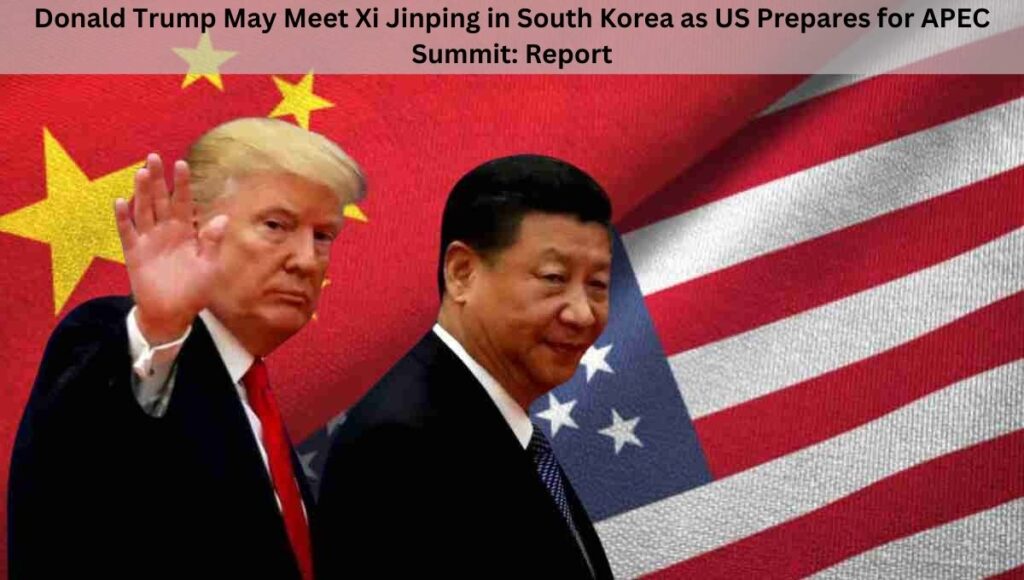
Donald Trump May Meet Xi Jinping in South Korea as US Prepares for APEC Summit: Report
Why South Korea and Why Now?
South Korean President Lee Jae Myung personally invited Donald Trump to attend the APEC summit during a meeting in Seoul last week.
According to officials, the trip is being framed as a chance to:
- Deepen economic collaboration between Washington and Seoul.
- Discuss trade, defense, and civil nuclear cooperation.
- Explore opportunities for new economic investments in the United States, a key priority in Trump’s foreign visits.
One White House official told CNN:
“A visit to South Korea is being discussed, which would focus on economic collaboration. Other goals include trade, defense, and civil nuclear cooperation.”
The timing is significant. Trump’s Asia trip would unfold amid heightened geopolitical maneuvering, where China has been actively strengthening its ties with Russia, India, and North Korea through high-profile summits and military parades.
Trump vs. Xi: A Meeting That Could Reset Relations
A potential meeting between Trump and Xi Jinping at APEC could prove pivotal.
The US and China have been locked in tariff battles, with Trump imposing a 145% tariff on Chinese imports earlier this year. Beijing retaliated with a 125% levy on American goods.
While those higher rates were scheduled to snap back last month, Trump signed an executive order delaying them until November, keeping the door open for negotiations.
The APEC sidelines offer a rare opportunity for Trump and Xi to discuss:
- The future of tariffs and trade policy.
- China’s role in global supply chains.
- Regional security dynamics, especially concerning North Korea.
- Trump’s criticism of China’s expanding influence in Asia and beyond.
Although officials stress that “no firm plans” have been confirmed, the fact that preparations are quietly underway highlights the importance both sides are attaching to this possible meeting.
The Modi-Putin-Kim Factor
Tensions escalated last week after Xi Jinping hosted Prime Minister Narendra Modi, Russian President Vladimir Putin, and North Korean leader Kim Jong-un in Beijing and Tianjin.
- Modi attended the Shanghai Cooperation Organisation (SCO) Summit in Tianjin.
- Putin was present at both the SCO Summit and China’s grand military parade.
- Kim Jong-un participated in the parade, where China showcased its expanding defense capabilities.
Trump was quick to lash out on social media, accusing China, Russia, and North Korea of conspiring against the United States.
In one fiery post, Trump wrote:
“May President Xi and the wonderful people of China have a great and lasting day of celebration. Please give my warmest regards to Vladimir Putin and Kim Jong Un, as you conspire against The United States of America.”
On another occasion, he shared a photo of Xi, Putin, and Modi with the caption:
“Looks like we’ve lost India and Russia to deepest, darkest China. May they have a long and prosperous future together!”
The posts sparked controversy, particularly regarding Trump’s remarks about India. Within days, however, Trump backtracked, softening his tone toward Prime Minister Modi and emphasizing that US-India ties remain strong.
Trump Backtracks on Modi Comments
While his remarks initially suggested that India was drifting closer to China, Trump later clarified that his relationship with Prime Minister Narendra Modi remained “very well” and that the two leaders would “always be friends.”
This shift was welcomed in New Delhi. Prime Minister Modi responded warmly, stating that he “deeply appreciates and fully reciprocates” Trump’s sentiments, affirming that India-US ties remain a “very special relationship.”
The back-and-forth highlights Trump’s sometimes volatile approach to diplomacy alternating between harsh criticism and personal warmth, often within days of each other.
North Korea: Will Kim Jong-un Join the Summit?
Another wildcard for Trump’s South Korea trip is whether North Korean leader Kim Jong-un will attend the APEC Summit.
Officials say it is not confirmed, but if Kim joins, the event could become a stage for another Trump-Kim meeting their first since their high-profile summits in Singapore (2018) and Hanoi (2019).
Trump has already signaled his willingness to meet Kim again. Speaking to reporters alongside South Korea’s President Lee, Trump claimed:
“I will do that, and we’ll have talks. He’d like to meet with me. We look forward to meeting with him, and we’ll make relations better.”
If this materializes, the summit could turn into a three-way stage involving Trump, Xi, and Kim an extraordinary moment in modern geopolitics.
Trump’s Praise for China’s Military Parade
Despite his criticisms, Trump admitted he was “watching closely” when China held its military parade earlier this month.
Calling it a “beautiful ceremony” and “very impressive,” Trump acknowledged:
“I understood the reason they were doing it, and they were hoping I was watching and I was watching.”
This acknowledgment suggests that, despite his fiery rhetoric, Trump continues to carefully monitor China’s moves while leaving room for dialogue.
Trade War Still Looms Large
At the heart of any potential Trump-Xi meeting lies the trade war.
- The US tariffs of 145% on Chinese goods remain one of Trump’s most aggressive economic measures.
- Beijing’s retaliatory 125% tariffs have worsened tensions, hitting American exporters hard.
- Trump delayed the higher tariff rates until November, signaling a window for negotiation.
US and Chinese economic advisers have already met twice in Europe to discuss trade. But the APEC Summit could provide the first face-to-face opportunity for Trump and Xi to break the deadlock.
What This Means for US Foreign Policy
Trump’s South Korea trip and the possibility of a meeting with Xi has implications far beyond Asia.
- US-China Relations: Could mark either a reset or a further breakdown in ties.
- India-US Ties: Trump’s clarification on Modi underscores India’s role as a balancing power.
- North Korea Diplomacy: A Trump-Kim meeting could revive denuclearization talks, or at least reopen channels.
- Global Trade: A Trump-Xi agreement on tariffs could calm volatile markets or escalate tensions further.
Conclusion: A Summit That Could Shape the World
As Trump quietly prepares for his South Korea visit, the world is watching.
A possible Trump-Xi meeting at APEC could shape not only the future of US-China relations but also the global balance of power involving India, Russia, and North Korea.
Whether it ends in breakthrough deals, fiery confrontations, or symbolic gestures, the Gyeongju APEC Summit is set to be one of the defining moments of Trump’s foreign policy in 2025.