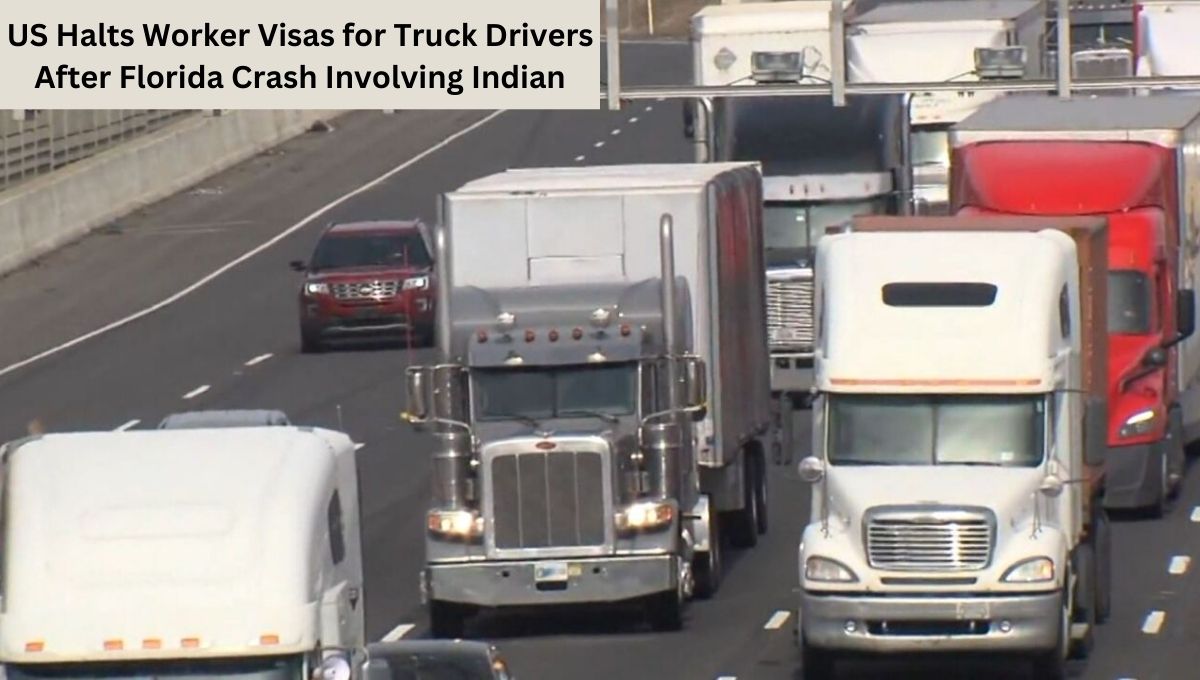
US Halts Worker Visas for Truck Drivers After Florida Crash Involving Indian National, Citing Safety Concerns. The Trump administration has announced an immediate halt to the issuance of US worker visas for commercial truck drivers, a sweeping policy shift that has ignited debate across America’s trucking industry and immigrant communities. The decision comes after a deadly crash in Florida involving an Indian-origin driver, intensifying calls for stricter immigration controls and safety regulations on US roads.
US Halts Worker Visas for Truck Drivers After Florida Crash Involving Indian
Florida Crash Sparks Nationwide Debate
On August 12, 2025, tragedy struck in St. Lucie County, Florida, when a semi-truck attempted an illegal U-turn on a highway, colliding with a minivan.
The crash killed three people, sparking outrage and reigniting debates over foreign-born truckers’ role in the industry.
The driver, Harjinder Singh, an Indian national who reportedly entered the US illegally via the Mexico border in 2018, was behind the wheel.
Singh, who had obtained a California commercial driver’s license (CDL) under state rules allowing undocumented residents to apply for licenses, now faces three counts of vehicular homicide.
Florida officials confirmed that Singh lacked legal immigration status and struggled with English language proficiency, failing a post-crash examination.
These revelations fueled the Trump administration’s decision to impose new restrictions.
Rubio Announces Halt on Worker Visas
Just days after the crash, Secretary of State Marco Rubio declared on X (formerly Twitter):
“Effective immediately we are pausing all issuance of worker visas for commercial truck drivers. The increasing number of foreign drivers operating large tractor-trailer trucks on U.S. roads is endangering American lives and undercutting the livelihoods of American truckers.”
This announcement halts the H-2B visa program for truck drivers, a temporary work visa category often used by foreign nationals, including many from India, Mexico, and Eastern Europe.
According to State Department officials, the pause applies to all nationalities and is not targeted at a single country.
However, the incident involving Singh has intensified focus on Indian truckers, who represent a growing presence in America’s trucking sector.
Political Fallout: Florida vs. California
The case quickly turned political. Florida Governor Ron DeSantis, a close Trump ally, seized on the crash to attack California Governor Gavin Newsom, accusing his state’s liberal licensing policies of endangering American lives.
California, home to tens of thousands of Indian-American truckers, defended itself by stating that Singh had been issued a federal work permit while awaiting asylum.
Newsom’s office stressed that California cooperated with Florida in extraditing Singh to face charges.
Still, the clash highlighted the broader ideological divide: Republicans pushing for tighter immigration enforcement versus Democrats advocating inclusion and labor rights.
The Trump Administration’s Immigration Crackdown
Since returning to the White House, President Donald Trump has made immigration restrictions a cornerstone of his second-term agenda.
The suspension of US visas for truck drivers aligns with broader efforts, including:
- April 2025 Executive Order: Mandating enforcement of an English proficiency rule for commercial drivers, reversing Obama-era guidance that relaxed penalties.
- Visa Revocations: The State Department has already revoked twice as many visas in 2025 compared to the same period in 2024.
- Increased Border Control: Enhanced vetting of asylum seekers and foreign workers entering the US.
Transportation Secretary Sean Duffy defended the move, arguing that failing to enforce driver qualifications, including language skills, “poses serious safety concerns and increases the likelihood of crashes.”
English Proficiency Rule Back in Focus
The English requirement for truck drivers is not new. Federal law has long required commercial drivers to demonstrate basic English skills for reading road signs, communicating with inspectors, and understanding safety regulations.
However, enforcement has historically been inconsistent. In 2016, inspectors were instructed not to disqualify drivers solely for lacking English proficiency.
Trump’s April order reversed that guidance, and now, after the Florida crash, enforcement is expected to intensify.
Foreign-Born Truck Drivers in the US
The US trucking industry has long relied on immigrant labor, particularly as it struggles with chronic driver shortages.
- From 2000 to 2021, the number of foreign-born truck drivers doubled to 720,000.
- Foreign-born drivers now account for 18% of the industry, mirroring the overall US labor market.
- Many come from Latin America, India, and Eastern Europe, with Sikhs from India playing a particularly vital role in California’s trucking economy.
The Los Angeles Times has reported that Indian-American communities run trucking schools, businesses, truck stops, and Gurudwaras (Sikh temples), creating entire ecosystems around the industry.
Impact on Indian Truckers
Indian truckers are among the most affected by this policy shift. The Sikh community, which has a strong tradition of trucking in both India and abroad, has built a significant presence in US logistics, especially in long-haul freight.
According to industry estimates:
- Tens of thousands of Indian-origin drivers operate across the US.
- Many hold H-2B visas or other temporary permits.
- A substantial number own small businesses tied to the trucking ecosystem.
The suspension of visas is expected to hurt new arrivals from India while straining existing networks that rely on family or community-based recruitment of drivers.
US Trucking Industry’s Labor Shortage
The move also raises questions about how the US will address its trucking labor shortage.
- In 2022, the industry faced a shortage of 78,800 drivers.
- By 2025, reports suggested a shortfall of 24,000 drivers, costing the freight sector an estimated $95.5 million per week in undelivered goods.
- The American Trucking Associations continues to warn about supply chain disruptions if the shortage worsens.
Foreign drivers, including many from India, have helped bridge these gaps. Critics argue that halting visas could make shortages worse, driving up shipping costs and delaying deliveries.
What Happens to Pending Worker Visas?
A critical question now is: What happens to visas already applied for?
The State Department clarified that all applications are on hold while a review of “screening and vetting protocols” is conducted.
This means that 1,490 visas issued so far in 2025 and other pending applications may face delays or cancellations.
Officials stressed the pause is temporary, but no timeline has been given for when – or if – visa issuance will resume.
Supporters vs. Critics
Supporters of the policy argue it prioritizes safety and American jobs.
- “Foreign drivers unfamiliar with US roads and unable to communicate in English pose real dangers,” said a Florida highway safety official.
- Trucking unions welcomed the pause, saying it could help raise wages for American drivers.
Critics, however, call the move a political stunt with dangerous economic consequences.
- Immigration advocates accuse the administration of scapegoating immigrants.
- Business groups warn that supply chains already under stress will suffer further.
- Civil rights organizations point to the targeting of immigrant communities, especially Indian Sikhs, as discriminatory.
A Community on Edge
For Indian truckers in America, the policy has created fear and uncertainty. Many community leaders say the actions unfairly paint all immigrant drivers as unsafe.
In Fresno, California home to one of the largest Sikh trucking hubs Gurdwara leaders said they will offer legal and counseling support to truckers and their families.
“Our community has kept America moving. One tragic case should not erase decades of contribution,” one leader said.
Conclusion: A Balancing Act Between Safety and Labor Needs
The Trump administration’s halt on worker visas for commercial truck drivers underscores the deep tensions in US immigration policy balancing road safety, labor shortages, and political narratives.
While the Florida crash has undoubtedly raised serious concerns, the decision also risks worsening the trucking industry’s labor crisis, with ripple effects across the supply chain. For Indian truckers, particularly the Sikh community that has become synonymous with US trucking, the policy shift is a major setback.
Whether the visa suspension becomes a permanent ban or a temporary pause will likely depend on political pressures, industry pushback, and the outcome of ongoing investigations.
Also Read: Trump Administration is Scrutinizing 55 million US Visa Holders for Deportation Violations
Related Posts:
- 7 Heartbreaking Facts About Venezuela's Earthquake Disaster

- 5 Major Takeaways from the US Supreme Court's…

- Trump’s 20-Point Gaza Peace Plan Gains Urgent Global…

- 7 Powerful New Developments in the White House Shooting Case

- 3 Explosive Conditions Iran Sets to End War with US…

- 9 Explosive Claims as Trump Says US Winning Iran War