During his current term in office, Trump Deserves Nobel Peace Prize, Says White House, After Brokering Six Global Ceasefires. In a bold and high-profile claim, the White House has stated that President Donald Trump has brokered an average of one international peace deal per month.
Thank you for reading this post, don't forget to subscribe!Speaking during a press briefing, White House Press Secretary Karoline Leavitt called for Trump to be awarded the Nobel Peace Prize, pointing to successful US-brokered ceasefires in multiple global conflict zones. Leavitt cited six separate international conflicts that she said had been de-escalated or resolved thanks to Trump’s personal intervention.
These include ceasefires between India and Pakistan, Thailand and Cambodia, Israel and Iran, Rwanda and the Democratic Republic of the Congo, Serbia and Kosovo, and Egypt and Ethiopia. “It is well past time that President Trump be awarded the Nobel Peace Prize,” said Leavitt. “The President has now ended conflicts in some of the world’s most dangerous flashpoints using direct diplomacy and trade leverage.”
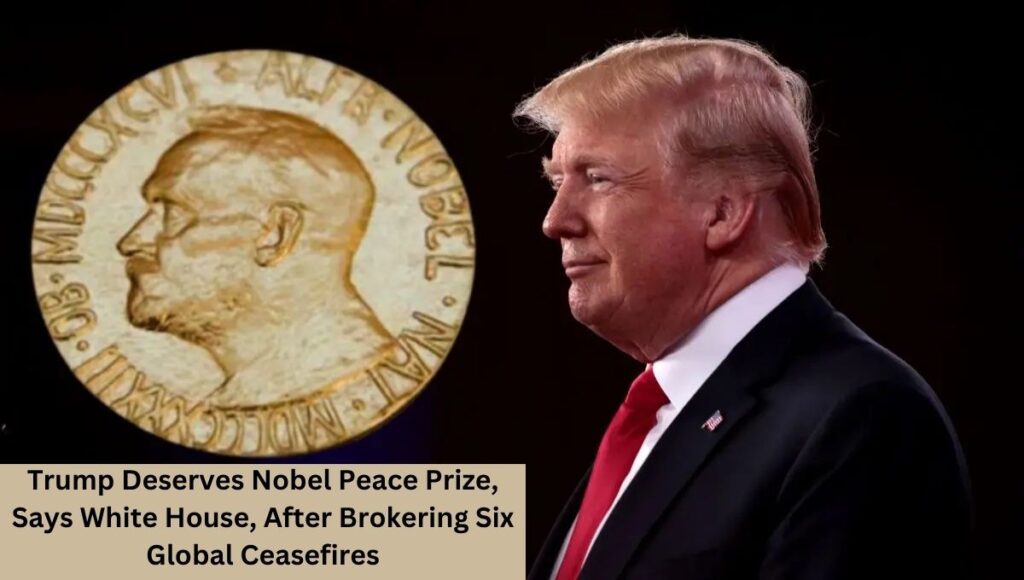
Trump Deserves Nobel Peace Prize, Says White House, After Brokering Six Global Ceasefires
Thailand-Cambodia Ceasefire: ASEAN Acknowledges US Role
The latest example highlighted by the White House was the Thailand-Cambodia conflict, which had escalated into deadly skirmishes along the disputed border.
The conflict had displaced more than 300,000 people until a ceasefire was brokered last month in Kuala Lumpur, Malaysia.
According to the White House, Trump spoke directly to both Thai and Cambodian leaders, warning them that unless the violence ended, there would be no trade discussions or deals with the US.
The two countries, under mediation led by Malaysian Prime Minister Anwar Ibrahim (in his role as ASEAN chair), agreed to a full and unconditional ceasefire.
“This peace will save thousands of lives,” Leavitt stated, “and has already paved the way for renewed trade negotiations.”
Cambodian Deputy Prime Minister Sun Chanthol later confirmed the US played a crucial role and announced plans to nominate Trump for the Nobel Peace Prize.
Trump’s Tactics: Trade Pressure as a Peace Tool
Throughout his presidency, Trump has used trade and tariffs as diplomatic levers, and the peace efforts cited by the White House are no exception.
According to Leavitt, Trump’s strategy has been simple but effective: use the power of the US market to demand peace and stability.
A similar tactic was reportedly applied in Cambodia and Thailand, where reciprocal tariffs as high as 49% were threatened earlier this year.
After the ceasefire, those were lowered to 19% for both countries, with Cambodia receiving additional concessions in exchange for removing its own tariffs on US goods and agreeing to purchase 10 Boeing 737 MAX 8 jets, with an option for 10 more.
“Peace through pressure is the Trump Doctrine,” a senior White House official said.
India-Pakistan Ceasefire: Trump Claims Credit, India Disagrees
Perhaps the most controversial claim in the White House’s peace list is the India-Pakistan ceasefire, which followed India’s Operation Sindoor, a retaliatory strike on Pakistani terror infrastructure.
Leavitt reiterated Trump’s position that the US helped bring about an end to hostilities between the two nuclear-armed neighbors.
She claimed that Trump’s behind-the-scenes diplomacy and warnings to both parties were pivotal.
However, India has firmly rejected these claims.
Speaking in Parliament during a discussion on Operation Sindoor, Indian Prime Minister Narendra Modi stated unequivocally that no foreign leader had told India to stop its operation.
He recounted how he did not take a call from the US Vice President during the operation, saying national security matters were being handled directly with the Indian military.
“Later, I did call him back,” Modi told Parliament, “and told him clearly: if Pakistan attacks, we will respond with full force. That was my only message.”
Despite the US claiming partial credit, the actual cessation of hostilities occurred after Pakistan’s Director-General of Military Operations called his Indian counterpart, requesting a de-escalation signaling a bilateral military communication that bypassed international mediators.
Other Conflicts: Trump Claims Six Major Peace Deals
Besides India and Pakistan, and Thailand and Cambodia, the White House credited Trump with facilitating ceasefires in four other major conflict zones:
1. Israel and Iran
While no formal treaty has been announced, Leavitt claimed that “back-channel diplomacy” and secret pressure campaigns by the Trump administration had resulted in a reduction of hostilities in the region.
2. Rwanda and the Democratic Republic of the Congo
Trump reportedly leveraged US humanitarian aid and sanctions relief to persuade both governments to curb border violence. Though skirmishes still occur, US officials argue that tensions have “markedly declined.”
3. Serbia and Kosovo
Trump has long claimed credit for economic normalization talks between Serbia and Kosovo. While peace remains fragile, the White House included this achievement among the six ceasefires.
4. Egypt and Ethiopia
With tensions running high over the Grand Ethiopian Renaissance Dam (GERD), the Trump administration reportedly stepped in to facilitate technical cooperation and diplomacy between the two countries.
Nobel Peace Prize: Growing Support for Trump’s Nomination
The push to nominate Donald Trump for the Nobel Peace Prize has gained momentum not just in Washington, but also abroad.
Cambodian Deputy Prime Minister Sun Chanthol publicly endorsed Trump for the award, saying that “without the U.S. president’s intervention, Cambodia and Thailand would likely not have forged a deal.”
Israel and Pakistan are also reported to have already submitted Trump’s name to the Norwegian Nobel Committee.
In Africa, unnamed nations have voiced support for a formal nomination, pointing to Trump’s work in the Congo and Ethiopia.
“He should get the Nobel, not only for Cambodia, but for other places where American leadership made a difference,” Sun Chanthol said.
A Political Calculus: Peace, Praise, and Pressure
The political timing of these declarations is no coincidence. Trump is campaigning for re-election and using foreign policy wins as a centerpiece of his narrative.
His administration has touted “one peace deal per month” as evidence of a results-driven presidency, positioning him as a global peacemaker.
Leavitt’s comments were carefully crafted to appeal to both domestic and international audiences, emphasizing how Trump’s America-first policies can still yield global peace dividends.
“The world is safer, trade is resuming, and American strength is being respected again,” Leavitt told reporters.
Critics Say “Not So Fast”
Despite the self-congratulatory tone from the White House, foreign policy experts and critics argue that many of these claims are exaggerated or premature.
Skeptics point to the lack of formal treaties, the continued risk of renewed violence, and the absence of lasting solutions in some regions.
Others warn that the use of economic blackmail as some view Trump’s trade-based diplomacy may produce short-term wins but long-term instability.
“Trump’s approach can be described as transactional, not transformational,” said a former US diplomat. “You may get a ceasefire today, but peace is a process.”
Ukraine Conflict: A Missing Achievement
One glaring omission from Trump’s peace record is Ukraine, where his campaign-trail promise to end the war with Russia on ‘day one’ remains unfulfilled.
Despite repeatedly claiming he would bring an immediate end to the conflict, the war in Ukraine continues with no resolution in sight.
This inconsistency has led some critics to dismiss the Nobel Prize push as premature, while others argue it shouldn’t overshadow legitimate diplomatic wins elsewhere.
Conclusion: A Bold Bid for Peace Recognition
Whether or not Donald Trump ultimately wins the Nobel Peace Prize, the White House has made it clear that his administration considers its track record of conflict resolution to be award-worthy.
The “one peace deal per month” narrative is now a central talking point in Trump’s reelection messaging, highlighting his unconventional approach to diplomacy leveraging tariffs, pressure, and personal diplomacy to achieve what traditional channels often could not.
While the veracity and longevity of these peace deals remain under scrutiny, one thing is certain:
Trump’s bid to recast himself as a global peacemaker is in full swing.
Also Read: Trump Says “They Won’t Give It to Me” as Pakistan Nominates Him for 2026 Nobel Peace Prize
Also Read: Map Shows Where Donald Trump Has Helped Broker Peace Deals Since Election
Related Posts:
- Trump’s Nobel Peace Prize Bid: Gaza Peace Plan, 8…
- Trump’s 2025 Nobel Peace Prize Snub: Politics Over…

- 7 Shocking Reasons FIFA’s Peace Prize for Trump…

- Trump’s 2025 Gaza Peace Plan Signing and Historic…

- Trump Says “They Won’t Give It to Me” as Pakistan…
- Trump Says He Deserves Nobel Peace Prize for Ending…