The June 22nd Trump’s Iran Airstrikes Spark War Powers Fight as Lawmakers Push to Limit Military Action. President Donald Trump’s June 22 airstrikes on Iran’s key nuclear facilities have ignited a storm in Washington, launching a new chapter in the ongoing constitutional battle over war powers. With U.S. B-2 bombers hitting Fordow, Natanz, and Isfahan, the White House hails it as a decisive move but critics in Congress warn it was a clear overreach of presidential authority.
The strikes have not only intensified tensions in the Middle East but also deepened divisions in Congress, where bipartisan lawmakers are now rallying behind a new War Powers Resolution to reassert Congress’s constitutional right to declare war.
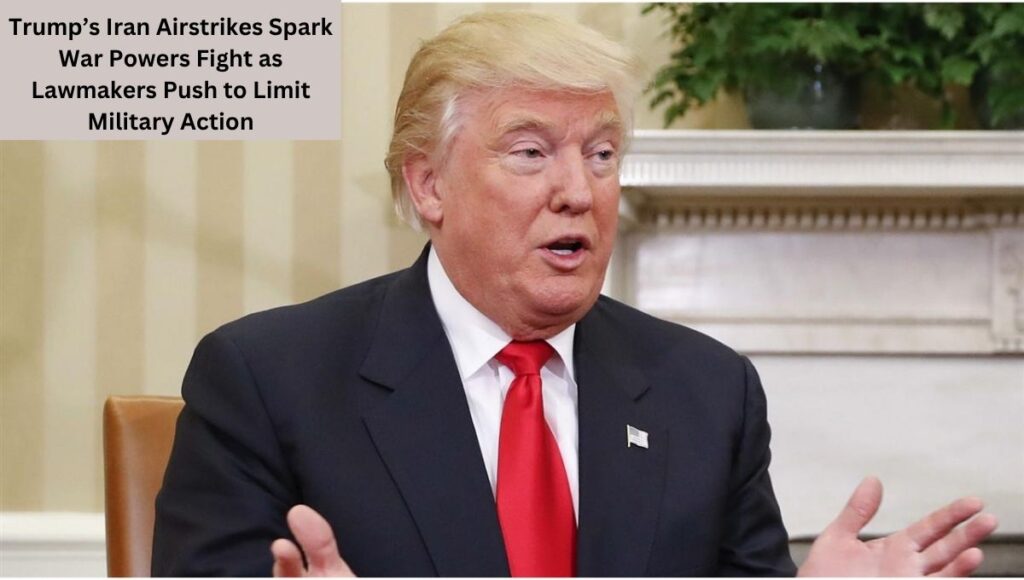
Trump’s Iran Airstrikes Spark War Powers Fight as Lawmakers Push to Limit Military Action
White House Defends Article II Authority
In defense of the action, senior White House officials cited Article II of the U.S. Constitution, which grants the president command over the armed forces. “The president is clearly well within his Article II powers here,” a former senior official told CNN.
The Justice Department’s Office of Legal Counsel backed the strike in internal memos, referencing past operations like George H.W. Bush’s Panama invasion and Barack Obama’s 2011 Libya strikes.
However, constitutional experts and a growing list of lawmakers argue the move violates the War Powers Resolution of 1973, which limits the president’s power to engage in hostilities without congressional approval.
Legal Experts Say Trump Overstepped
Many legal scholars insist Trump’s strike should be classified as an act of war, which only Congress can authorize. Ilya Somin, a law professor at George Mason University, argued:
“This is a large enough scale action that I think it’s likely that it should be considered a war… and therefore, it requires congressional authorization.”
Critics say no imminent threat to the U.S. existed, a key requirement under both constitutional law and the War Powers Act. The legislation mandates that the president consult Congress “whenever possible” before committing to armed conflict.
No Urgent Threat Justified Strikes, Say Lawmakers
Chris Anders from the ACLU was blunt: “This isn’t some technical rule making. It literally is one of the enumerated powers of Congress.”
A Justice Department official also admitted that while the initial strike might not require authorization, any escalation or prolonged military campaign would.
Even Director of National Intelligence Tulsi Gabbard confirmed the U.S. had no evidence Iran had actively decided to build a bomb, although it could do so within months if it chose.
Congress Reacts: 47 Lawmakers Push War Powers Resolution
A bipartisan group of 47 lawmakers, led by Rep. Ro Khanna (D-CA) and Rep. Thomas Massie (R-KY), introduced a War Powers Resolution hours after the attack.
The resolution would prevent Trump from launching additional military actions against Iran without congressional approval.
“Stopping Iran from having a nuclear bomb is a top priority,” Khanna said, “but dragging the U.S. into another Middle East war is not the solution.”
Massie added on CBS: “We were promised no more endless wars. There was no imminent threat to the United States.”
Senator Tim Kaine Leads Senate Push
In the Senate, Sen. Tim Kaine (D-VA) introduced a companion bill aimed at forcing a debate.
“This is the U.S. jumping into a war of choice at Donald Trump’s urging,” Kaine said on Face the Nation. “There is no compelling national security interest.”
Senate Majority Leader Chuck Schumer also expressed concern, while the White House declined to comment on Kaine’s proposed measure.
Congressional Leaders Briefed, Rank-and-File Kept in the Dark
According to sources, House Speaker Mike Johnson and Senate Majority Leader John Thune were notified in advance of the attack. Other lawmakers, however, were not briefed until after the operation and are scheduled for formal updates on Tuesday.
Rep. Massie criticized the lack of transparency: “Congress was on vacation when this happened. We haven’t been briefed.”
List of Lawmakers Supporting War Powers Resolution
The resolution has attracted support from a mix of progressives, moderates, and libertarian conservatives. Key backers include:
House Sponsors and Supporters:
Ro Khanna, Thomas Massie, Alexandria Ocasio-Cortez, Pramila Jayapal, Jamie Raskin, Rashida Tlaib, Ayanna Pressley, Ilhan Omar, Donald Beyer, Lloyd Doggett, Veronica Escobar, Greg Casar, Jan Schakowsky, and more.
Senate Sponsor:
Tim Kaine (D-VA)
Khanna aims to secure 213 Democratic votes by week’s end, hoping to force a House vote as Congress reconvenes.
Progressives Call for Impeachment
Some lawmakers believe Trump’s actions rise to the level of impeachment. Rep. Alexandria Ocasio-Cortez declared: “He has impulsively risked launching a war that may ensnare us for generations. It is absolutely and clearly grounds for impeachment.”
Others, like Sen. Dick Durbin, agreed that Trump violated the Constitution but stopped short of supporting impeachment.
GOP Reaction: Broad Support, Some Pushback
Most Republicans stood behind Trump. House Speaker Mike Johnson called the strike: “A necessary, limited, and targeted operation.”
Sen. Lindsey Graham defended Trump’s authority, stating: “He had all the authority he needs under the Constitution. If you don’t like it, cut off the funding.”
But Rep. Thomas Massie, a key Republican voice in the resolution, warned: “When two countries are bombing each other and a third joins in, that’s war. Let’s stop the mental gymnastics.”
Rep. Marjorie Taylor Greene voiced opposition as well, tweeting: “I can support President Trump but still disagree with bombing Iran and starting a hot war.”
Trump Responds with Political Threats
Trump lashed out at Massie on Truth Social, vowing to support a primary challenger against him in 2026.
“MAGA is not about lazy, grandstanding, nonproductive politicians, of which Thomas Massie is definitely one.”
The populist MAGA base is reportedly split some backing Trump’s show of strength, others rejecting what they see as another “forever war.”
Global Fallout and UN Scrutiny
International reaction has been swift. Iran labeled the strikes a “grave violation of international law,” while the UN Security Council prepares an emergency session.
Democrats warn the mission’s long-term impact remains unclear. Iran may have relocated nuclear materials, and experts caution against premature declarations of victory.
“We triumphantly declare the mission is accomplished the day after,” Khanna said, “and then we’re left with Americans bearing the consequences for decades.”
Constitutional Crossroads: War Powers at Stake
Trump’s bombing of Iran has become a defining moment for America’s constitutional balance of power. As lawmakers push back, the future of executive military authority hangs in the balance.
“This is a decisive moment,” said Khanna. “We must act to prevent a war with Iran.” Whether or not the resolution passes, the War Powers debate has reemerged as a critical test of Congressional will and constitutional duty.
Also Read: Israel Strikes Iranian Airfields, Destroys 15 Jets and Missile Sites Amid Escalating Conflict
Also Read: Explained: Can Trump go to war in Iran without approval from US Congress?