

In a dramatic turn that has stirred international debate, Trump Says “They Won’t Give It to Me” as Pakistan Nominates Him for 2026 Nobel Peace Prize. Pakistan has officially nominated United States President Donald J. Trump for the 2026 Nobel Peace Prize, citing his “decisive diplomatic intervention” during the recent India-Pakistan conflict.
While Islamabad hailed Trump as a “genuine peacemaker,” Trump reignited his longstanding complaint: he deserves the Nobel “four or five times,” but won’t get it because the committee favors “liberals.” India, meanwhile, has again rejected U.S. involvement in the ceasefire process, asserting that the resolution was a result of direct military negotiations between New Delhi and Islamabad.
The nomination, timed shortly after Trump hosted Pakistan’s Army Chief Field Marshal Asim Munir at the White House, underscores not only the geopolitical complexities of South Asia but also Trump’s unyielding pursuit of the Nobel Peace Prize.
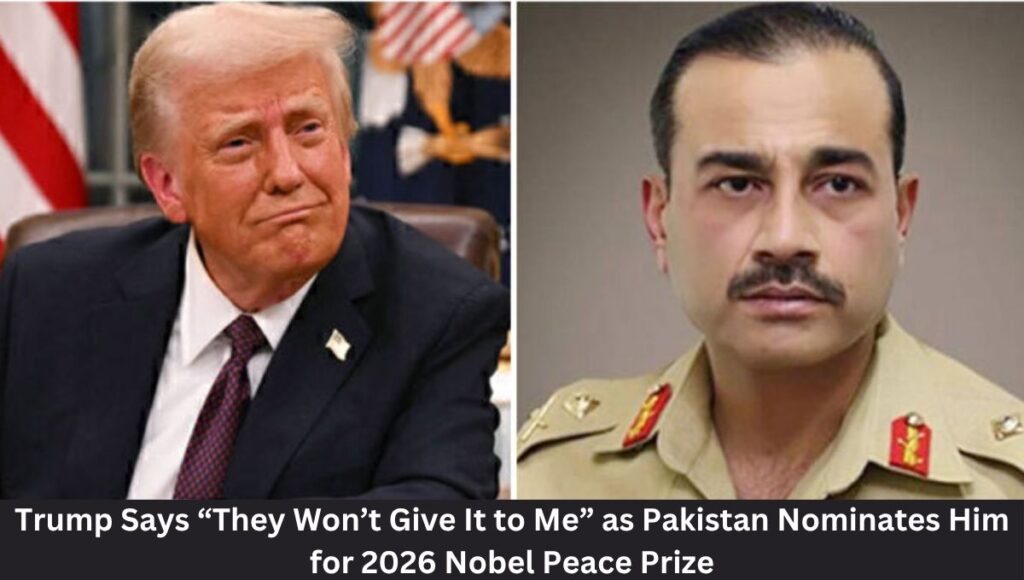
Trump Says “They Won’t Give It to Me” as Pakistan Nominates Him for 2026 Nobel Peace Prize
Pakistan Credits Trump with Averting War in South Asia
In an official post on X (formerly Twitter), Pakistan’s Foreign Ministry announced its nomination of President Donald Trump for the Nobel Peace Prize 2026, citing his “pivotal leadership” during a military standoff with India in May.
“President Donald J. Trump deserves the Nobel Peace Prize in 2026 in recognition of his decisive diplomatic intervention and pivotal leadership during the recent India-Pakistan crisis.”
According to Pakistan, Trump’s back channel diplomacy helped prevent a catastrophic war between two nuclear-armed states following India’s Operation Sindoor a retaliatory strike on Pakistani military targets in response to the April 22 terror attack in Pahalgam, Jammu and Kashmir, which killed 26 Indian citizens.
India Rejects Mediation Claim, Calls It a Bilateral Resolution
Despite Trump and Pakistan’s claims, India maintains a starkly different narrative. According to the Indian government, the ceasefire reached on May 10 was negotiated directly between military leaders from both countries without any third-party involvement.
Prime Minister Narendra Modi reportedly spoke with President Trump following the ceasefire, explicitly clarifying that U.S. mediation was never requested or involved.
“India has made it clear, repeatedly, that the resolution was reached through bilateral military channels at Pakistan’s request,” an Indian foreign affairs official told The News.
Trump: “They Won’t Give It to Me Because They Only Give It to Liberals”
In response to the nomination, Trump held nothing back. Speaking to reporters and on Truth Social, he repeated his demand for recognition by the Nobel Committee.
“I should have gotten the Nobel Peace Prize four or five times,” Trump declared. “They won’t give me the Nobel Peace Prize because they only give it to liberals.”
He also said the India-Pakistan crisis was “the big one” that merited his recognition and touted other global interventions he claimed to have led including a treaty between Rwanda and the Democratic Republic of Congo, and peace efforts in Serbia-Kosovo, Egypt-Ethiopia, and the Middle East Abraham Accords.
The Congo-Rwanda Deal: Trump’s Latest Diplomatic Claim
In the same breath, Trump revealed that he and Secretary of State Marco Rubio had brokered a peace agreement between the Democratic Republic of the Congo and Rwanda, a region plagued by decades of conflict, ethnic violence, and instability.
“I am very happy to report that I have arranged…a wonderful Treaty between the Democratic Republic of the Congo and the Republic of Rwanda. This is a Great Day for Africa and, quite frankly, a Great Day for the World!”
While details remain unclear and no independent verification has confirmed the U.S. role, Trump said the treaty would be signed in Washington on Monday.
A Long History of Nobel Aspirations
This is not Trump’s first brush with the Nobel Peace Prize. During his first term, he was nominated for the Abraham Accords, which established diplomatic relations between Israel and several Arab nations.
He has also previously claimed credit for de-escalating tensions with North Korea though no formal peace was achieved.
Despite these efforts, the Norwegian Nobel Committee has never awarded Trump the prize, nor has it publicly acknowledged the validity of past nominations.
“No matter what I do… I won’t get a Nobel Peace Prize. But the people know, and that’s what matters to me,” Trump said on Truth Social.
Trump Hosts Asim Munir in Washington: A Rare Diplomatic Gesture
The timing of the nomination also aligns with a rare meeting at the White House, where Trump hosted Pakistan’s Army Chief, Field Marshal Asim Munir, for lunch.
According to Pakistani media, Munir personally advocated for Trump’s Nobel nomination, citing his “critical diplomatic intervention” during the May conflict.
The Pakistani military has presented this invitation as a diplomatic victory, underscoring Munir’s rising influence on the global stage.
White House spokeswoman Anna Kelly confirmed the meeting, saying it was held “in recognition of President Trump’s efforts to avoid war between India and Pakistan.”
Operation Sindoor and Operation Bunyan-un-Marsoos: Clashing Narratives
India’s Operation Sindoor, launched on May 7, targeted multiple Pakistani airbases and military facilities, including the strategic Nur Khan airbase. India described it as a necessary response to the terror attack in Pahalgam.
In contrast, Pakistan characterized India’s actions as “unprovoked aggression” and launched Operation Bunyan-un-Marsoos, described as a “measured and precise” response aimed at restoring deterrence.
According to Islamabad, the crisis was spiraling until Trump’s alleged “quiet back-channel diplomacy” intervened, leading to the May 10 ceasefire.
Trump’s Critics Respond: “Self-Promotion Over Substance”
Not everyone is convinced by Trump’s Nobel campaign. Former Pentagon official Michael Rubin slammed Trump’s motivations, arguing that his foreign policy is driven by a desire for personal acclaim, not peace.
“He’s prone to false equivalence and puts other nations’ security below his own desire to win a Nobel Peace Prize.”
Many analysts have also pointed out that several of Trump’s so-called interventions lack documented evidence of success or U.S. centrality.
Pakistan Praises Trump’s Kashmir Approach
Beyond the recent ceasefire, Pakistan also commended Trump’s past statements offering to mediate the Kashmir dispute, which Islamabad believes shows a “sincere commitment to durable peace in South Asia.”
The Pakistani government added that “true peace in the region will remain elusive until the UN Security Council resolutions on Jammu and Kashmir are implemented.” India, however, has firmly rejected any mediation in Kashmir, calling it an internal matter.
What Lies Ahead: Will Trump Win the Nobel in 2026?
The Nobel Peace Prize is awarded annually by the Norwegian Nobel Committee to individuals or organizations that have made significant contributions to peace, disarmament, democracy, and human rights.
With hundreds of global nominations received every year, being nominated does not guarantee selection. The Committee typically does not comment on nominations and keeps its selection process confidential.
While Trump’s nomination by Pakistan is now official, his polarizing legacy and lack of multilateral consensus on his peace efforts make it uncertain whether he’ll be among the 2026 laureates.
Conclusion: A Nomination That Divides
President Trump’s Nobel Peace Prize nomination by Pakistan has sparked both praise and skepticism. Supporters view it as justified recognition of Trump’s bold and unconventional diplomacy. Critics dismiss it as self-serving theater, unsupported by tangible outcomes or international consensus.
In Trump’s own words: “I won’t get a Nobel Peace Prize no matter what I do. But the people know, and that’s what matters to me.” Whether the Nobel Committee agrees remains to be seen.
Also Read: Trump Hosts Pakistan’s Munir, Claims Credit for Averting War
Also Read: ‘Nobel Laureates Filled With Courage, Integrity’: Committee Explains Trump Snub
Related Posts:
- Trump’s Nobel Peace Prize Bid: Gaza Peace Plan, 8…
- Trump’s 2025 Nobel Peace Prize Snub: Politics Over…

- Trump Says He Deserves Nobel Peace Prize for Ending…
- 7 Shocking Reasons FIFA’s Peace Prize for Trump…

- Trump Deserves Nobel Peace Prize, Says White House,…
- 5 Powerful Highlights as Trump Lands Second Nobel…
