
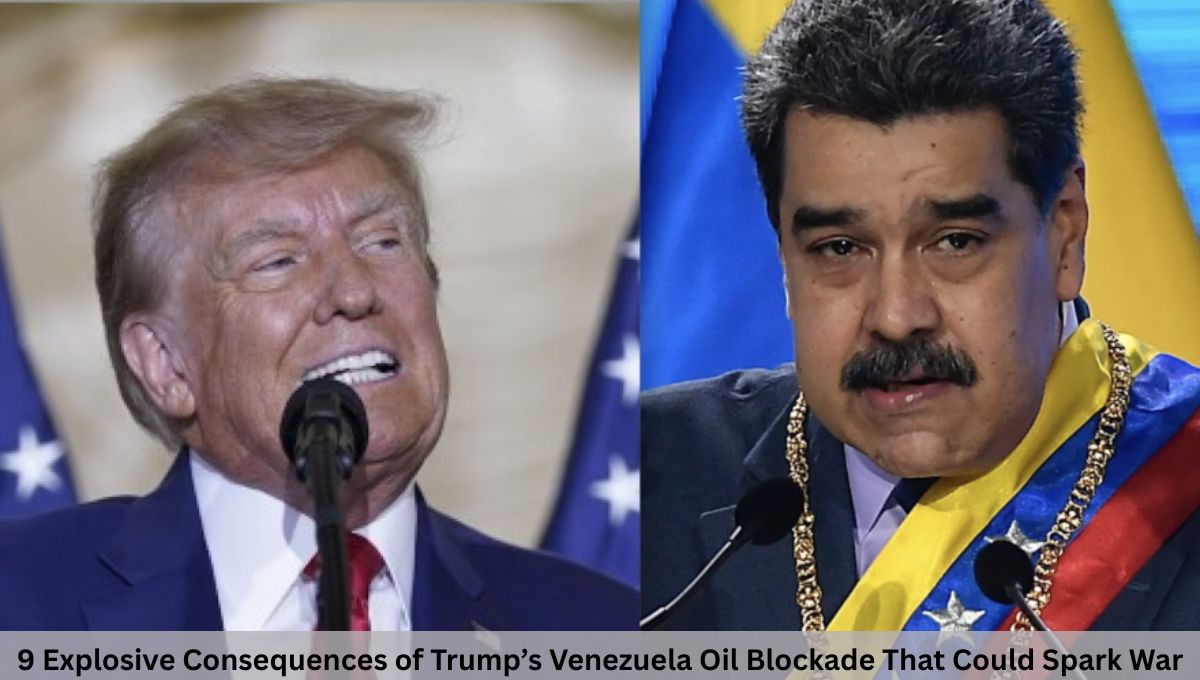
9 Explosive Consequences of Trump’s Venezuela Oil Blockade That Could Spark War and violate international law. United States President Donald Trump has dramatically escalated tensions with Venezuela by ordering what he described as a “total and complete” naval blockade of all US-sanctioned oil tankers entering or leaving the South American nation.
The announcement, delivered late Tuesday via Trump’s social media platform Truth Social, marked one of the most aggressive moves taken by a US administration against Venezuela in decades and immediately sparked international alarm, accusations of piracy, and warnings that the action could be interpreted as an act of war under international law.
The blockade order comes amid a growing US military buildup in the Caribbean and eastern Pacific, recent seizures of Venezuelan oil tankers, airspace restrictions, and a widening campaign that critics say increasingly resembles a regime-change operation targeting President Nicolás Maduro.

9 Explosive Consequences of Trump’s Venezuela Oil Blockade That Could Spark War
Trump Declares Venezuela ‘Surrounded’ by US Forces
In his post, Trump used sweeping language to describe the scale of US military presence near Venezuela.
“Venezuela is completely surrounded by the largest Armada ever assembled in the History of South America,” Trump wrote. “It will only get bigger, and the shock to them will be like nothing they have ever seen before.”
He went further, accusing the Venezuelan government of theft, terrorism, drug smuggling, and human trafficking, and claiming that the country had “stolen” US assets, including oil and land.
Trump said the Maduro government had been designated a “FOREIGN TERRORIST ORGANIZATION”, a label traditionally reserved for non-state extremist groups.
“Therefore, today, I am ordering A TOTAL AND COMPLETE BLOCKADE OF ALL SANCTIONED OIL TANKERS going into, and out of, Venezuela,” he declared.
Venezuela Condemns ‘Grotesque’ and ‘Irrational’ Threat
Caracas responded swiftly and forcefully. In an official statement, Venezuela’s government rejected Trump’s announcement as a “grotesque threat” and a blatant violation of international law.
“The President of the United States intends to impose, in an utterly irrational manner, a supposed naval blockade on Venezuela with the aim of stealing the riches that belong to our homeland,” the statement said.
President Nicolás Maduro earlier warned that the world would rise against what he called “piracy and oil plunder”, following the US seizure of a Venezuelan oil tanker last week.
US Seizure of Oil Tanker Sparks Escalation
The blockade order follows the unprecedented seizure of the Skipper, a tanker carrying Venezuelan crude oil. US forces intercepted the vessel in international waters off Venezuela’s coast and reportedly escorted it to Texas, where its oil cargo was unloaded.
Caracas described the move as state piracy, accusing Washington of kidnapping the ship’s crew and stealing sovereign assets. Venezuela’s ambassador to the United Nations, Samuel Moncada, formally denounced the seizure in a letter delivered to the UN Security Council (UNSC).
“This is an act of state piracy carried out through the use of military force,” Moncada wrote. “It constitutes a blatant theft of assets that do not belong to the United States.”
Venezuela Appeals to the United Nations
Following Trump’s blockade announcement, Venezuela said it would immediately escalate the matter to the UN.
Officials in Caracas said the blockade violates:
- Free navigation
- International trade law
- UN Charter principles
- Sovereignty of member states
Moncada’s letter described the US actions as an illegal attempt to strangle Venezuela’s economy and intimidate a sovereign nation through force.
Blockade Widely Viewed as Act of War
Under international law, naval blockades are often considered acts of war, particularly when imposed without UN authorization or a formal declaration of hostilities.
US Congressman Joaquin Castro, a Democrat from Texas, said Trump’s move crossed a dangerous legal line. “This is unquestionably an act of war,” Castro wrote. “A war that the Congress never authorized and the American people do not want.”
Castro said lawmakers would soon vote on a resolution directing Trump to end hostilities with Venezuela, forcing members of Congress to take a public stance.
Legal Concerns Inside the United States
Trump’s unilateral declaration has reignited debate over presidential war powers.
A 1961 US Justice Department memo, written during Cold War tensions with Cuba, warned that blockades are belligerent acts typically justified only during war.
Legal scholars and lawmakers argue:
- Congress has not authorized force against Venezuela
- No Authorization for Use of Military Force (AUMF) exists
- Venezuela has not declared war on the US
Social media reaction was swift, with critics warning that the US was sliding into an unauthorized conflict.
Massive US Military Buildup Off Venezuelan Coast
The blockade order comes amid one of the largest US naval deployments in the Caribbean in decades.
According to reports:
- An aircraft carrier strike group is positioned in the region
- Amphibious assault ships are deployed
- P-8 Poseidon surveillance aircraft are monitoring shipping lanes
- US forces are conducting Operation Southern Spear
While officially described as a counter-narcotics mission, the operation has involved dozens of strikes on vessels.
Deadly Strikes Raise Human Rights Concerns
Since September, US forces have killed at least 87 to 95 people in strikes on boats accused of drug trafficking.
International law experts have criticized the campaign as:
- Lacking due process
- Conducted without evidence disclosure
- Potentially constituting extrajudicial killings
Washington has not publicly provided proof linking the destroyed vessels to drug trafficking.
Oil at the Center of the Conflict
Venezuela holds the largest proven oil reserves in the world, making oil the lifeblood of its economy and the focal point of US pressure.
Trump has repeatedly suggested that the United States should regain access to Venezuelan oil if Maduro is removed from power.
“Until such time as they return to the United States of America all of the Oil, Land, and other Assets that they previously stole from us,” Trump said.
Chevron’s Special Role
Despite sweeping sanctions, Chevron remains the only US oil company authorized to operate in Venezuela under a sanctions carve-out.
According to Reuters:
- Only Chevron-chartered tankers have left Venezuelan ports since the Skipper seizure
- Chevron operates joint ventures with state oil company PDVSA
- Proceeds are tightly restricted
Trump revoked Chevron’s license earlier this year, then reinstated it under stricter conditions.
Sanctions Have Crippled Venezuela’s Economy
US sanctions on Venezuelan oil date back to 2005 and intensified sharply during Trump’s first term.
Key impacts include:
- Collapse of oil exports
- Severe currency shortages
- Reliance on discounted black-market sales
- Deep humanitarian crisis
Earlier this month, a US court also ordered the forced sale of Citgo, a major Venezuelan-owned refiner in the US, to pay creditors.
China Watches Closely
China is the largest buyer of Venezuelan oil, purchasing most exports at steep discounts. Energy analysts say China’s reaction will be critical.
If Beijing ignores US sanctions, Venezuelan oil could continue flowing, undermining the blockade’s effectiveness and risking wider geopolitical confrontation.
Oil Markets React
Following Trump’s announcement:
- Brent crude rose to $59.46 per barrel
- West Texas Intermediate climbed to $55.82 per barrel
Analysts say targeting only sanctioned tankers could disrupt 300,000 barrels per day, but a full blockade could remove up to 900,000 barrels daily from global supply.
Shadow Fleet Under Scrutiny
Venezuela relies heavily on a “shadow fleet” of tankers designed to evade sanctions.
Experts warn the US may expand interdictions to:
- Non-sanctioned vessels
- Dark-fleet operators
- Third-party shipping companies
Such actions could dramatically escalate maritime tensions.
Threat of Land Strikes Looms
Trump has repeatedly hinted that land strikes inside Venezuela could follow.
“Now we’re starting by land, and by land is a lot easier,” he said recently.
Officials say options include:
- Missile strikes on alleged drug labs
- Attacks on warehouses
- Targeting air-defense systems
Maduro Defiant Amid Pressure
Before Trump’s announcement, Maduro praised Venezuela’s resilience.
“We have taken the oath to defend our homeland,” he said. “On this soil, peace and shared happiness will triumph.”
He accused Washington of conducting multidimensional aggression, from cyber attacks to military intimidation.
A Dangerous Turning Point
Trump’s order represents a pivotal moment in US-Venezuela relations.
What began as sanctions and counter-narcotics operations has evolved into:
- Tanker seizures
- Airspace closures
- Naval blockades
- Open threats of invasion
With Congress divided, oil markets watching, and the UN now involved, the situation carries significant risk of miscalculation.
What Comes Next
Key developments to watch:
- Congressional vote on war powers
- UN Security Council response
- China’s reaction to enforcement
- Possible expansion of US interdictions
- Venezuelan military posture
As legal scholars warn and diplomats scramble, one reality is clear: the blockade has pushed the US and Venezuela closer to open conflict than at any time in recent history.
Also Read: 7 Stunning Implications of Trump’s Dramatic Venezuela Tanker Seizure
Also Read: Oil jumps 2% as Trump’s Venezuela blockade stokes uncertainty
Related Posts:
- 9 Explosive Signals as Trump Warns Maduro and U.S.…

- Can the EU and NATO Impose Tariffs on India and…

- 9 Explosive Claims as Venezuela Slams US ‘Extortion’ at UN

- 5 Powerful Highlights as Trump Lands Second Nobel…

- 11 Explosive Warnings as Trump Vows to ‘Knock the…

- Trump’s 20-Point Gaza Peace Plan Gains Urgent Global…
