7 Powerful Reasons Trump’s F-35 Deal with Saudi Arabia Is Rewriting Middle East Geopolitics under a new US–Saudi defense pact. In a move that could dramatically reshape the military balance of the Middle East, US President Donald Trump has confirmed that the United States will sell advanced F-35 stealth fighter jets to Saudi Arabia.
The announcement, delivered during Crown Prince Mohammed bin Salman’s high-profile visit to Washington, marks a seismic shift in American defence policy—one that for decades ensured Israel remained the sole operator of the F-35 in the region.
The decision not only signals a recalibration of Washington’s relationships in the Middle East, but also reveals the Trump administration’s strategic priorities: deeper defence ties with Riyadh, a bold bet on Saudi investments, and a renewed push for regional realignment under the Abraham Accords.
Below is a comprehensive, fully contextualised breakdown of the developments, controversies, motivations, and implications behind this historic arms deal.
7 Powerful Reasons Trump’s F-35 Deal with Saudi Arabia Is Rewriting Middle East Geopolitics
Trump Confirms F-35 Sale to Saudi Arabia—A Historic Break With US Policy
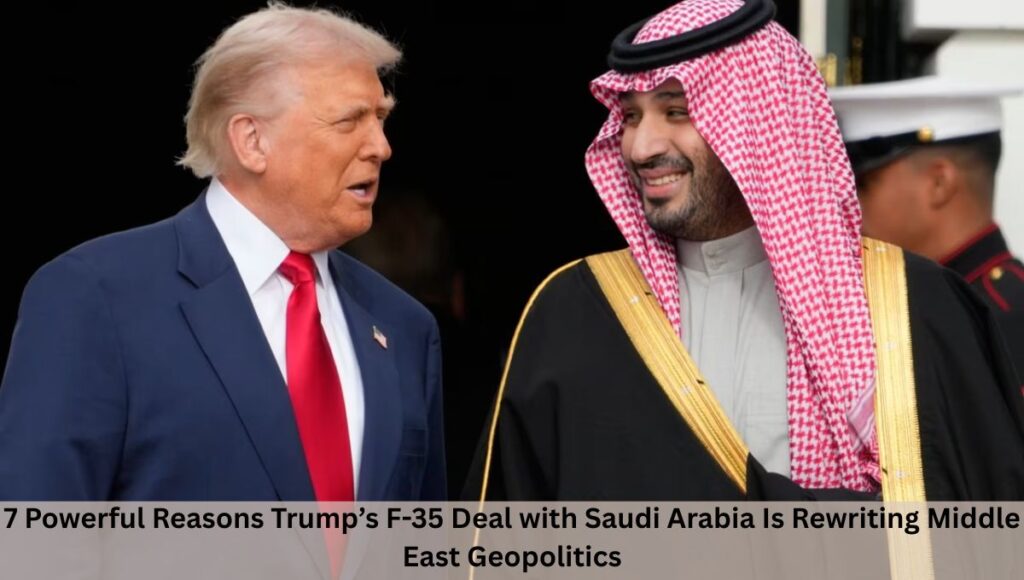
Speaking in the Oval Office alongside Crown Prince Mohammed bin Salman (MBS), Trump said the United States would move ahead with the sale of the fifth-generation fighter jets long requested by Riyadh.
“We will be selling F-35s. They’ve been a great ally,” Trump declared. His remarks were remarkable for several reasons.
No More Exclusive Status for Israel
For years, Washington refused to sell the F-35 to any Arab nation, citing the legal requirement to protect Israel’s qualitative military edge (QME).
Israel remains America’s closest military ally in the region and has relied on exclusive access to cutting-edge US technology—particularly the F-35—to maintain deterrence against regional adversaries.
But Trump signalled that both allies—Israel and Saudi Arabia—deserve the “top of the line.”
“As far as I’m concerned, they should both get top of the line,” he said, acknowledging that Israel preferred Saudi Arabia receive a “reduced calibre” version.
Riyadh Has Requested 48 F-35 Jets
Saudi Arabia has formally asked for up to 48 aircraft, amounting to one of the most significant arms acquisitions in the kingdom’s history.
The purchase would make Saudi Arabia the first Arab nation to join the F-35 program, after the earlier UAE deal collapsed under the Biden administration over technology-sharing concerns with China.
What Makes the F-35 So Valuable to Saudi Arabia?
The World’s Most Advanced Stealth Fighter
The F-35 Lightning II is manufactured by Lockheed Martin and is widely regarded as the most sophisticated combat aircraft ever built. It combines stealth technology, advanced sensors, electronic warfare capabilities, and AI-driven situational awareness.
Its primary advantages include:
- Radar-evading stealth
- 360-degree threat detection
- Ability to strike targets before being detected
- Data-sharing across allied forces
- Deep integration of intelligence and targeting systems
With tensions occasionally flaring in the Gulf and the future of the Saudi-Iran détente uncertain, Riyadh sees the F-35 as critical to maintaining regional air superiority.
The F-35 Could Transform Saudi Arabia’s Air Force
Saudi Arabia already operates one of the most capable air forces in the Arab world, with fleets of F-15SA and Eurofighter Typhoon jets. But the leap to fifth-generation aircraft would:
- Modernise the kingdom’s deterrence capabilities
- Strengthen defence against Iran
- Enhance long-range strike capabilities
- Boost interoperability with US forces
For a country re-positioning itself as a regional stabiliser and global investment hub under Vision 2030, the F-35 is also a symbol of strategic prestige.
Why the Deal Is Controversial—The Israel Factor
For decades, Washington has operated under a bipartisan commitment to safeguard Israel’s military superiority.
Israel’s Concerns Are Immediate and Concrete
Israeli officials and defence leaders have openly warned that giving Saudi Arabia F-35s could undermine Israel’s deterrence posture.
A senior Israeli security source told CNN:
“It is very concerning… For many years we ensured that no one in the Middle East has the same aircraft and capabilities as Israel.”
Yair Golan, a former deputy IDF chief, also criticised the move, saying it could trigger an arms race in the Middle East.
Why Didn’t Israel Publicly Protest This Time?
Unlike in past scenarios, Israel has, at least publicly, refrained from aggressive pushback. Analysts suggest this could be due to:
- Trump linking the deal to a future normalisation agreement
- Israel prioritising diplomatic realignment amid Gaza war fallout
- Recognition that Saudi Arabia’s strategic value outweighs risks
- US assurances behind closed doors
Even so, Israeli lawmakers across the political spectrum remain uneasy.
A Massive Investment Sweetener—Saudi Pledges $1 Trillion for the US
Beyond defence, the Saudi Crown Prince arrived with a staggering announcement.
Riyadh would increase its planned US investments from $600 billion to $1 trillion, including:
- Semiconductor manufacturing
- Artificial intelligence infrastructure
- Critical minerals
- Logistics and technology partnerships
Trump welcomed the news enthusiastically.
“Good, I like that very much,” he said.
Saudi Arabia’s pledge signals that the kingdom wants to anchor its economic future deeper within American technological and industrial ecosystems—even amid its growing ties with China.
The US-Saudi Defence Pact—A New Chapter in Bilateral Ties
During a formal dinner at the White House, Trump revealed another major development:
Saudi Arabia will be designated a “major non-NATO ally” (MNNA).
What MNNA Status Means
The designation grants:
- Priority access to US military equipment
- Increased defence cooperation
- Cooperative R&D opportunities
- Streamlined arms sales
- Strategic defence commitments (without a NATO-style guarantee)
Trump called it a “little secret” he saved for the night.
The two nations also signed a historic strategic defence agreement, expanding cooperation on:
- Missile defence
- Joint training
- Cybersecurity
- Maritime security
- Nuclear energy
The China Question—A Key Risk for the F-35 Deal
Washington’s concerns over Saudi Arabia’s ties with China remain a central obstacle.
Why the F-35 Is Extremely Sensitive Technology
The F-35’s systems include:
- Advanced stealth coatings
- AI-assisted targeting
- Real-time data fusion
- Electronic warfare modules
- Secure communications networks
US officials fear that if Saudi Arabia continues to deepen military cooperation with China, sensitive technology could be compromised.
Bradley Bowman of the Foundation for Defense of Democracies warned:
“Congress could press the administration to detail what assurances Riyadh has given about its relationship with China.”
A similar concern torpedoed the UAE’s F-35 deal in 2021. Whether Saudi Arabia can make the security guarantees needed remains an open question.
The Abraham Accords—Trump’s Bigger Strategic Game?
Trump has long viewed the Abraham Accords as a signature foreign policy achievement and is pushing to extend them.
Did Saudi Arabia Agree to Normalisation? No—But Trump Is Using Leverage
Riyadh insists it will not normalise relations with Israel unless:
- There is a credible and irreversible path to a Palestinian state
- Jerusalem recognises Palestinian sovereignty
- The Gaza conflict de-escalates
Trump, meanwhile, has hinted that the F-35 sale could play a role in persuading Saudi Arabia toward a future deal.
Nawaf Obaid, a Gulf security expert, put it bluntly:
“Trump delinked the issues. He wasn’t going to stop weapons sales just because of Netanyahu.”
While Saudi Arabia hasn’t committed to joining the Accords now, analysts believe the F-35 deal:
- Strengthens US-Saudi ties
- Enhances trust between Riyadh and Washington
- Keeps the door open for future normalisation
Why the US Shifted Position—Washington’s Strategic Calculations
1. Countering China’s Influence
Saudi Arabia’s expanding economic ties with China—including Huawei 5G and joint ballistic missile production—have alarmed Washington. Offering the F-35 could serve as a strategic anchor to keep Riyadh aligned with the US, not Beijing.
2. Strengthening Gulf Allies Against Iran
Even amid diplomatic thaw, Iran remains a long-term rival to Saudi Arabia. The F-35 enhances Gulf deterrence while complementing US regional strategy to contain Iranian ambitions.
3. Creating Economic Interdependence
With $1 trillion in Saudi investments on the table, Washington stands to gain economically.
4. Reasserting US Influence in the Middle East
Trump’s move sends a message:
- The US is not withdrawing from the region
- American tech—and not Chinese hardware—remains the premium choice
- Gulf security still flows through Washington
Human Rights Shadows—The Khashoggi Question Returns
Prince Mohammed’s visit marks his first return to the White House since the killing of journalist Jamal Khashoggi in 2018. A US intelligence report concluded the Crown Prince approved the operation, a claim he denies.
While Biden vowed to make Saudi Arabia a “pariah,” Trump has taken a drastically different approach—prioritising strategic interests over political sensitivities.
Human rights groups have criticised the F-35 deal, arguing that:
- It rewards the kingdom despite past abuses
- It removes leverage for reforms
- It militarises the region further
But Trump has made clear that strategic alliances take precedence in his foreign policy framework.
The Future of the Middle East Has Been Redrawn
The F-35 sale—if completed—will be remembered as a landmark moment.
It signals:
- A new era of US-Saudi defence ties
- A rebalancing of power between Riyadh and Jerusalem
- A recalibrated American posture in the Middle East
- A strategic contest with China over Gulf influence
- A path that could eventually reshape Arab-Israeli relations
Whether Congress will approve the sale, and whether Riyadh will make concessions on China or move toward normalisation, remains uncertain. But one thing is clear: the geopolitical map of the Middle East has shifted—and the F-35 is at the centre of it.
Also Read: What is the F-35 fighter jet, and why does Saudi Arabia want it?