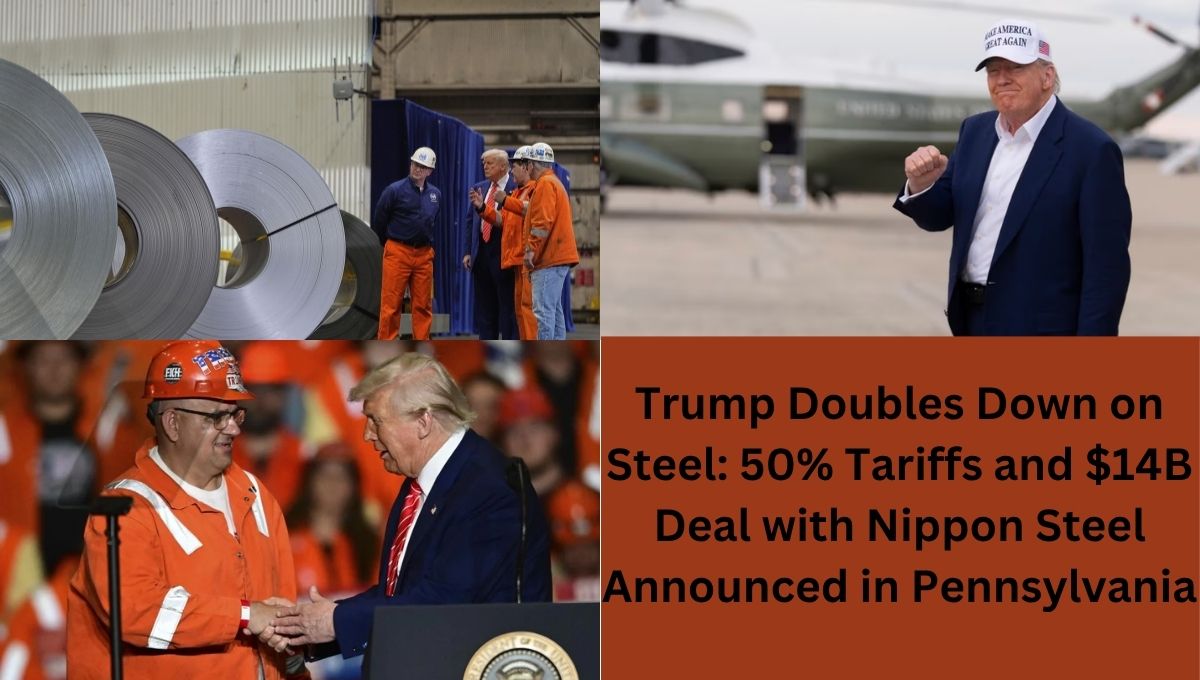
In a move to revive the American steel industry Trump Doubles Down on Steel: 50% Tariffs and $14B Deal with Nippon Steel Announced in Pennsylvania. In a fiery rally in Mon Valley, Pennsylvania, President Donald Trump made headlines by announcing the doubling of tariffs on steel and aluminium imports from 25% to 50%.
This bold move, effective Wednesday, June 4, is part of Trump’s renewed effort to revive the American steel industry and position himself as the champion of blue-collar workers in the Rust Belt. “We’re going to bring it from 25 percent to 50 percent,” Trump told a crowd of thousands, mostly steelworkers. “Nobody’s going to get around that.”
This announcement comes amid growing global concerns over trade tensions and is likely to have major implications for global steel exporters like China, India, and even close allies such as Canada and Mexico.
Trump Doubles Down on Steel: 50% Tariffs and $14B Deal with Nippon Steel Announced in Pennsylvania
Reviving the Rust Belt: Trump’s Appeal to Working-Class Voters
Trump’s rally served as both a policy declaration and a campaign-style event. With Pennsylvania being a key swing state that helped secure his second term in 2024, the former president is now doubling down on protectionist economic policies that resonate deeply with industrial communities.
The Mon Valley, once the heart of American steel production, has seen a gradual decline in recent decades. Trump reminded the crowd of past job losses and emphasized his earlier successes in preventing plant closures.
“By the time I came into office, many feared that the Mon Valley would lose up to 3,000 steel jobs,” he said. “But I kept that promise.”
His message was clear: America First is back and stronger than ever.
$14 Billion Partnership: US Steel and Nippon Steel Join Forces
In a surprising pivot, Trump endorsed a revised $14 billion partnership between US Steel and Japan’s Nippon Steel. Just last year, he had strongly opposed a proposed $14.9 billion full acquisition of US Steel by Nippon, labeling it a “terrible deal.” President Joe Biden had also blocked the sale on national security grounds.
Now, Trump is backing what he calls a “controlled partnership” that includes:
- A $14 billion investment over 14 months
- $2.2 billion targeted specifically at the Mon Valley
- $7 billion for plant upgrades in Indiana, Minnesota, Alabama, and Arkansas
- A 10-year job guarantee
- US board representation and a government veto on production cuts
“This is a blockbuster agreement that ensures this storied American company stays an American company,” Trump declared.
Union Reactions: Skepticism Over Foreign Ownership
While the announcement drew cheers from many in the audience, labor unions remain cautious. The United Steelworkers (USW) union, which represents thousands of workers at US Steel, expressed concern about whether the partnership truly differs from a full buyout.
“We’ve seen nothing in the reporting suggesting that Nippon has walked back from its position of full ownership,” USW stated.
Mayor JoJo Burgess of nearby Washington, Pennsylvania, who is also a longtime union member, voiced “cautious optimism,” adding, “I’m never going to disagree with something that levels the playing field for American manufacturing.”
India, China, and Global Exporters Brace for Impact
The new Trump steel tariffs are expected to reverberate across global markets. India, which exported over $4.56 billion in iron, steel, and aluminium products to the US in FY2024-25, will be particularly affected.
According to the Global Trade Research Initiative (GTRI), the tariff hike could slash profit margins for Indian exports such as:
- $3.1 billion in iron and steel articles
- $860 million in aluminium products
Ajay Srivastava, GTRI co-founder, warned that India might retaliate: “India has already notified the World Trade Organization (WTO) of its intent to impose reciprocal tariffs on US goods.”
China also came under fire, with Trump accusing the country of “totally violating” a recent trade agreement. He did not elaborate on the alleged breach but claimed it justified the latest round of tariffs.
Tariffs as a Trade Weapon: Strategic Leverage or Economic Risk?
Trump has long used tariffs as a tool of economic leverage, both during his first term and now in his second. The 50% steel import tariff is the latest escalation in a broader strategy aimed at reducing America’s dependence on foreign manufacturing.
“If you don’t have steel, you don’t have a country,” Trump repeated a familiar refrain from his earlier presidency when he imposed the initial 25% tariff under Section 232 of the Trade Expansion Act of 1962.
But critics argue that such protectionist policies can backfire. Rachel Ziemba of the Center for a New American Security warned, “Hiking the steel tariffs may be good for steel workers, but it is bad for manufacturing and the energy sector.”
The previous round of tariffs sparked trade wars and retaliatory measures that hurt American farmers and manufacturers reliant on imported steel and aluminium.
Legal Challenges and Political Implications
Trump’s aggressive tariff strategies have already sparked a series of legal challenges. A federal court recently ruled that he had improperly used emergency powers to impose tariffs but an appeals court has temporarily stayed that decision.
Politically, the move distinguishes Trump from President Biden, who has largely favored multilateral trade diplomacy over unilateral tariffs. By doubling tariffs and endorsing a massive steel deal, Trump is making economic nationalism a central pillar of his legacy and his party’s strategy heading into the 2026 congressional elections.
Markets React and Approval Still Pending
Following Trump’s endorsement of the US Steel-Nippon partnership, US Steel shares surged by over 20%, signaling investor optimism. However, the deal still awaits final approval from the Committee on Foreign Investment in the United States (CFIUS).
“I have to approve the final deal with Nippon, and we haven’t seen that final deal yet,” Trump admitted. Japanese officials, too, were cautious, noting there has been no formal approval from the U.S. side yet.
Conclusion: A Bold Gamble on American Industry
With the announcement of 50% steel and aluminium tariffs and support for a $14 billion investment from Nippon Steel, Trump is staking his second term on a bold economic gamble. While the short-term political benefits are clear rallying Rust Belt support and asserting U.S. control over key industries the long-term impact on global trade and economic stability remains uncertain.
Still, Trump’s message is unambiguous: American steel is once again at the heart of his political and economic vision.
Also Read: Trump Doubles Metal Tariffs to 50% India Faces Trade Setback as UK Secures Exemption
Also Read: Nippon finalizes $14B US Steel takeover