
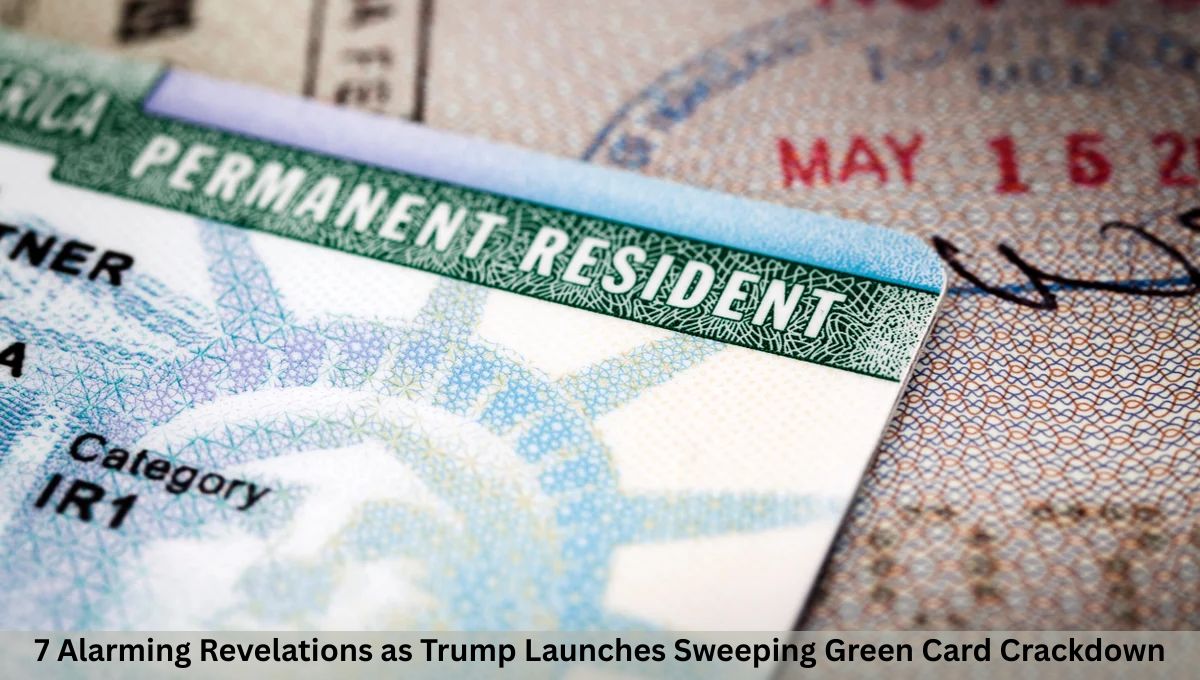
7 Alarming Revelations as Trump Launches Sweeping Green Card Crackdown following the shooting of two National Guard members by an Afghan national in Washington, DC. In one of the most sweeping immigration actions of his presidency, US President Donald Trump has ordered a full national-security review of all Green Card holders from 19 “countries of concern” following the shooting of two National Guard members near the White House in Washington, DC.
The incident, carried out by 29-year-old Afghan national Rahmanullah Lakanwal, has not only shaken the nation on the eve of Thanksgiving but has also spurred the Trump administration into announcing an expansive and immediate overhaul of immigration vetting procedures.
The move represents a dramatic escalation in Trump’s long-running campaign to reshape legal and illegal immigration systems, and marks a major shift in how the United States treats permanent residents, asylum seekers, refugees, and foreign nationals from countries deemed high-risk.
Below is a detailed breakdown of what happened, what the new policy means, who is affected, and why the administration insists the move is necessary.

7 Alarming Revelations as Trump Launches Sweeping Green Card Crackdown
The Triggering Incident — National Guard Members Shot Near White House
On the afternoon of November 26, just blocks from the White House, chaos erupted when an assailant opened fire on two National Guard members near the Farragut West Metro entrance. The attack occurred at approximately 2 pm at 17th and I Streets NW, a busy area filled with commuters and government workers preparing for the Thanksgiving holiday.
Who Was the Suspect?
The shooter was identified as Rahmanullah Lakanwal, a 29-year-old Afghan national who had travelled nearly 3,000 miles across the country from Bellingham, Washington, before allegedly carrying out the attack. Federal investigators believe he acted alone.
The Victims
The attack left two members of the National Guard gravely injured:
- US Army Specialist Sarah Beckstrom (20) – later died from gunshot wounds
- US Air Force Staff Sergeant Andrew Wolfe (24) – remains in critical condition
A National Guard major, armed only with a pocket knife, managed to subdue the attacker before more people were harmed.
How the Afghan Suspect Entered the US
Lakanwal entered the United States in 2021 through Operation Allies Welcome, a Biden administration program that resettled tens of thousands of Afghans in the rushed aftermath of the US withdrawal from Afghanistan. His asylum claim was approved after Trump took office, adding another layer of political complexity to the case.
The Trump administration argues that:
- The Biden-era vetting system was “reckless and insufficient.”
- Thousands of Afghans were admitted “without proper security screening.”
- The National Guard attack is evidence of systemic failures in prior vetting processes.
Immediate Federal Response — Green Card Crackdown
Just hours after the shooting, US Citizenship and Immigration Services (USCIS) Director Joseph Edlow announced sweeping new measures. At Trump’s direction, USCIS will conduct a:
“Full-scale, rigorous re-examination of every Green Card for every alien from every country of concern.”
This marks one of the most aggressive administrative reviews of lawful permanent residents in modern US history.
The 19 Countries on the High-Risk List
These are the same 19 countries restricted in Trump’s June 2025 Presidential Proclamation 10949, which targeted nations considered security risks or lacking reliable identity-document systems.
Full List of Countries
- Afghanistan
- Burma (Myanmar)
- Burundi
- Chad
- Republic of the Congo
- Cuba
- Equatorial Guinea
- Eritrea
- Haiti
- Iran
- Laos
- Libya
- Sierra Leone
- Somalia
- Sudan
- Togo
- Turkmenistan
- Venezuela
- Yemen
These nations are now the focus of intensive immigration scrutiny, and Green Card holders from these countries are subject to immediate review.
Are Indian Green Card Holders Affected?
No. Indians are not affected by this crackdown.
India is not on the 19-country list, and no new restrictions have been proposed for Indian nationals. The policy specifically targets nations with:
- High security-risk profiles
- Weak document-verification systems
- Terrorist or extremist activity
- High visa overstay rates
As such, Indian immigrants in the US can remain unaffected by the newly announced review.
What the New USCIS Guidance Says
The updated USCIS policy introduces several new criteria for evaluating immigration applications and reviewing existing Green Cards.
Key Provisions of the New Guidance
- Country of origin can now be treated as a “strong adverse factor”
Officers may deny immigration benefits based solely on the applicant’s nationality if the country is on the high-risk list. - Stricter document verification
Officers must assess whether the applicant’s country can reliably issue secure identity documents or verify background checks. - Expanded screening protocols
Applicants may undergo additional security interviews, biometric checks, and inter-agency vetting. - Immediate applicability
The new rules apply to all pending and future requests filed on or after November 27, 2025. - Enhanced enforcement of PP 10949
This proclamation restricts entry for foreign nationals considered national-security threats.
“Permanently Pause Migration” — Trump’s Most Controversial Announcement Yet
In a highly charged Thanksgiving message on Truth Social, Trump declared that he intends to:
“Permanently pause migration from all Third World Countries.”
This is one of the toughest immigration proposals ever publicly articulated by a US president.
Trump argued that:
- America’s social and economic systems need time “to recover.”
- The country has absorbed “millions of Biden illegal admissions.”
- Federal benefits for non-citizens should be terminated.
- Migrants who “undermine domestic tranquility” should be denaturalized.
- Only “reverse migration” can fix the current crisis.
The term “reverse migration” refers to policies encouraging or compelling foreign nationals to leave the US, particularly those deemed security risks, public charges, or ideologically incompatible with “Western Civilization.”
Suspension of Afghan Immigration Processing
Shortly after the shooting, USCIS halted all immigration processing for Afghans, pending a fresh review of vetting procedures.
This includes:
- Asylum cases
- Humanitarian parole requests
- Refugee admissions
- Pending Green Card and work-permit applications
The administration blamed the prior government for allegedly allowing tens of thousands of Afghans into the US “unvetted and unchecked.”
Visa Revocations Surge Under Trump’s New Crackdown
Another detail buried in DHS briefings is that the Trump administration has recently revoked around 80,000 non-immigrant visas since taking office in January.
Reasons include:
- 16,000+ for DUI
- 12,000 for assault
- ~8,000 for theft
- Over 40,000 for other criminal or administrative violations
This is part of a broader push to tighten social-media vetting, re-evaluate visa holders, and remove individuals considered “non-compatible with Western Civilization,” as stated in Trump’s declaration.
Why the Administration Insists the Green Card Review Is Necessary
USCIS Director Joseph Edlow emphasized that:
“American lives come first.”
The administration argues that:
- National-security threats have increased
- Vetting under the previous administration was “dismantled” or weakened
- Rapid resettlement programs admitted high-risk individuals
- Certain countries cannot verify documents reliably
- Illicit entries, overstays, and asylum abuse have surged
Edlow insists that the Green Card is a privilege, not a right, and must be re-evaluated if national-security risks emerge.
Critics Warn of Legal and Human Implications
Civil rights groups and legal analysts have raised concerns about:
- Targeting of specific nationalities, which may invite discrimination lawsuits
- Retroactive reviews of Green Cards, which are rare
- Uncertainty for long-term residents, including people who have lived in the US for decades
- Reduced due-process protections in immigration systems
- Potential for mass deportations
Advocates argue that punishing entire national groups based on isolated incidents undermines principles of fairness and proportionality.
The Political Context — Immigration as Trump’s Signature Agenda
The crackdown aligns with Trump’s broader immigration doctrine, which includes:
- Total overhaul of asylum systems
- Expansion of detention facilities
- Nationwide deportations
- Suspension of refugee admissions
- Implementation of ideological screening
- Tightened criteria for citizenship and naturalization
For Trump, the National Guard shooting underscores what he calls the “greatest national security threat” facing the United States: unchecked migration from high-risk regions.
What Happens Next?
The immediate steps underway include:
- Re-examination of all Green Cards from 19 nations
- Suspension of Afghan immigration requests
- Expansion of security vetting for asylum, refugee, and visa applicants
- Potential legislative proposals to pause migration from entire world regions
- Aggressive visa cancellation efforts
- Deployment of federal agencies to reassess security risks among foreign nationals
More announcements are expected in the coming weeks as the administration finalizes its immigration overhaul.
Conclusion
The National Guard shooting has set off a dramatic chain reaction in Washington, propelling the Trump administration into one of its most sweeping immigration crackdowns to date. With Green Card holders from 19 countries now under review, Afghan immigration suspended, vetting standards intensified, and Trump calling for a permanent pause on migration from “Third World countries,” the nation is entering a new phase of immigration policy — one defined by security-first decision making and radical restructuring of traditional pathways to permanent residence.
For now, the administration insists that these measures are necessary to prevent further tragedies and to restore what it sees as order within the immigration system. Critics warn of fear, uncertainty, and overreach. The political battlelines are already visible, and the national debate over security, migration, and identity is poised to grow sharper in the days ahead.
Also Read: Trump launches massive review of immigration cases including Green Card holders of 19 countries


