In an aggressive and controversial move, Trump Doubles Maduro Bounty to $50 Million Amid Drug Trafficking Charges. The United States has doubled the bounty for the capture of Venezuelan President Nicolás Maduro to a record-breaking $50 million. The announcement, made by Attorney General Pam Bondi on behalf of the Trump administration, accuses Maduro of being “one of the largest narco-traffickers in the world.”
This increase marks one of the most severe actions the U.S. has ever taken against a sitting foreign leader, equaling the once-record bounty placed on Osama bin Laden.
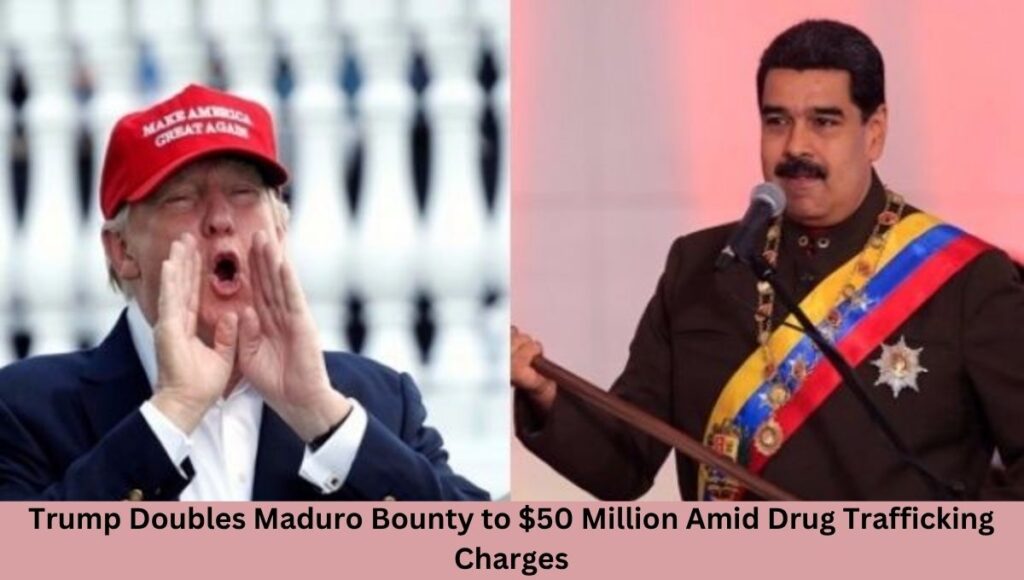
Trump Doubles Maduro Bounty to $50 Million Amid Drug Trafficking Charges
Why Has the U.S. Doubled the Reward Now?
Pam Bondi’s video statement, posted on X (formerly Twitter), stated that Maduro has collaborated with international drug cartels, including Tren de Aragua, the Cartel de Los Soles, and Mexico’s Sinaloa Cartel, to flood the U.S. with fentanyl-laced cocaine.
“He is one of the largest narco-traffickers in the world and a threat to our national security,” said Bondi. “Therefore, we doubled his reward to $50 million.”
According to Bondi, the Drug Enforcement Administration (DEA) has linked over 30 tons of cocaine to Maduro’s network, with nearly 7 tons directly connected to the Venezuelan president.
Additionally, more than $700 million in assets including private jets and vehicles have been seized.
A Timeline of Allegations Against Nicolás Maduro
This is not the first time Maduro has been the target of U.S. legal action. In March 2020, under the Trump administration, he was indicted on charges including narco-terrorism, corruption, and conspiracy to import cocaine into the United States.
At that time, the State Department placed a $15 million reward on him. That bounty increased to $25 million during the Biden administration in early 2025, following Maduro’s controversial re-election for a third term.
Now, with Trump reasserting influence on U.S. foreign policy, the bounty has soared to $50 million.
Venezuela Responds: “A Ridiculous Smokescreen”
Venezuelan officials were quick to dismiss the bounty hike. Foreign Minister Yvan Gil called it:
“The most ridiculous smokescreen we have ever seen… A crude political propaganda operation.”
Gil suggested that the timing of the announcement is intended to distract from U.S. domestic issues, including the Jeffrey Epstein investigation and allegations against Pam Bondi herself.
He reiterated that Venezuela “will not be intimidated,” declaring, “The dignity of our homeland is not for sale.”
Who Is Nicolás Maduro?
Nicolás Maduro has been president of Venezuela since 2013, succeeding the late Hugo Chávez. His regime has been marked by:
- Widespread allegations of election fraud
- Authoritarian rule
- Economic collapse and humanitarian crisis
Despite increasing international sanctions and condemnation, Maduro has retained power through tight control over the military, judiciary, and state-run media.
The 2024 Venezuelan presidential election was declared a “sham” by the United States, the European Union, and several Latin American nations.
The Hugo Carvajal Factor: A Legal Turning Point
Adding further weight to the U.S. decision was the recent guilty plea of Hugo “El Pollo” Carvajal, Venezuela’s former military intelligence chief.
In June 2025, Carvajal pleaded guilty in a U.S. federal court to drug trafficking and narco-terrorism charges.
Once a key Maduro ally, Carvajal’s cooperation with U.S. authorities is believed to have opened new avenues of investigation and possibly led to the increased bounty.
Narco-Terrorism and the Cartel Connection
Attorney General Bondi pointed to Maduro’s deep ties with Tren de Aragua, Cartel de Los Soles, and Sinaloa Cartel.
These groups are accused of using Venezuela as a hub to smuggle fentanyl-laced cocaine into the U.S., further worsening the opioid crisis.
The Cartel de Los Soles, allegedly run by Venezuelan military officials, has been linked to money laundering and trafficking operations stretching across Latin America.
In February 2025, the U.S. designated Tren de Aragua as a foreign terrorist organization, placing it alongside MS-13 and other notorious criminal networks.
By July, Cartel de Los Soles received the same designation.
Social Media Reaction: Sarcasm and Skepticism
News of the $50 million bounty triggered a wave of reactions online many laced with sarcasm.
A popular phrase trending on X was:
“He’s in Venezuela. Where’s my $50 million?”
Right-wing commentator Laura Loomer mocked the announcement, joking that she had “won” the bounty by pointing out Maduro’s obvious location in Miraflores Palace, the presidential residence in Caracas.
The backlash underscored public skepticism toward the practicality of the reward especially given Maduro’s status as a sitting head of state and the lack of direct legal pathways for enforcement.
Diplomatic Contradictions: Deals Despite Accusations
Despite this tough talk, U.S.–Venezuela relations remain entangled in strategic negotiations.
In July 2025, the Trump administration struck a prisoner swap deal, securing the release of 10 jailed Americans in exchange for deported migrants being returned to Venezuela.
Even more strikingly, the White House recently eased sanctions on Chevron, allowing the U.S. oil giant to resume operations in Venezuela.
This move was criticized as contradictory, especially as Washington continues to portray Maduro as a narco-terrorist.
Can Maduro Actually Be Captured?
While the reward may sound dramatic, the likelihood of Maduro’s capture remains extremely low. He remains shielded by:
- A loyal security apparatus
- Support from countries like Russia, China, and Iran
- Limited cooperation from international law enforcement agencies like Interpol
Legal experts suggest the bounty is largely symbolic, intended more to send a message than to facilitate a real arrest.
Is This About U.S. Politics?
Some analysts argue that the bounty increase is as much about domestic U.S. politics as it is about international law. By doubling down on Maduro, Trump may be:
- Appealing to conservative voters
- Demonstrating a hardline stance on drugs and crime
- Deflecting from other controversies, such as his own legal battles
However, critics warn that such moves could undermine diplomacy and further isolate Venezuela, potentially deepening the country’s ongoing humanitarian crisis.
Conclusion: Rhetoric vs. Reality
The doubling of the reward for Nicolás Maduro’s arrest may be the boldest move yet in the U.S.’s long-running standoff with Venezuela. Framed as a battle against narco-terrorism, the action reflects a growing concern over fentanyl trafficking and transnational crime.
Yet, with no clear path to extradition or arrest, and with Maduro still firmly in power, the bounty is likely to remain a political signal rather than a practical solution. As both sides continue their war of words, the lives of ordinary Venezuelans remain caught in the crossfire of international posturing, economic hardship, and political gridlock.
Also Read: Trump Signs Secret Order Targeting Latin American Drug Cartels
Related Posts:
- Shocking Claim: Trump Warned About Bin Laden Before 9/11

- Trump’s Explosive Truth Social Post Sparks…

- 12 Shocking Reasons Behind Trump’s Explosive Firing…
- 9 Explosive Revelations as Trump Declares His Health…
- 7 Shocking Reasons FIFA’s Peace Prize for Trump…

- Trump to Host 2026 G20 Summit at His Florida Golf…