11 Punitive Shockwaves from Trump’s Cuba Oil Tariff Threat amid backlash from Venezuela, Cuba and Mexico. US President Donald Trump’s decision to threaten tariffs on any country supplying oil to Cuba has ignited a new geopolitical crisis with global implications.
Framed by the White House as a national security measure, the move has been denounced by Cuba, Venezuela and Mexico as punitive, coercive and potentially catastrophic for an island already facing its worst economic crisis in decades.
By declaring a “national emergency” and authorising tariffs on third countries trading oil with Havana, Trump has effectively weaponised US trade policy to isolate Cuba further. The announcement immediately rattled governments, energy markets and ordinary Cubans, many of whom rushed to fuel stations amid fears of even longer blackouts.
What distinguishes this escalation from previous US sanctions is its extraterritorial reach. Rather than targeting Cuba alone, Washington is now threatening to punish other sovereign nations for maintaining commercial ties with the island.
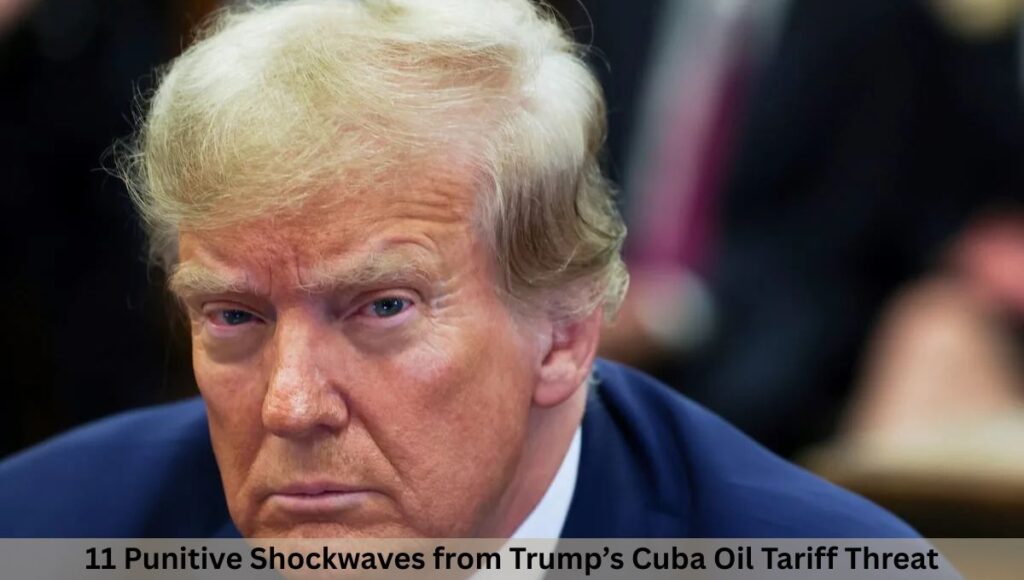
11 Punitive Shockwaves from Trump’s Cuba Oil Tariff Threat
Venezuela Condemns ‘Punitive’ Measures
Venezuela was among the first to respond. In a sharply worded statement, its foreign ministry condemned Trump’s order as “punitive” and warned it would have serious humanitarian consequences for the Cuban people.
Caracas accused Washington of punishing countries engaged in legitimate trade and expressed solidarity with Havana.
“Free trade is a core principle of international economic relations between sovereign states and cannot be subject to coercion,” the statement said, calling on the international community to oppose what it described as aggressive US measures.
The condemnation is particularly striking given Venezuela’s own precarious position. Until recently, Caracas supplied more than one-third of Cuba’s oil needs, forming a vital lifeline for the island’s power generation and transport sectors.
Cuba Reacts: ‘Attempt to Suffocate Our Economy’
In Havana, the reaction was immediate and visceral. Long queues formed at petrol stations within hours of Trump’s announcement, as residents scrambled to secure fuel amid fears of worsening shortages.
Cuban President Miguel Díaz-Canel accused Trump of trying to “suffocate” the island’s economy under a false pretext.
Writing on social media, he said the threatened tariffs were designed to impose extreme living conditions on ordinary Cubans.
“This new measure reveals the fascist, criminal and genocidal nature of a clique that has hijacked the interests of the American people for personal gain,” Díaz-Canel said, echoing language used by senior Cuban officials.
Cuba’s foreign minister, Bruno Rodríguez, went further, denouncing the move as a “brutal act of aggression” and accusing Washington of blackmailing other countries into enforcing what would amount to a total fuel blockade.
A Nation Already on the Brink
Cuba is currently grappling with rolling power outages lasting up to 20 hours a day, severe shortages of food and medicine, and an accelerating exodus of citizens seeking better lives abroad.
Government officials blame the long-standing US embargo for crippling the energy sector, while critics also point to years of underinvestment and mismanagement.
Regardless of the cause, the reality on the ground is stark.
Entire neighbourhoods of Havana are plunged into darkness each night. Traffic lights frequently fail at major intersections.
State-run radio and television stations have been forced to suspend broadcasts due to a lack of electricity and fuel for generators.
The threatened tariffs risk pushing an already fragile system toward collapse.
Mexico Caught in a Diplomatic Bind
No country illustrates the dilemma created by Trump’s order more clearly than Mexico.
As both a major US trading partner and one of Cuba’s last remaining oil suppliers, Mexico finds itself walking a diplomatic tightrope.
In 2025, Mexican shipments accounted for roughly 44% of Cuba’s foreign oil supply.
Mexican President Claudia Sheinbaum warned that cutting off oil exports could trigger a “far-reaching humanitarian crisis” affecting hospitals, food supply and essential services.
Yet she stopped short of saying whether Mexico would halt shipments.
“Of course, we don’t want to risk further tariffs on Mexico,” Sheinbaum said, “but through diplomatic channels, we seek dialogue that prevents a serious situation for the Cuban people.”
She reiterated that oil exports are a “sovereign decision” made by state-owned energy firm Pemex, even as Mexico’s economy remains deeply dependent on access to the US market.
Inside Trump’s Executive Order
Trump signed the executive order on Thursday, formally declaring a national emergency over what he described as Cuba’s “unusual and extraordinary threat” to US national security and foreign policy.
The order authorises the Secretaries of State and Commerce to determine which countries are supplying oil to Cuba and to recommend tariffs on their exports to the United States.
The president retains final authority over whether and how such tariffs are imposed.
The document accuses the Cuban government of aligning with “hostile countries and malign actors,” including Russia, China and Iran, and claims Havana hosts foreign military and intelligence facilities.
It also alleges that Cuba provides safe haven to militant groups such as Hezbollah and Hamas—claims the Cuban government vehemently denies.
Marco Rubio and the Push for Regime Change
Within Trump’s cabinet, Secretary of State Marco Rubio has emerged as a key architect of the hardline approach toward Cuba.
The son of Cuban immigrants, Rubio rose politically within Miami’s exile community, where memories of the revolution and hostility toward the Havana government remain deeply ingrained.
He has long advocated regime change and tougher sanctions.
Critics argue that Rubio’s influence has driven policy decisions that prioritise ideological goals over humanitarian consequences. Supporters counter that pressure is necessary to force political reform.
Venezuela’s Collapse and Its Ripple Effects
Cuba’s energy crisis has been exacerbated by recent events in Venezuela. Earlier this month, the US military captured Venezuelan leader Nicolás Maduro in a dramatic operation that Washington described as restoring democracy.
Trump subsequently announced that the US would take control of Venezuela’s oil reserves, effectively cutting off supplies to allies such as Cuba.
While Delcy Rodríguez now serves as acting president, analysts question how much autonomy Caracas retains under US pressure.
Although she has complied with several Washington demands, Venezuela has still joined Cuba in condemning the tariff threat.
Humanitarian Concerns Take Centre Stage
Across Latin America and beyond, humanitarian organisations have expressed alarm at the potential consequences of a fuel blockade.
Oil is critical not just for transportation and electricity, but also for water treatment, agriculture and healthcare.
Cuban state media warned that Trump’s order could paralyse electricity generation, disrupt food production and cripple hospitals.
“What is the goal? A genocide of the Cuban people,” a government statement asked during a nightly television broadcast.
Such language underscores the depth of fear within Cuban society as memories of past crises resurface.
International Law and Extraterritorial Sanctions
Legal experts argue that threatening tariffs on third countries raises serious questions under international trade law.
By punishing states for lawful commerce with Cuba, the US risks violating World Trade Organization principles and bilateral trade agreements.
Venezuela has explicitly framed the measure as a breach of international law.
Similar extraterritorial sanctions in the past have strained US relations with allies, particularly in Europe. Whether Washington is prepared for a broader trade backlash remains unclear.
Global South Pushback—or Silence
While China has called for the immediate lifting of sanctions on Cuba and pledged continued support, much of the Global South has responded cautiously.
Some governments have issued statements of solidarity, but few have committed to concrete action. Analysts say this reflects both economic vulnerability and fear of US retaliation.
For Cuba, the lack of decisive international backing reinforces a sense of isolation at a moment of acute crisis.
Trump’s Calculus: Pressure as Policy
Defending the order, Trump has insisted he is not trying to “choke off” Cuba’s economy, describing the island as a failing state whose government mistreats its people.
Commerce Secretary Howard Lutnick framed the move as ensuring US foreign policy is respected by allies. “The president wants to make clear what our allies and friends should do,” he said.
Yet critics argue that decades of pressure have failed to produce regime change, instead entrenching hardship for ordinary Cubans.
Economic Fallout Beyond Cuba
The threatened tariffs could reverberate far beyond the Caribbean.
For Mexico, even limited US trade penalties would have significant economic consequences. For energy markets, disruption of regional oil flows could add volatility at a time of global uncertainty.
Shipping insurers, commodity traders and multinational firms are already assessing potential exposure if the policy is enforced.
Lives in the Balance
For many Cubans, the debate over tariffs and geopolitics feels distant from daily realities defined by blackouts, empty shelves and endless queues.
Stories of families cooking by candlelight and hospitals rationing power have become commonplace. Any further reduction in fuel supplies threatens to deepen human suffering.
As one Havana resident put it:
“We are tired of being the battlefield for other countries’ politics.”
Can Diplomacy Still Work?
Mexico has said it will seek clarification from Washington and explore alternative ways to assist Cuba. Other regional actors, including Turkey and Qatar, have previously offered mediation in related disputes.
Whether such efforts can soften Trump’s stance remains uncertain. The executive order allows for modification if Cuba or affected countries take steps aligned with US objectives—but Havana shows no sign of compliance.
A Test for the International Order
At its core, Trump’s tariff threat represents a broader challenge to the global trading system.
If major powers increasingly use trade as a coercive weapon against third parties, smaller states may find their sovereignty eroded. The Cuba case could set a precedent with implications far beyond the island.
Conclusion: A Crisis With No Easy Exit
Trump’s threat to impose tariffs on countries supplying oil to Cuba has intensified an already volatile situation. For Cuba, it raises the spectre of deeper humanitarian disaster.
For Mexico and Venezuela, it creates impossible choices between economic survival and regional solidarity.
For the wider world, it is a reminder of how quickly unilateral decisions by powerful states can ripple across borders, markets and lives.
As fuel lines lengthen in Havana and diplomats scramble behind the scenes, one question looms large:
will pressure finally force change—or will it simply harden suffering and division in a world already stretched to breaking point?
Also Read: 7 Explosive Warnings: Trump Threatens Colombia as Cuba ‘Looks Ready to Fall’
Also Read: Trump Is Now Threatening Tariffs On Nations Selling Oil To Cuba. Here’s Why