

11 Explosive Revelations From Ted Cruz’s Leaked Audio on Trump, Vance and India Trade deal. Leaked audio recordings of US Senator Ted Cruz have opened an unusually candid window into the internal conflicts, ideological rifts, and power struggles inside President Donald Trump’s administration, revealing sharp disagreements over tariffs, foreign policy, and a stalled trade deal with India.
The recordings, first reported by Axios and obtained from a Republican source, capture nearly ten minutes of Cruz speaking privately to donors in early and mid-2025. In them, the Texas Republican sharply criticises Trump’s tariff-driven trade strategy, accuses Vice President JD Vance and White House trade adviser Peter Navarro of blocking an India–US trade deal, and portrays himself as a traditional free-trade, pro-intervention Republican preparing for a possible 2028 presidential run.
Together, the recordings provide one of the most detailed behind-the-scenes accounts yet of how deeply divided the Republican Party has become under Trump’s second term — and how those divisions could affect US economic policy, America’s relationship with India, and the political balance heading into the 2026 midterm elections and beyond.
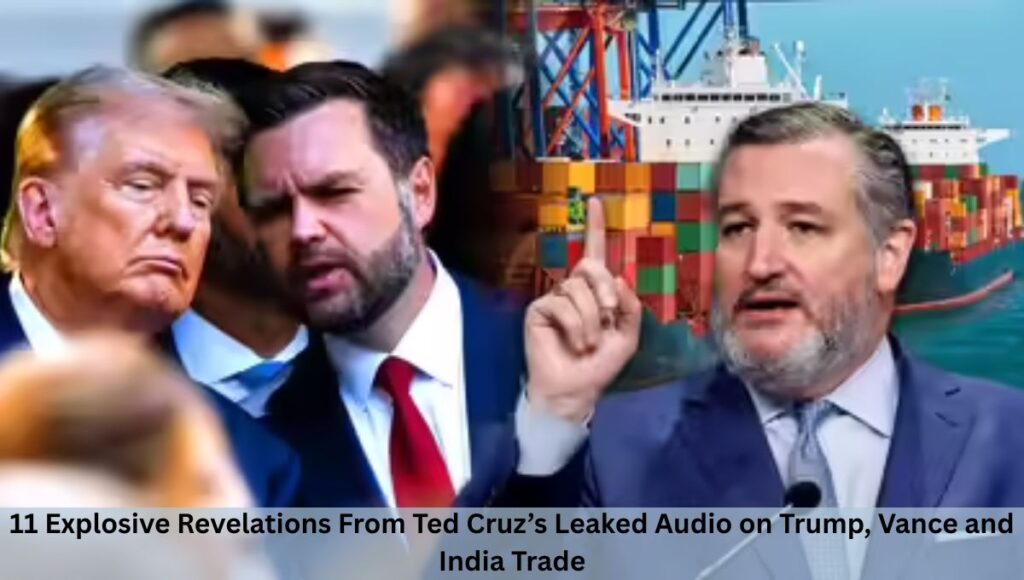
11 Explosive Revelations From Ted Cruz’s Leaked Audio on Trump, Vance and India Trade
A Rare Look Behind Closed Doors
Publicly, Ted Cruz has been one of President Trump’s most visible allies in the Senate. Privately, the leaked audio suggests a far more complicated relationship.
Speaking to wealthy donors, Cruz appears unfiltered and strategic, openly questioning Trump’s economic judgment, mocking White House messaging, and positioning himself as an alternative pole of Republican leadership.
A spokesperson for Cruz later insisted that the senator remains “the president’s greatest ally in the Senate,” dismissing reports of internal conflict as an attempt to sow division.
Yet the recordings themselves tell a more nuanced story — one of a senior Republican figure frustrated by the administration’s direction and increasingly willing to voice that frustration behind closed doors.
Cruz vs Trump’s Tariff Strategy
A Dire Economic Warning
At the center of Cruz’s criticism is Trump’s aggressive tariff policy, particularly the sweeping measures announced in early April 2025 and branded by the White House as “Liberation Day.”
In the recordings, Cruz ridicules the branding and describes tariffs as an economic gamble that could devastate American households.
According to Axios, Cruz recounts a late-night call with Trump shortly after the tariffs were announced. On the call were Cruz and several other Republican senators attempting to persuade the president to reconsider.
“That call did not go well,” Cruz told donors.
He described Trump as “yelling” and “cursing,” adding, “Trump was in a bad mood. I’ve been in conversations where he was very happy. This was not one of them.”
Cruz said he warned Trump that tariffs could lead to falling retirement savings and rising food prices — a politically lethal combination.
“Mr President, if we get to November of 2026 and people’s 401(k)s are down 30 percent and prices are up 10 to 20 percent at the supermarket, we’re going to go into Election Day, face a bloodbath,” Cruz said.
According to Cruz, Trump’s response was blunt:
“F**k you, Ted.”
Fear of a 2026 ‘Bloodbath’
Cruz’s warning went beyond economic anxiety. He framed tariffs as an existential threat to Republican control of Congress.
“You’re going to lose the House, you’re going to lose the Senate,” Cruz recalled telling Trump. “You’re going to spend the next two years being impeached every single week.”
The remark underscores growing Republican fears that tariff-driven inflation and market instability could hand Democrats a decisive advantage in the 2026 midterm elections.
Several prominent Republicans, according to the recordings and subsequent reporting, privately share Cruz’s concern — even if few are willing to voice it publicly.
Mocking ‘Liberation Day’
Cruz also mocked the administration’s messaging around tariffs.
When a donor referenced Trump’s “Liberation Day” slogan for the tariff rollout, Cruz joked that he had issued an internal directive to his staff.
“I’ve told my team if anyone uses those words, they will be terminated on the spot,” Cruz said. “That is not language we use.”
The remark highlights the gulf between Trump’s populist rhetoric and Cruz’s more traditional conservative framing of trade policy.
India–US Trade Deal: ‘Battling the White House’
Cruz’s Big Claim
One of the most consequential revelations in the leaked audio concerns the stalled India–US trade deal.
Cruz told donors that he has been “battling” the White House to move the agreement forward — and directly blamed specific figures for blocking it.
When asked who was resisting the deal, Cruz named:
- White House trade adviser Peter Navarro
- Vice President JD Vance
- And, “sometimes,” President Trump himself
The claim has drawn particular attention in India, where negotiations with Washington have dragged on for months amid escalating tariff tensions.
Why the India Deal Matters
Trade talks between India and the United States gained urgency after Trump imposed an additional 25 percent tariff on Indian goods for India’s continued oil trade with Russia — taking total duties to 50 percent.
Despite at least six rounds of negotiations, the deal remains unresolved.
For Cruz, the failure to close an agreement with India is not just an economic issue but a strategic one.
He has long argued that India and the United States are “natural allies,” both economically and geopolitically, especially as a counterweight to China.
During a 2019 visit to India, Cruz praised New Delhi as:
“The largest democracy on the face of the earth… a critically important partner in countering China’s aggression.”
The leaked audio suggests Cruz sees the stalled trade deal as a missed opportunity — and as evidence of deeper dysfunction within the Trump administration.
Peter Navarro, a longtime advocate of protectionism and tariffs, emerges in the recordings as a central obstacle to trade liberalisation.
Navarro has been a key architect of Trump’s tariff policy since the president’s first term, consistently arguing that tariffs are necessary to protect American manufacturing and reduce trade deficits.
Cruz’s criticism reflects a broader ideological divide within the Republican Party: free-trade conservatives versus economic nationalists.
For Cruz and his allies, blocking a deal with India — a democratic partner and major emerging market — represents a strategic miscalculation driven by ideological rigidity.
JD Vance: A Central Target
‘Tucker Created JD’
Cruz’s sharpest personal criticism in the recordings is reserved for Vice President JD Vance.
Cruz repeatedly portrays Vance as politically inseparable from conservative commentator Tucker Carlson.
“Tucker created JD,” Cruz said. “JD is Tucker’s protégé, and they are one and the same.”
The remark reflects Cruz’s long-running feud with Carlson, whom he has accused of promoting antisemitism and an anti-interventionist foreign policy.
While Cruz has publicly criticised Carlson, the recordings show him privately drawing a much tighter link between Carlson and the sitting vice president than he has been willing to make in public.
Foreign Policy Fault Lines
Iran, Israel, and Intervention
The leaked audio also reveals intense disputes over foreign policy — particularly regarding Iran and Israel.
Cruz accused Vance and Carlson of orchestrating the removal of former national security adviser Mike Waltz, who supported a more aggressive stance toward Iran.
“Waltz supported being vigorous against Iran and bombing Iran — and Tucker and JD took Mike out,” Cruz said.
Cruz also alleged that Vance and Carlson backed the appointment of Army veteran Daniel Davis to a senior intelligence role, describing Davis as “a guy who viciously hates Israel.”
Davis was ultimately removed from the position shortly after his appointment.
Tucker Carlson denied involvement in either Waltz’s ouster or Davis’s appointment when contacted by Axios.
Cruz Positions Himself for 2028
Taken together, the recordings paint Cruz as a politician carefully positioning himself for the post-Trump Republican Party.
In donor meetings, he casts himself as:
- Pro-trade
- Pro-intervention
- Strongly pro-Israel
- Skeptical of economic nationalism
This positioning places him in implicit contrast with JD Vance, who is widely viewed as Trump’s ideological heir and a potential 2028 frontrunner.
Cruz’s criticisms suggest an early attempt to define the fault lines of the next Republican primary — one that pits traditional conservative internationalism against a more isolationist, populist vision.
A Party at War With Itself
From Free Trade to Tariffs
The Republican Party was once defined by its commitment to free markets and free trade. Trump’s rise has upended that consensus.
The leaked audio underscores how unresolved that transformation remains.
Cruz’s remarks echo concerns from other Republicans who fear that tariffs and economic nationalism could alienate business leaders, suburban voters, and key demographic groups — including Indian-Americans.
Indian-Americans and Texas Politics
Indian-Americans are a significant political constituency in Cruz’s home state of Texas.
According to AAPI data, more than 500,000 Indian-Americans live in Texas, making up roughly 2 percent of the state’s population.
Cruz’s longstanding advocacy for closer US–India ties has resonated with many in the community — making the stalled trade deal not just a foreign policy issue but a domestic political one.
White House Pushback
Cruz’s office moved quickly to downplay the significance of the leaked recordings.
A spokesperson described Cruz as a loyal ally of the president, saying his efforts were aimed at “fighting staffers who try to enter the administration despite disagreeing with the president and seeking to undermine his foreign policy.”
The statement dismissed attempts to highlight divisions as “pathetic and getting boring.”
The White House has not directly responded to Cruz’s allegations regarding the India trade deal.
What It Means for India–US Relations
The recordings suggest that internal US politics — not just technical trade disputes — are a major obstacle to finalising an India–US trade agreement.
They also highlight competing visions within the Trump administration:
- One that sees India as a strategic partner deserving of economic integration
- Another that prioritises tariffs and transactional leverage
For New Delhi, the revelations offer insight into why negotiations have stalled — and why progress may depend as much on US domestic politics as on bilateral diplomacy.
2026 and Beyond
Cruz’s warnings about a 2026 “bloodbath” reflect growing anxiety within Republican ranks.
If tariffs drive up prices and markets fall, the political consequences could be severe.
At the same time, the recordings suggest that the battle over the Republican Party’s future — its economic philosophy, foreign policy stance, and leadership — is already underway.
A Defining Moment
The leaked audio of Ted Cruz is more than a political scandal. It is a snapshot of a party in transition — and turmoil.
It reveals a Republican Party torn between loyalty to Donald Trump and fear of the consequences of his policies; between economic nationalism and free trade; between isolationism and intervention.
It also underscores how decisions made behind closed doors — about tariffs, trade with India, and foreign policy priorities — could shape not only the next election cycle, but the future of US global leadership.
As Cruz himself warned, the stakes are enormous — and the clock is already ticking.
Also Read: Donald Trump Alleges ‘Triple Sabotage’ at UN: Escalator Halt, Teleprompter Failure & Audio Blackout
Also Read: Who is blocking US-India trade deal? US Senator Ted Cruz’s Leaked Audio Revealed
Related Posts:
- Can the EU and NATO Impose Tariffs on India and…

- 5 Powerful Highlights as Trump Lands Second Nobel…

- Dramatic Moments Behind Trump’s Gaza Peace Push and…

- Trump Threatens Military Action in Nigeria Over…
- Trump’s 20-Point Gaza Peace Plan Gains Urgent Global…

- 7 Powerful Measures: Trump Sanctions Russian Oil…
