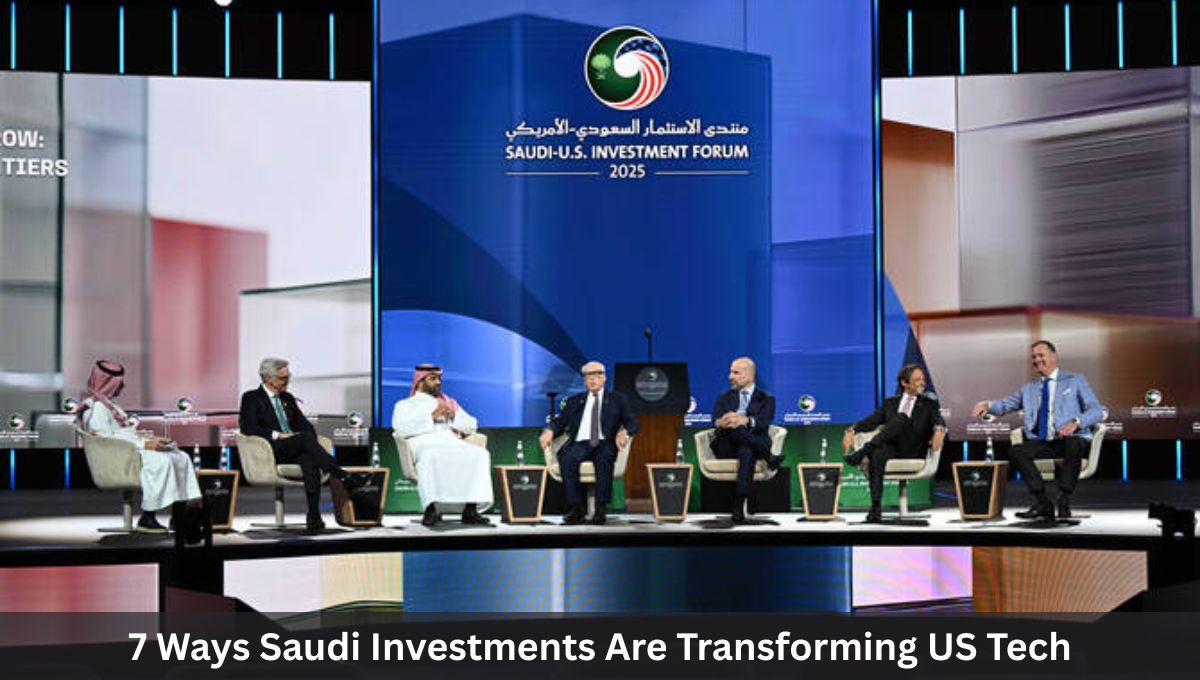
7 Ways Saudi Investments Are Transforming US Tech and boosting strategic cooperation. As Crown Prince Mohammed bin Salman prepares for his official visit to the White House on Tuesday, Saudi Arabia’s rapidly growing footprint in American technology has taken center stage.
No longer defined only by traditional oil or energy ties, Saudi–US relations are now being reshaped by bold, high-impact investments in electric vehicles, artificial intelligence, cloud computing, and data infrastructure.
What once began as targeted stakes in companies like Uber has evolved into a strategic ecosystem of investments—powered by the Public Investment Fund (PIF) and Vision 2030—that is shaping the next generation of innovation across both nations.
From Lucid Motors’ manufacturing expansion to the emergence of Riyadh as a global AI hub, the Kingdom is positioning itself as one of the most influential players in the world of advanced technology. Below are seven powerful ways Saudi investments are transforming American tech and accelerating a new era of partnership.
7 Ways Saudi Investments Are Transforming US Tech
1. PIF’s Strategic Investments Are Rewiring the US Innovation Landscape
Saudi Arabia’s Public Investment Fund—now one of the world’s most active sovereign wealth funds—has become a vital force in the global technology economy. While its early high-profile deal was a multibillion-dollar investment in Uber, PIF has since diversified into:
- Electric vehicles
- Artificial intelligence
- Agricultural tech
- Cloud computing
- Robotics
- Semiconductors
- Green energy technologies
These investments are not merely financial. They serve a dual purpose:
- Accelerating American tech innovation, particularly in EVs and AI
- Building a knowledge-based economy inside Saudi Arabia aligned with Vision 2030
This strategy is transforming economic ties into technology-focused partnerships that create jobs, transfer expertise, and embed Saudi Arabia deeper into the global tech ecosystem.
2. Lucid Motors: A Flagship of Saudi–US Collaboration
No company reflects the Saudi–American technology partnership more clearly than Lucid Motors, the California-based luxury EV manufacturer in which PIF holds a majority stake.
Saudi Arabia’s EV push accelerates Lucid’s growth
With PIF support, Lucid has opened its first international manufacturing plant in King Abdullah Economic City, marking one of the Kingdom’s most significant industrial technology achievements.
Faisal Sultan, President of Lucid Motors’ Middle East operations, said the collaboration is transforming the region’s EV landscape:
“A lot of progress has already been made with the formation of EVIC, the electric vehicle infrastructure company from PIF. We are collaborating closely to identify where consumers live and where infrastructure is needed.”
Expanding EV infrastructure across Saudi Arabia
Lucid and EVIC are rolling out home-charging solutions, public charging points, and hotel-based charging stations. Sultan noted that 22-kilowatt AC chargers have been installed at major hotels such as:
- Four Seasons
- Hilton
- Shangri-La
These chargers are free to use and compatible with all EV brands, removing key barriers to adoption.
Saudi demand for EVs is rising
Lucid is already selling thousands of vehicles in the Kingdom. The company showcased its latest models—including the Gravity seven-seater SUV—at the Riyadh EV AutoShow, signaling Saudi Arabia’s determination to lead the clean mobility transition.
These developments reinforce the goals of the Saudi Green Initiative, which aims for 30% of new cars sold in the Kingdom to be electric.
3. AI and Data Innovation: Riyadh Emerges as a Global Technology Hub
Saudi Arabia is rapidly positioning itself as a world leader in artificial intelligence and data policy. The driving engine behind this momentum is the Saudi Data and Artificial Intelligence Authority (SDAIA).
Established six years ago, SDAIA has become central to:
- National AI governance
- Data regulation
- Cloud development
- AI training and skills development
- Global digital partnerships
Supported directly by Crown Prince Mohammed bin Salman—who serves as Chairman of SDAIA’s Board—the authority is accelerating national transformation at remarkable speed.
Major Milestones in Saudi AI Leadership
Global AI Summit 2020:
Launched global conversations on data ethics, AI adoption, and digital policy.
Global AI Summit 2022:
Attracted 200 speakers and 10,000 participants; established the International Center for AI Research and Ethics (ICAIRE) in Riyadh under UNESCO’s patronage.
Global AI Summit 2024:
Drew 30,000 attendees and unveiled the Arabic Large Language Model ALLaM, positioning Saudi Arabia as a regional leader in AI linguistics.
These summits showcased the Kingdom’s capacity to convene international leaders and shape global AI standards.
Next: Global AI Summit 2026
Saudi Arabia will host the next Global AI Summit from September 15–17, 2026, which is expected to attract:
- Global CEOs
- Ministers of technology
- AI researchers and innovators
- International organizations such as the UN and OECD
This is further evidence that Riyadh is becoming a critical hub for worldwide AI decision-making.
4. US Agri-Tech Innovators Are Finding a Strong Partner in Saudi Arabia
While EVs and AI dominate the headlines, Saudi Arabia is also driving innovation in agricultural and environmental technologies.
One example is AgerPoint, a US-based firm specializing in AI-driven solutions for:
- Water management
- Food security
- Agriculture analytics
- Natural asset monitoring
Speaking at Biban 2025, AgerPoint CEO Kevin Lang said:
“It’s an exciting time to be in Saudi Arabia. We see strong opportunities to contribute to Vision 2030—especially around food security and the management of critical resources like water.”
AgerPoint is exploring pilot projects that could shape the future of sustainable agriculture across the Arabian Peninsula, helping Saudi Arabia diversify its technology partnerships beyond urban and industrial sectors.
5. KAUST and Cisco Launch a Landmark AI Institute
Another breakthrough in US–Saudi technology collaboration is the new AI Institute launched by Cisco and the King Abdullah University of Science and Technology (KAUST).
This partnership is designed to advance:
- AI research
- Cybersecurity
- Cloud-scale AI infrastructure
- Edge computing
- Talent development
KAUST President Sir Edward Byrne said the initiative represents the next stage of the university’s digital-first strategy.
Cisco echoed this sentiment, announcing a commitment to provide free digital training to 500,000 learners in Saudi Arabia, with a strong emphasis on AI and cybersecurity.
Key focus areas for the KAUST–Cisco AI Institute
- AI-native communication systems
- Secure Edge Computing
- Critical infrastructure protection
- Autonomous mobility
- AI research and ethics
Cisco will also supply advanced technologies, including a Cisco AI POD, to support secure and scalable innovation.
This institute deepens an already 25-year-long partnership between Cisco and the Kingdom.
6. Vision 2030: Technology as the Backbone of a New Economy
All these initiatives—EVs, AI, research partnerships, cloud services, and sustainability tech—are interconnected through the framework of Vision 2030, Saudi Arabia’s national transformation plan.
Vision 2030 aims to:
- Diversify the economy
- Reduce dependence on oil
- Build a knowledge-based society
- Foster high-tech industries
- Attract global companies and talent
- Develop a digital-first infrastructure
The Kingdom’s investments in American tech are central to this strategy, enabling:
- Knowledge transfer
- Corporate partnerships
- Joint research
- Workforce development
- Economic diversification
Saudi Arabia is not simply importing technology; it is building a two-way innovation ecosystem.
7. A New Chapter in Saudi–US Relations: From Oil to AI and Innovation
Beyond EVs, AI, and agri-tech, the broader shift is unmistakable: Saudi capital is powering the next generation of American innovation, while US expertise is accelerating the Kingdom’s digital transformation.
This new phase is defined by:
- Shared technology priorities
- High-level collaborations
- New AI governance standards
- Joint R&D initiatives
- Bilateral investment pipelines
- Mutually beneficial innovation ecosystems
As Crown Prince Mohammed bin Salman heads to Washington, these developments highlight a maturing partnership built on technology rather than traditional energy ties.
Also Read: Saudi Arabia to Open Property Market to Foreign Buyers from 2026 Under Vision 2030
Conclusion: Saudi Arabia Is Powering a New Era of Global Tech Growth
From Lucid Motors and EV infrastructure to global AI governance and next-generation research institutes, Saudi investments are reshaping American technology and accelerating the digital future of both nations.
The Kingdom is emerging not only as a financial powerhouse but as a global hub for innovation, a leader in artificial intelligence, and a partner of choice for US companies seeking scale, capital, and strategic alignment.
With Vision 2030 driving long-term transformation and PIF backing some of the world’s most ambitious tech ventures, Saudi Arabia’s technology partnerships with the United States are set to grow even deeper in the years ahead.
Also Read: From energy to technology: Key areas of economic partnership between Saudi Arabia and US
Related Posts:
- 7 Powerful Ways the US–Saudi $1 Trillion Partnership…
- Saudi Arabia's 'Sleeping Prince' Dies After 20-Year Coma

- 9 Powerful Signals Behind Saudi Arabia Honoring…

- Saudi Arabia to Open Property Market to Foreign…

- 7 Stunning Signs Trump and Musk Are Repairing Their…

- 7 Shocking Revelations from Trump’s Defense of MBS…