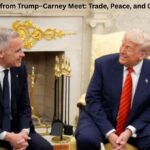
5 Bold Signals Mark Carney’s China Pivot as Canada Rewrites Trade Strategy amid rising tensions with Trump’s America First agenda. Canadian Prime Minister Mark Carney’s visit to China this week marks one of the most consequential foreign policy decisions Ottawa has taken in nearly a decade.
Coming at a moment of global trade disruption, geopolitical realignment, and deepening uncertainty in Canada–US relations, the trip signals a deliberate attempt to rebalance Canada’s economic future away from near-total reliance on the United States.
Carney’s journey to Beijing—his first as prime minister and the first by a Canadian leader in almost ten years—is not about a sudden embrace of China. Instead, it reflects strategic necessity, driven largely by the economic and political shockwaves emanating from US President Donald Trump’s America First agenda.
As Washington escalates tariffs, questions alliances, and even toys with the idea of Canada becoming a “51st state,” Ottawa is being forced to confront a long-ignored vulnerability: over-dependence on a single trade partner.

5 Bold Signals Mark Carney’s China Pivot as Canada Rewrites Trade Strategy
A High-Stakes Visit at a Critical Moment
Carney arrives in China on Wednesday for a visit that will run through Saturday. He is scheduled to meet President Xi Jinping, Premier Li Qiang, and senior Chinese officials, before travelling onward to Qatar and Switzerland for the World Economic Forum in Davos.
Canadian officials have framed the China leg of the trip as an effort to revive a dormant strategic partnership, stabilize a relationship that has been frozen for years, and open channels for dialogue across trade, energy, agriculture, and international security.
“This is about building resilience,” Carney said ahead of the visit. “At a time of global trade disruption, Canada is focused on building a more competitive, sustainable, and independent economy.”
The language is careful—but the message is unmistakable.
Why Canada Is Rethinking Its US Reliance
For decades, Canada structured its economy around privileged access to the American market. Until recently, more than 75% of Canadian exports went to the United States, a level of dependence unmatched among advanced economies.
That strategy worked—until it didn’t.
Trump’s Tariffs and Rhetoric
President Trump’s return to office has reopened old wounds and introduced new uncertainties:
- Tariffs on steel, aluminium, vehicles, and lumber
- Threats of further trade penalties
- Public musings about Canada becoming America’s “51st state”
While much of US–Canada trade remains tariff-free, the unpredictability of US policy has shaken confidence in the reliability of the relationship.
As Carney bluntly put it during the election campaign:
“Never have all your eggs in one basket. We have too many eggs in the American basket.”
Turning to China does not come naturally for Ottawa.
Canada’s relationship with Beijing has been among the most strained of any Western democracy, shaped by:
- The arrest of Huawei executive Meng Wanzhou in 2018
- China’s retaliatory detention of Michael Kovrig and Michael Spavor
- Allegations of foreign interference in Canadian elections
- Human rights disputes
- Trade retaliation targeting key Canadian exports
Yet China remains Canada’s second-largest trading partner, accounting for roughly 4% of exports and more than C$118 billion in two-way trade in 2024.
For a government seeking diversification, there are few alternatives of comparable scale.
What Carney Wants From Beijing
Trade Comes First
Trade will dominate Carney’s discussions, particularly:
- Canadian canola oil and meal, hit with punitive Chinese tariffs
- Seafood and pork exports
- Energy and agricultural access
China imposed 100% duties on Canadian canola oil after Ottawa followed Washington in slapping tariffs on Chinese electric vehicles. An additional 75.8% anti-dumping duty effectively shut Canadian producers out of their second-largest market.
Beijing has made its position clear: tariffs are reciprocal.
Canadian officials caution that no immediate breakthroughs should be expected. Instead, the visit is intended to restart technical negotiations, rebuild trust, and reopen channels that have been frozen for years.
A Lesson From Australia
Experts point to Australia’s experience as a reality check.
When relations between Canberra and Beijing soured, China imposed sweeping trade restrictions.
Yet their eventual easing:
- Did not occur during high-profile visits
- Took months or years of patient diplomacy
- Followed sustained engagement, not symbolic gestures
Carney’s China visit should be seen in this context—not as a deal-making summit, but as an ice-breaker.
Stabilization, Not Reset
Despite headlines suggesting Canada is “cosying up” to China, those close to the government emphasize that this is not a reset, let alone a rapprochement.
Instead, the goal is stabilization with continuity:
- More dialogue
- Fewer surprises
- Clearer channels for managing disputes
Canadian officials stress that:
- National security concerns remain unchanged
- Democratic values are non-negotiable
- Engagement does not mean endorsement
Domestic Scrutiny and Political Risk
Carney’s pivot places his government under intense domestic scrutiny.
Canadians remain wary of China, shaped by:
- The trauma of the “Two Michaels”
- Allegations of transnational repression
- Concerns over intellectual property theft
- China’s growing Arctic presence
Critics warn that Beijing could interpret Canada’s outreach as weakness, especially amid tensions with Washington.
Former diplomat Michael Kovrig, himself detained in China for more than 1,000 days, offers a stark assessment:
“China offers competence and predictability—not benevolence. Canada must be clear-eyed about what it’s dealing with.”
Balancing Trade and Security
Analysts argue that Carney’s success will depend on discipline and coherence:
- Centralized messaging
- Cabinet unity on China policy
- Avoiding inflammatory rhetoric for domestic gain
Margaret McCuaig-Johnston, a China expert at the University of Ottawa, warns against opening sensitive sectors:
- Aerospace
- Artificial intelligence
- Critical minerals
- Clean energy technology
“The reality is we should stay miles away from certain sectors,” she cautions.
The Taiwan Sensitivity
The visit has also exposed the delicate diplomacy surrounding Taiwan. Two Liberal MPs ended a trip to Taiwan early to avoid overlap with Carney’s Beijing visit, citing the need to avoid confusion over Canada’s foreign policy.
Conservative MPs remained on the island, underscoring domestic political divisions. Canada’s official position on Taiwan remains unchanged, but the episode highlights how every gesture is scrutinized in Beijing.
China’s Calculus
For Beijing, Carney’s visit offers strategic advantages:
- A chance to project stability amid global volatility
- An opportunity to weaken US-led pressure
- A platform to showcase China as a reliable economic partner
Chinese officials have welcomed the visit as a way to “bring relations back to the right track,” while carefully avoiding commitments.
Trade Diversification as National Strategy
Carney has set an ambitious goal: doubling Canada’s non-US exports over the next decade.
China is only one piece of that puzzle. Ottawa is also:
- Deepening ties in the Indo-Pacific
- Expanding engagement with India
- Strengthening links with Gulf states
- Leveraging multilateral forums like the G7 and WTO
But China’s market size makes it unavoidable.
What Success Looks Like
A “successful” visit will not be defined by headlines or immediate tariff relief.
Instead, it will mean:
- Reopened diplomatic channels
- Clearer expectations on both sides
- A framework for sustained engagement
- Reduced risk of sudden escalation
As Roland Paris of the University of Ottawa puts it:
“You can walk and chew gum at the same time.”
A Turning Point—or Just the Beginning?
When Carney’s plane touches down in Beijing, it will symbolize more than a diplomatic visit. It will mark Canada’s reluctant acknowledgment that the world it once knew—anchored firmly to the United States—is changing.
Whether this pivot leads to greater resilience or new vulnerabilities will depend on how carefully Ottawa navigates the months ahead.
For now, one thing is clear:
Canada is no longer willing to leave its economic future tied to a single partner—no matter how close that partner once was.
Also Read: U.S. and Canada Navigate Tensions as Carney, Trump Meet to Reset Cross-Border Ties
Also Read: Mark Carney heading to China with ‘work to be done’ to repair strained relationship with Canada