
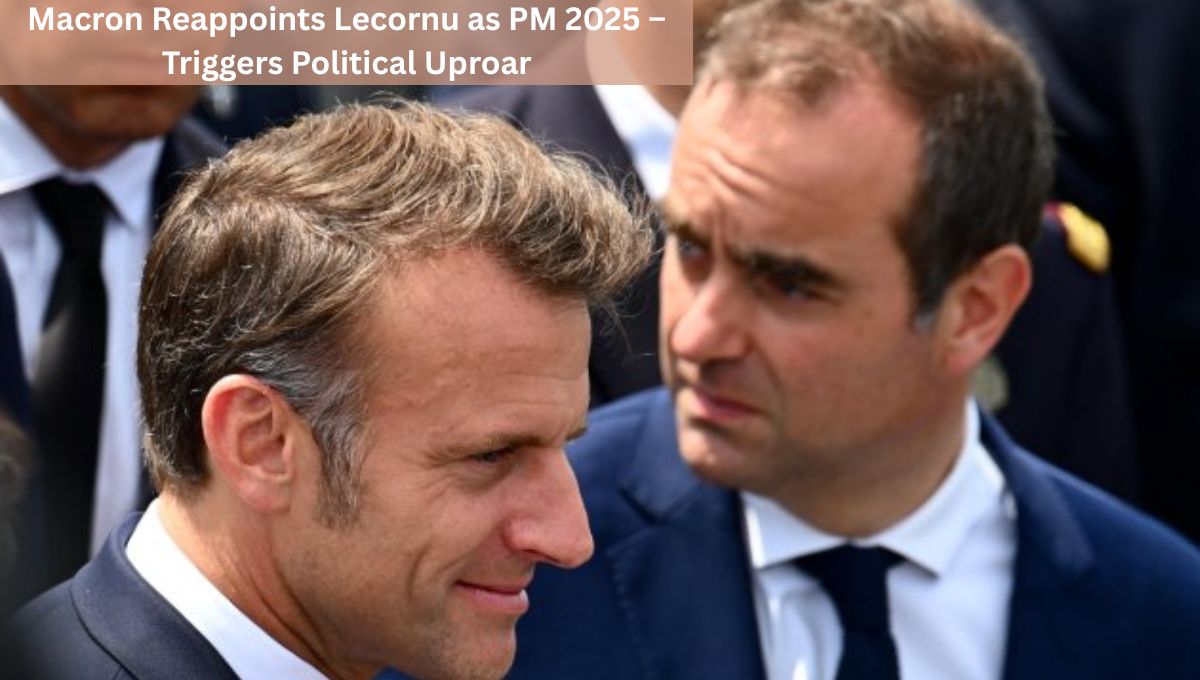
Amid economic pressures and parliamentary gridlock, Macron Reappoints Lecornu As PM 2025 – Triggers Political Uproar. French President Emmanuel Macron has made a dramatic and controversial decision by reappointing Sébastien Lecornu as Prime Minister, just four days after he resigned from the same post.
This move has sent shockwaves through French politics, highlighting both the fragility of Macron’s government and the widening political divides in France. Lecornu, 39, a centrist and loyal Macron ally, is tasked with forming a new cabinet and presenting the 2026 budget to Parliament by the end of the year. However, with Macron’s centrist bloc lacking a parliamentary majority and opposition parties vocally critical, Lecornu faces a daunting political challenge.

Macron Reappoints Lecornu as PM 2025 – Triggers Political Uproar
The Surprise Reappointment
Macron’s decision to bring back Lecornu came hours after meeting most political party leaders at the Élysée Palace, excluding the far-right National Rally and far-left France Unbowed.
Lecornu himself had previously stated on national television that he was “not chasing the job” and that his “mission was over.” Yet, out of duty, he accepted Macron’s request, promising on social media:
“We must put an end to this political crisis that exasperates the French people and to this instability, which is damaging to France’s image and interests.”
This marks a high-stakes gamble for Macron, reflecting the deep political turmoil that has engulfed France in recent months.
Macron’s Political Deadlock
Since the dissolution of Parliament in June 2024, Macron’s centrist bloc has struggled to maintain a working majority. Snap elections produced a hung National Assembly, forcing successive governments to collapse under parliamentary pressure.
The reappointment of Lecornu underscores Macron’s limited options. In less than a year, Lecornu’s previous government fell after opposition parties criticized ministerial appointments, leaving France without stable leadership and eroding public confidence.
Lecornu’s Political Mission
Sébastien Lecornu outlined his objectives for the new government:
- Deliver the 2026 budget on time to Parliament.
- Address the daily concerns of French citizens, including economic pressures and public services.
- Ensure ministers commit to suspending personal presidential ambitions for 2027, promoting a focus on governance rather than political rivalry.
- Open all issues raised during party consultations to parliamentary debate, avoiding previous attempts to bypass the legislature.
Lecornu stressed that anyone joining his cabinet must prioritize national interest over personal gain, signaling a call for unity amidst fragmentation.
Opposition Reaction
The reappointment was met with fierce criticism across the political spectrum:
- Far-right National Rally: Jordan Bardella called the move a “bad joke” and a “humiliation for the French people”, announcing plans to censure the government via a no-confidence vote.
- Far-left France Unbowed: Jean-Luc Mélenchon mocked Macron, saying, “Macron can do nothing other than Macron.”
- Socialists: Francois Kalfon expressed skepticism, demanding concrete action on pension reforms before offering support.
- Greens: Marine Tondelier warned that appointing another loyalist could worsen political isolation, calling Macron’s choice “stunning.”
Even some centrist allies privately questioned the wisdom of reappointing Lecornu, fearing it ignores public frustration and further diminishes Macron’s approval rating.
The Economic Context
France’s public debt is at 114% of GDP, one of the highest in the eurozone, and the budget deficit is projected at 5.4% of GDP. The European Commission has urged France to restore fiscal discipline, while credit rating agencies have flagged the lack of stability as a financial risk.
The political turmoil has already slowed economic growth. France’s central bank reported that political uncertainty has reduced growth by 0.2%, adding to existing economic strain. Investors are closely monitoring Lecornu’s ability to form a government capable of delivering the budget.
Challenges Facing Lecornu
Lecornu faces multiple obstacles as he attempts to form a functioning government:
Fragmented Parliament
- Macron’s centrist bloc lacks a clear majority.
- Opposition parties from both the left and right are unlikely to cooperate fully.
- Some centrists and conservatives are split over key policy issues like the pension reform.
Budget Deadline
- Lecornu must submit the 2026 budget by Monday to comply with the French constitution.
- Delays or failure to pass the budget could trigger emergency measures or force Macron to call snap elections.
Public and Political Skepticism
- Macron’s approval rating is at a record low of 14%.
- Many voters perceive the government as disconnected from public concerns.
- Critics accuse Macron of clinging to loyalists rather than seeking reform-minded leadership.
The Pension Reform Controversy
Macron’s 2023 pension reforms, which raised the retirement age from 62 to 64, remain a major source of tension:
- Left-wing parties demanded a prime minister from their side or suspension of reforms.
- Macron offered delays rather than full suspension, angering centrists who had supported the reforms.
- The compromise remains unpopular with both sides, complicating Lecornu’s task.
Lecornu’s Cabinet Strategy
While Lecornu has not publicly announced his cabinet, his approach is expected to reflect:
- A mix of Macron loyalists and select centrists willing to support the government.
- Exclusion of leaders from the far-left and far-right, given their opposition to Macron’s centrist agenda.
- A focus on budget delivery and stability, rather than broad political appeasement.
Lecornu’s prior cabinet fell apart less than 24 hours after announcement, illustrating the delicate balance he must maintain this time.
Macron’s Calculated Risk
Reappointing Lecornu is Macron’s last major gamble to stabilize his presidency before 2027:
- He has ruled out resignation and fresh parliamentary elections.
- Betting on Lecornu’s loyalty and negotiation skills to secure a fragile majority.
- Attempting to restore public confidence and international credibility, which has been shaken by repeated government collapses.
However, political analysts warn that repeating the same strategy may backfire, further alienating both Parliament and the electorate.
France’s Political Turmoil in Context
France’s current crisis is being compared to Italy’s historic instability, with multiple governments collapsing in short succession. Since Elisabeth Borne’s resignation, France has seen five prime ministers in just two years.
The deadlock stems from:
- Fragmented Parliament with no clear majority.
- Polarized opposition unwilling to compromise.
- Macron’s reliance on loyalists, limiting negotiation options.
- Public dissatisfaction with economic performance and social policies.
The Stakes for France
Failure to form a stable government or pass the 2026 budget could have serious consequences:
- Political instability leading to snap elections.
- Economic setbacks, including reduced investor confidence and slower growth.
- Erosion of public trust in Macron’s leadership and democratic processes.
- International scrutiny, as France’s role in the EU and global markets could be affected.
Also Read: France’s Political Crisis 2025: Macron’s Next Move
International Observers Weigh In
Al Jazeera’s Natacha Butler noted that the reappointment “underscores the chaos gripping French politics.” Analysts argue that Macron’s options are narrowing, and Lecornu faces a highly uncertain path to forming a viable government.
Investors and European officials are closely monitoring Lecornu’s progress, particularly with regard to the budget and fiscal discipline. Failure to resolve the deadlock could damage France’s credit rating and undermine its position in the EU.
Lecornu’s Message to the Nation
On social media, Lecornu stressed:
“We must put an end to this political crisis that exasperates the French people and to this instability that is harmful to France’s image and interests.”
He also emphasized that all ministerial candidates must suspend presidential ambitions, signaling a focus on governance over politics.
Lecornu has highlighted that parliamentary debate will be respected for all decisions, aiming to avoid accusations of bypassing democratic processes, a common criticism of Macron’s earlier government.
Public Reaction
France’s citizens have expressed mixed feelings:
- Many are frustrated by repeated government collapses.
- Some see Lecornu’s return as necessary continuity, while others view it as a repetition of past mistakes.
- Public anger over pension reforms, economic stagnation, and political gridlock remains high.
Polls indicate growing support for far-right and far-left parties, signaling potential challenges for Lecornu in building a sustainable coalition.
Lecornu’s Immediate Challenges
Forming a Cabinet
- Must balance centrist, conservative, and possibly left-leaning allies.
- Exclude far-left and far-right leaders, limiting options.
- Avoid repeating mistakes that led to his previous cabinet collapse.
Delivering the Budget
- Submit 2026 budget by Monday, including measures to reduce deficit and public debt.
- Convince a fragmented Parliament to approve fiscal and social policies.
Rebuilding Trust
- Restore confidence among citizens and international observers.
- Demonstrate ability to navigate political complexity and deliver tangible results.
Potential Outcomes
- Success: Lecornu forms a stable government, passes the budget, and restores public and parliamentary confidence.
- Partial Success: Cabinet formation is fragile, leading to ongoing negotiations and potential political stalemate.
- Failure: Opposition forces push for no-confidence vote or snap elections, escalating instability.
The stakes could shape Macron’s presidency through 2027 and France’s economic and political trajectory.
Conclusion
Sébastien Lecornu’s reappointment as French Prime Minister marks a whiplash-inducing twist in France’s political drama. Amid a fractured parliament, economic strain, and public dissatisfaction, Lecornu must form a cabinet, deliver the 2026 budget, and restore stability.
President Macron has bet his political credibility on Lecornu’s loyalty and effectiveness. However, opposition parties are poised to challenge him, and public frustration continues to grow.
The coming weeks will determine whether Lecornu can navigate this complex political landscape or whether France will face yet another period of instability, echoing comparisons to historically tumultuous European governments.
France now waits with bated breath to see if Macron’s gamble will save his presidency or plunge the nation into further political and economic uncertainty.
Also Read: France’s new Prime Minister Lecornu resigns hours after naming cabinet
Related Posts:
- France’s PM Resigns: 5 Days of Political Turmoil

- France’s Political Crisis 2025: Macron’s Next Move

- 5 Shocking Developments in Macron’s Political Crisis

- France in Turmoil as ‘Block Everything’ Protests…

- Afghanistan–Pakistan War 2025: Inside the 48-Hour Ceasefire

- In 8 Moves, EU Targets China-Linked Refineries and…
