Iran’s Supreme Leader, Ayatollah Ali Khamenei Reemerges Publicly After Iran-Israel War Amid Nuclear Crisis. Ayatollah Ali Khamenei, made his first public appearance on Saturday since the deadly Iran-Israel war that erupted last month. His return to the spotlight, captured on state television during an Ashura mourning ceremony in Tehran, ended weeks of speculation over his health, security, and leadership amid the gravest national crisis Iran has faced in years.
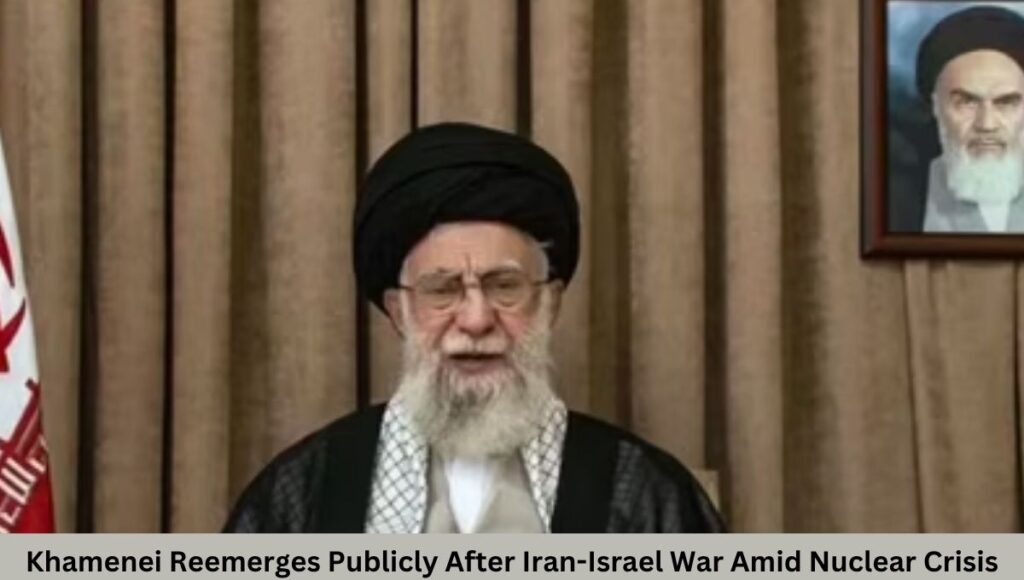
Khamenei Reemerges Publicly After Iran-Israel War Amid Nuclear Crisis
Khamenei’s First Public Appearance Since War Began
State-run media broadcast video footage of Khamenei at the Imam Khomeini Mosque, dressed in black and greeted by a standing crowd of mourners chanting, “The blood in our veins for our leader!”
The occasion marked Ashura, a pivotal date in the Shia Muslim calendar commemorating the martyrdom of Imam Hussein.
Though he made no public remarks at the event, his appearance amid tight security was a carefully choreographed signal to the nation and the world: Iran’s leader is alive, present, and in control.
The 86-year-old had last been seen publicly on June 11, just two days before Israel launched a surprise aerial assault on Iran’s military and nuclear sites.
Weeks in Hiding as Iran Faced War and Airstrikes
For nearly three weeks, Ayatollah Khamenei vanished from the public eye. As Israeli airstrikes rocked Tehran and U.S. bombers joined the conflict on June 22, Iranian state media aired only pre-recorded video messages.
Officials avoided questions about his whereabouts. Intelligence sources suggested that the Supreme Leader took shelter in a high-security underground bunker, anticipating possible assassination attempts.
Both Israel and the United States were reportedly considering direct strikes on Iranian leadership.
Former U.S. President Donald Trump, who ordered American strikes on three nuclear sites Fordo, Natanz, and Isfahan said on social media, “We know where he is, but have no plans to kill him at least for now.”
Israeli Prime Minister Benjamin Netanyahu echoed similar views, saying a strike on Khamenei “would not escalate the conflict, it would end it.”
Heavy Losses and Nuclear Fallout
Iran’s 12-day war with Israel was its most devastating in decades. The country’s judiciary confirmed more than 900 people were killed, including senior commanders, elite Revolutionary Guard officers, and nuclear scientists.
The U.S. air campaign crippled Iran’s nuclear infrastructure, striking key facilities in central Iran.
While Khamenei later claimed in a video that Iran had achieved “victory,” international experts say the attacks severely degraded Iran’s nuclear capabilities.
Trump bluntly assessed the outcome: “They got beat to hell. Iran’s nuclear ambitions were obliterated.”
The Iranian government responded by suspending cooperation with the International Atomic Energy Agency (IAEA).
On July 3, President Masoud Pezeshkian signed legislation blocking access for UN nuclear inspectors, who had remained in Iran throughout the conflict but have now left.
IAEA Raises Alarm Over Lack of Access
IAEA Director-General Rafael Grossi voiced urgent concern on July 4, emphasizing the “critical importance” of resuming nuclear monitoring.
“Without inspections, we cannot verify what’s happening inside Iran,” Grossi warned. The lack of transparency has deepened global fears that Iran could resume covert nuclear activities.
While Foreign Minister Abbas Araghchi reiterated Iran’s commitment to the Nuclear Non-Proliferation Treaty (NPT), many in the West remain skeptical.
“We have not left the NPT and have no intention to,” Araghchi said, denying rumors that Iran would pursue a nuclear weapon.
Yet without IAEA oversight, verification is nearly impossible and experts believe Tehran may use the current crisis as cover to reposition its nuclear strategy.
U.S. and Israel Threaten Further Action
As tensions simmer, former President Trump who remains politically active and influential issued new warnings.
“If they restart the nuclear program, there will be a problem,” Trump said aboard Air Force One on July 4.
His remarks came ahead of a scheduled meeting with Netanyahu in Washington, during which future strategy against Iran is expected to top the agenda.
Israel’s Defense Minister also emphasized that Israel must maintain “aerial superiority” to prevent Iran from rebuilding its missile or nuclear programs.
Despite public denials from Iranian officials, U.S. sources suggest backchannel talks are underway.
These proposals reportedly include unfreezing billions of dollars, easing some sanctions, and allowing civilian nuclear energy development a potential path back to diplomacy.
Internal Dissent and Leadership Questions
While Khamenei’s reappearance may temporarily reassure his supporters, it has not silenced growing domestic unease. Analysts say the war, heavy losses, and his absence have fractured the public trust.
“The Islamic Republic had one deal with its people: no freedom in exchange for security. That deal is now broken,” said Ali Vaez of the International Crisis Group.
With Khamenei’s advanced age and no clear successor, tensions are rising among Iran’s powerful internal factions including the Revolutionary Guard, the Quds Force, and the Assembly of Experts.
Some hardliners are reportedly pushing for a less clerical future, while others demand a return to ideological purity.
Khamenei’s Message: Moral Victory or Strategic Denial?
In his June 26 video, Khamenei insisted Iran had given America a “slap in the face” by launching retaliatory missile attacks on a U.S. base in Qatar. However, the damage was minimal and did little to alter the course of the conflict.
Trump fired back: “You have to tell the truth. You got beat to hell.” Khamenei framed the war not as a defeat but as a spiritual and ideological stand.
“This is not about centrifuges or uranium. It is about Iran’s refusal to surrender to American imperialism,” he said.
That message may resonate with Iran’s conservative base, but among the broader population still reeling from loss, economic hardship, and isolation skepticism is growing.
Symbolism of Ashura and Khamenei’s Timing
Khamenei’s choice to reappear on Ashura, one of the most sacred days in Shia Islam, was symbolic.
It served to align his leadership with themes of sacrifice, endurance, and defiance, echoing the legacy of Imam Hussein, whose martyrdom is central to Shia identity.
During the ceremony, Khamenei reportedly turned to a senior cleric and asked him to sing “O Iran,” a patriotic anthem that gained renewed popularity during the war.
State media flooded the airwaves with footage of the event, encouraging citizens to send in video messages reacting to the Supreme Leader’s reappearance.
The Road Ahead: Stability or Further Strife?
While Khamenei’s public return may quiet rumors of illness or a leadership vacuum, Iran remains in deep crisis:
- Its nuclear program is crippled and under scrutiny.
- UN inspectors are gone, raising fears of a clandestine rebuild.
- Relations with the U.S. and Israel are more volatile than ever.
- Internal power struggles could define the country’s next chapter.
As Iran enters a post-conflict phase, the question is no longer whether Khamenei is present it is how long he can maintain control, and whether Iran can survive the mounting pressure from within and abroad.
Conclusion
Ayatollah Ali Khamenei’s reappearance may mark a pivotal moment in Iranian politics. Whether it leads to renewed negotiations, further conflict, or a shift in the country’s leadership trajectory remains to be seen. But one thing is clear: the war may be over, but the consequences are only just beginning.
Also Read: Khamenei’s Feminist Tweets Resurface Amid Israel-Iran War
Also Read: Iran’s Supreme Leader Makes First Public Appearance Since Beginning Of 12-Day War
Related Posts:
- 3 Explosive Conditions Iran Sets to End War with US…
- 10 Powerful Revelations from the Trump–Putin Call on…
- 10 Explosive Signals Trump Says Iran War Could End…
- 10 Explosive Facts About Mojtaba Khamenei’s Rise as…
- 7 Explosive Shifts: Mojtaba Khamenei Named Iran’s…
- 10 Explosive Signals: Trump Rates Iran War “15/10”…