In a trial program, China Launches Visa-Free Travel for Russians After Xi-Putin Talks: A One-Year Trial to Boost Tourism and Bilateral Ties. China has announced a visa-free entry policy for Russian citizens on a trial basis, beginning September 15, 2025, and running through September 14, 2026. The move, revealed just a day after the Shanghai Cooperation Organisation (SCO) Summit in Tianjin, comes following high-level talks in Beijing between Chinese President Xi Jinping and Russian President Vladimir Putin.
Under the new arrangement, Russian citizens holding ordinary passports will be permitted to stay in China for up to 30 days per visit, with the policy designed to encourage tourism, business, family visits, and cultural exchanges. This announcement underscores the strengthening ties between Beijing and Moscow, with both leaders highlighting that their partnership is at an “unprecedented level” in the face of global geopolitical shifts.
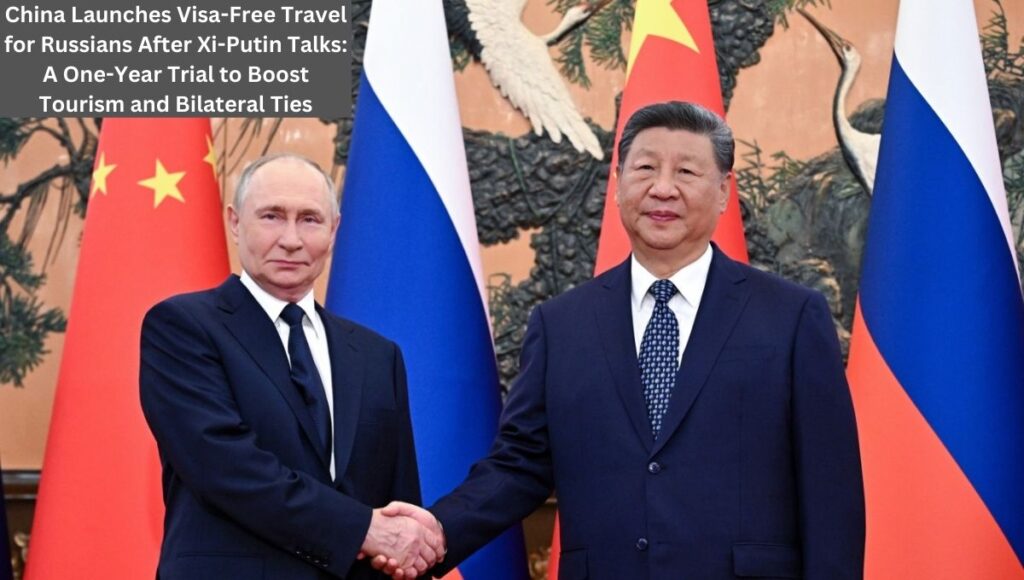
China Launches Visa-Free Travel for Russians After Xi-Putin Talks: A One-Year Trial to Boost Tourism and Bilateral Ties
A Strategic Move in China-Russia Relations
The visa-free travel initiative reflects the growing political, economic, and cultural alignment between the two nations.
Speaking in Beijing ahead of a military parade, Putin emphasized the closeness of ties, saying:
“Our close communication reflects the strategic nature of Russian-Chinese ties, which are currently at an unprecedented level. We were always together then, and we remain together now.”
For China, this policy is more than a symbolic gesture. It represents a strategic step in deepening its relationship with Russia while simultaneously boosting domestic tourism and international influence.
Tourism Boost Expected
Industry experts anticipate that this visa-free policy could increase Russian tourism to China by as much as 40% during the one-year trial.
According to Russia’s Association of Tour Operators, Chinese destinations such as Beijing, Shanghai, Xi’an, and the Great Wall are already popular among Russian tourists. With the removal of visa barriers, visits are expected to surge, enhancing not only tourism revenues but also cultural and people-to-people ties.
In the first half of 2025 alone, over 1 million Russian tourists visited China, marking a nearly 30% rise compared to the previous year. With this new policy, China is positioning itself to become a top travel destination for Russian citizens.
Expanding China’s Global Tourism Strategy
China has been actively broadening its visa-free entry policies since reopening its borders in 2023 after the pandemic. Currently, 75 countries benefit from some form of visa-free or simplified entry policy to China.
Adding Russia to this list reflects China’s ambition to strengthen its position as a global tourism hub while also reinforcing political alliances in a shifting international order.
Chinese Foreign Ministry spokesperson Guo Jiakun explained:
“We welcome more Russian friends to visit China often and regularly. Under the strategic guidance of the two heads of state, China-Russia relations have been operating at a high level. Facilitating personnel exchanges is an important step in our comprehensive strategic partnership of coordination for a new era.”
Xi-Putin Talks: Cooperation at “Unprecedented Level”
The timing of the announcement is crucial. It followed a face-to-face meeting between Xi Jinping and Vladimir Putin in Beijing, where both leaders reaffirmed their partnership.
The meeting took place ahead of a massive military parade in Beijing, marking 80 years since the end of World War II, attended by around two dozen world leaders, including North Korea’s Kim Jong-un, making his first visit to China since 2019.
During the discussions, Xi Jinping criticized Western “bullying behavior”, while Putin defended Russia’s Ukraine offensive, blaming the West for escalating tensions.
The visa-free policy thus stands as a symbol of solidarity between China and Russia, underscoring their united front against what they describe as Western hegemony.
Russia-China Business and Trade Relations
Beyond tourism, the visa-free trial is expected to strengthen bilateral trade. Russia and China already maintain a robust partnership, with trade volumes surpassing $200 billion annually.
The removal of visa barriers for business executives and professionals will allow for smoother cross-border investment, joint ventures, and co-financing opportunities.
Huntsville, home to major aerospace and defense centers, and Moscow’s tech and energy hubs are expected to see expanded collaboration. This comes as China continues to rely on Russian energy imports, while Russia looks to China as its largest trading partner.
Impact on Russian Citizens
For Russian travelers, this policy removes one of the biggest hurdles: the lengthy and costly visa process. Now, Russian citizens can plan spontaneous trips for business, leisure, or family purposes.
Destinations like:
- Beijing – China’s political and cultural heart.
- Shanghai – A hub for finance and modern urban culture.
- Xi’an – The gateway to China’s ancient Silk Road history.
- Guangzhou and Shenzhen – Emerging technology and business centers.
These cities are now more accessible than ever before.
Challenges of Implementation
While the visa-free trial offers immense opportunities, it also presents challenges. Authorities on both sides will need to ensure:
- Infrastructure readiness at airports and border checkpoints.
- Border security measures to monitor increased visitor flows.
- Balanced evaluation of how the policy impacts tourism, business, and security.
The one-year trial will serve as a test case for broader expansion, not just for Russia but potentially for other nations in the future.
Global Context: China’s Expanding Influence
The move aligns with China’s broader diplomatic strategy to expand its influence globally, particularly at a time when Western alliances are tightening against Russia.
By offering visa-free access, China demonstrates a commitment to open borders for strategic partners while reinforcing its image as a welcoming global power.
Looking Ahead: Potential Long-Term Policy
If the trial proves successful, analysts believe that China may extend the visa-free policy permanently. This could encourage Russia to reciprocate by easing entry for Chinese tourists, creating a two-way flow of travel and exchange.
Such developments would further bind the two countries, not just through political rhetoric but through people-to-people connections that shape public perception and strengthen bilateral goodwill.
Conclusion: A Landmark Step in China-Russia Cooperation
China’s decision to introduce visa-free travel for Russians represents a landmark moment in bilateral relations. What began as a policy decision to encourage tourism now stands as a symbol of strategic partnership between two of the world’s most influential powers.
For Russia, the policy offers its citizens easier access to one of the world’s most dynamic countries. For China, it boosts tourism revenues, trade opportunities, and its international image.
As the one-year trial unfolds, the world will be watching to see whether this experiment in visa diplomacy becomes a permanent fixture in the growing China-Russia alliance.
Also Read: Malaysia Turns Away 10 Indian Nationals Despite Visa-Free Entry
Also Read: Which 59 Countries Can Indian Passport Holders Travel Visa-Free To In 2025?
Related Posts:
- China Hosts SCO Summit 2025 and Military Parade as…

- PM Modi, Xi Jinping, Putin Will Join 20 World…
- Xi and Putin Unite at SCO Summit as China Pushes…

- Meet Xiao He: Humanoid Robot Assisting Journalists…

- ‘Dragon and Elephant Must Come Together’: PM Modi…
- Putin in China for SCO Summit 2025: Russia and China…