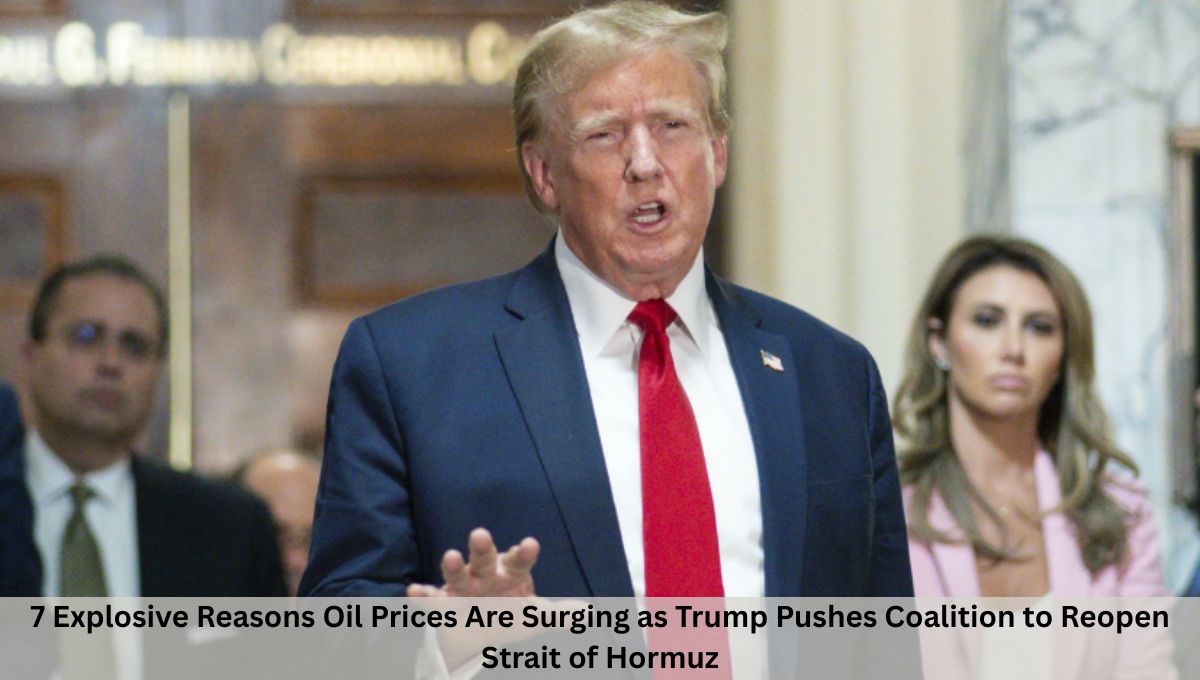
7 Explosive Reasons Oil Prices Are Surging as Trump Pushes Coalition to Reopen Strait of Hormuz to prevent a global economic slowdown. Global oil markets are once again facing intense turbulence as crude prices surge past the psychologically critical $100-per-barrel level. The dramatic rise comes as the ongoing war involving Iran has effectively shut down traffic through the Strait of Hormuz — one of the most vital energy choke points in the world.
With shipping routes severely disrupted and geopolitical tensions escalating, US President Donald Trump has called on the international community to form a coalition aimed at reopening the strategic waterway. However, the proposal has so far received only cautious responses from major global powers.
The situation has triggered widespread concerns across financial markets, governments, and industries, with economists warning that prolonged disruption could unleash a severe global energy shock.
Oil traders, policymakers, and investors are now closely watching developments in the Gulf region, where military tensions and retaliatory attacks have already reshaped the global energy landscape.
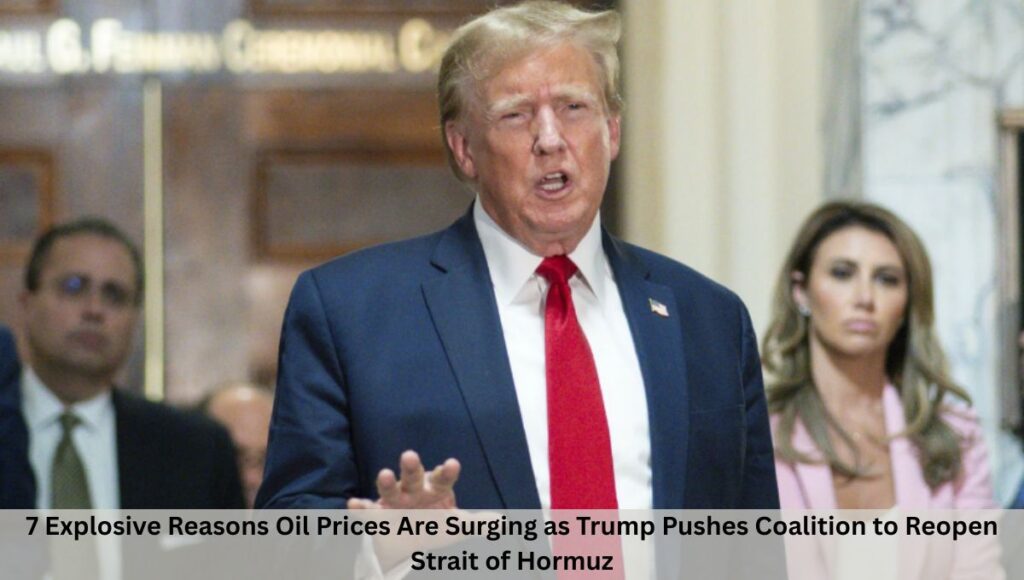
7 Explosive Reasons Oil Prices Are Surging as Trump Pushes Coalition to Reopen Strait of Hormuz
Brent Crude Climbs Above $106 Amid Market Anxiety
Oil prices surged sharply at the start of the week as traders reacted to continued uncertainty surrounding the Strait of Hormuz.
Brent crude, the international benchmark for oil prices, jumped as much as 3 percent during weekend trading, briefly crossing the $106 per barrel mark before easing slightly.
By early Monday morning, Brent crude was trading at around $104.63 per barrel, still up nearly 1.5 percent.
Meanwhile, US crude oil also crossed the $100 per barrel threshold, marking one of the most significant price surges since 2022.
The sharp rise reflects deep market concerns that the disruption in oil transportation could persist for weeks — or even months — if the conflict continues.
Energy analysts warn that the closure of the Strait of Hormuz has created a supply shock unlike anything seen in decades.
Why the Strait of Hormuz Matters to the Global Economy
The Strait of Hormuz is widely considered the world’s most important oil transit chokepoint.
Located between Iran, Oman, and the United Arab Emirates, the narrow waterway connects the Persian Gulf with global shipping routes.
Roughly one-fifth of the world’s total oil supply passes through this corridor every day under normal conditions.
This includes exports from major energy producers such as Saudi Arabia, Iraq, Kuwait, Qatar, and the United Arab Emirates.
When functioning normally, about 138 ships transit the strait daily. However, since the outbreak of hostilities in late February, traffic has slowed dramatically.
According to maritime monitoring authorities, only about five ships per day have been able to pass through the strait since the conflict escalated.
The sharp reduction in shipping has created a severe bottleneck in global energy supplies.
For energy-importing countries — particularly those in Asia and Europe — the disruption poses serious economic risks.
Iran’s Retaliation Brings Shipping to a Standstill
Iran has effectively halted most shipping in the strait as part of its retaliation against US and Israeli military strikes on its territory.
Reports indicate that Iranian forces have laid mines in key sections of the waterway and threatened to target vessels linked to Western countries.
Since the conflict began on February 28, at least sixteen commercial ships have reportedly been attacked or damaged in the region.
These incidents have made shipping companies extremely cautious, with many refusing to send tankers through the strait without military protection.
The heightened risk has pushed insurance costs for oil tankers to extreme levels, further discouraging commercial traffic.
As a result, the global oil market is facing a historic disruption in supply chains.
The International Energy Agency has described the crisis as the largest disruption to global energy supplies in modern history.
Trump Calls for International Coalition to Reopen the Strait
In response to the growing crisis, US President Donald Trump has urged global allies to help secure the Strait of Hormuz and restore shipping flows.
In interviews and social media statements, Trump said the United States was ready to escort oil tankers through the strait with naval forces but emphasized that other countries should share the burden.
He has specifically called on several major powers — including China, Japan, France, and the United Kingdom — to contribute naval support to protect commercial vessels.
Trump also warned that the future of the NATO alliance could be affected if allies fail to respond to the request.
According to Trump, ensuring safe passage through the strait is a global responsibility since the energy supplies transported there serve economies around the world.
However, initial responses from major countries have been cautious.
Japan and Australia have already indicated they currently have no plans to deploy naval forces to the region.
European officials are discussing the possibility of strengthening an existing maritime mission in the Middle East, but no definitive commitments have been made.
While the United States has indicated willingness to escort tankers, officials say it could take weeks before such operations begin.
Military planners must coordinate naval deployments, establish security protocols, and assess risks from mines, drones, and missile attacks in the region.
Energy Secretary Chris Wright acknowledged that the waterway is currently unsafe for commercial shipping.
He stated that restoring safe passage through the strait remains one of the key objectives of the ongoing military campaign.
Until that happens, global oil markets are expected to remain volatile. Some analysts believe prices could continue rising if the disruption extends into the coming months.
Oil Prices Have Already Jumped More Than 40 Percent
The impact of the conflict on global energy markets has been dramatic. Since the war began, oil prices have surged more than 40 percent.
This sharp rise has pushed fuel prices higher worldwide and increased fears of renewed inflation.
In the United States, gasoline prices have climbed significantly, rising to an average of around $3.70 per gallon.
The surge threatens to undermine one of the Trump administration’s key economic claims — that fuel prices had fallen significantly during the early part of the president’s second term.
Energy costs influence nearly every sector of the economy, from transportation and manufacturing to food production.
As oil prices climb, those higher costs are often passed on to consumers.
Countries Scramble to Respond to the Energy Shock
Governments across the world are scrambling to mitigate the economic impact of rising oil prices.
Several countries have already introduced emergency measures to stabilize domestic energy markets.
China has reportedly ordered refiners to halt exports of refined fuels such as gasoline, diesel, and aviation fuel in order to secure supplies for its domestic market.
Japan is considering price caps on gasoline to protect consumers from rapidly rising costs.
South Korea has also introduced price controls on petroleum products to reduce volatility. Some countries have begun releasing oil from their strategic reserves.
In addition, the International Energy Agency has announced the largest coordinated emergency oil release in history.
Member countries have agreed to release 400 million barrels of crude oil from strategic reserves to help stabilize the market.
However, much of that oil will not reach markets until later in the month.
Economic Ripple Effects Spread Across the World
The oil price surge is already rippling through global financial markets.
Stock markets across Asia have shown signs of caution, while bond yields have surged as investors anticipate higher inflation.
Central banks around the world now face a difficult policy dilemma. Higher oil prices increase inflation, making it harder for policymakers to cut interest rates.
At the same time, the conflict threatens economic growth, which would normally call for looser monetary policy.
Economists say the result could be a prolonged period of slower growth combined with persistent inflation — a scenario often described as stagflation.
This environment would complicate economic planning for governments worldwide.
Asian Economies Face Particular Risk
Asian economies are especially vulnerable to disruptions in the Strait of Hormuz. Many countries in the region rely heavily on oil and natural gas imports from the Middle East.
India, China, Japan, South Korea, Pakistan, and Bangladesh all receive a significant portion of their energy supplies through the strait.
Any prolonged closure could therefore have severe consequences for energy security across the region.
Experts warn that the disruption could also affect shipments of liquefied natural gas from Qatar and the United Arab Emirates.
Such disruptions would impact electricity generation and industrial production across Asia.
Potential Impact on Food Prices and Supply Chains
The crisis could also affect global food supply chains. Fertilizers shipped through the Middle East rely heavily on shipping routes that pass through the Strait of Hormuz.
If shipping disruptions persist, farmers worldwide could face shortages of key agricultural inputs. In addition, higher fuel costs increase transportation expenses for food products.
Perishable goods such as dairy, fruits, vegetables, and seafood could become more expensive as shipping costs rise.
These factors could contribute to broader inflation pressures in many countries.
Financial Markets Remain on Edge
Global financial markets are closely monitoring developments in the Middle East. Investors remain cautious as geopolitical risks continue to dominate market sentiment.
The US dollar has benefited from the uncertainty, as investors often turn to the currency as a safe-haven asset during times of crisis.
Meanwhile, gold prices have remained relatively stable despite geopolitical tensions.
Analysts say the strength of the dollar and rising bond yields have limited gold’s typical safe-haven rally.
However, market volatility is expected to remain high as the conflict evolves.
Could Oil Prices Reach $150 per Barrel?
Some energy analysts believe the current surge could be only the beginning. If the Strait of Hormuz remains closed for several weeks, oil prices could climb even higher.
Market forecasts suggest crude oil could potentially reach $125 to $150 per barrel under prolonged disruption scenarios.
Such levels would rival some of the highest prices seen during major geopolitical crises in the past.
A prolonged price surge could significantly increase inflation, disrupt economic growth, and strain government budgets worldwide.
For oil-importing nations, the financial burden could be particularly severe.
The Strategic Importance of Kharg Island
Another critical factor influencing oil markets is the situation surrounding Kharg Island.
The island is Iran’s primary oil export terminal and handles about 90 percent of the country’s crude exports.
Recent US strikes on Iranian military assets on the island have intensified concerns about potential disruptions to Iran’s oil production.
Although officials say oil infrastructure was spared in the initial attacks, analysts warn that further strikes could drastically reduce Iran’s exports.
Such a move could escalate the conflict and trigger even higher oil prices.
Global Energy Security Faces a Historic Test
The ongoing crisis represents one of the most serious tests of global energy security in decades. For decades, the Strait of Hormuz has served as a stable artery for the global oil trade.
Now, with shipping largely halted and military tensions escalating, that stability has been severely shaken.
Governments, corporations, and financial markets must now adapt to an increasingly uncertain energy landscape.
The outcome of the conflict — and the success or failure of efforts to reopen the strait — could determine the direction of global oil markets for months or even years.
The Road Ahead for Global Oil Markets
For now, the world’s energy markets remain in a state of heightened uncertainty.
If diplomatic efforts or military operations succeed in reopening the Strait of Hormuz, oil prices could stabilize relatively quickly.
However, if the conflict continues or spreads across the region, the disruption could deepen.
In that scenario, oil prices may continue climbing, potentially triggering broader economic consequences.
For policymakers and investors alike, the coming weeks may prove decisive in determining whether the current crisis becomes a temporary shock — or the beginning of a prolonged global energy crisis.
Also Read: 7 Explosive Facts About the US Strike on Iran’s Kharg Island That Could Reshape the Global Oil War
Also Read: Trump presses seven nations to deploy warships for Hormuz security as oil prices surge amid Iran war
Related Posts:
- 7 Shocking Reasons Trump Says Oil Spike Is “Worth…

- 7 Shocking Reasons FIFA’s Peace Prize for Trump…

- Trump to Host 2026 G20 Summit at His Florida Golf…

- 9 Explosive Revelations as Trump Declares His Health…

- Trump’s 2025 Gaza Peace Plan Signing and Historic…

- 7 Powerful Reasons the U.S. Is Letting Countries Buy…