
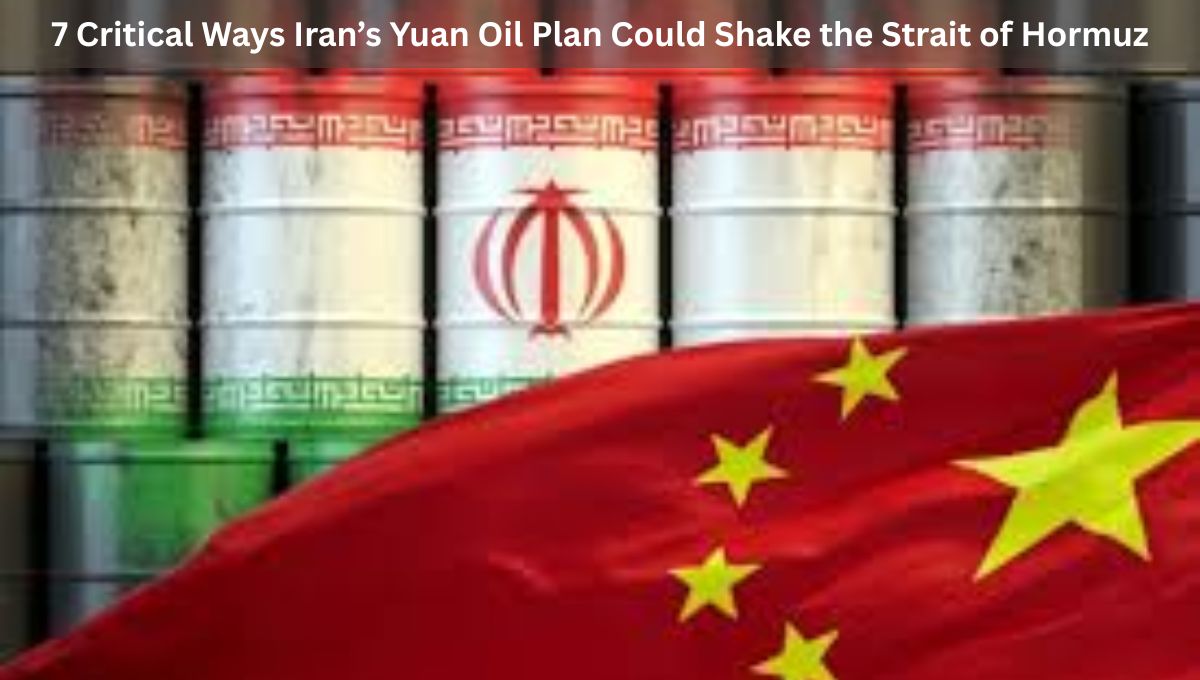
7 Critical Ways Iran’s Yuan Oil Plan Could Shake the Strait of Hormuz and challenge the petrodollar system. The Strait of Hormuz has long been one of the most strategically significant waterways on Earth. Nearly one-fifth of the world’s oil supply flows through this narrow maritime corridor linking the Persian Gulf to the Gulf of Oman and the wider Indian Ocean.
Thank you for reading this post, don't forget to subscribe!Now, amid rising geopolitical tensions and ongoing military conflict in the Middle East, Iran is reportedly considering a controversial strategy:
allowing a limited number of oil tankers to pass through the Strait of Hormuz—but only if the oil cargo is traded in Chinese yuan rather than US dollars.
If implemented, the proposal could reshape global energy markets, challenge the decades-old petrodollar system, and deepen geopolitical divisions between Western powers and countries aligned with China.
The idea also highlights how financial tools—such as currency requirements—are becoming as powerful as missiles or warships in the modern geopolitical landscape.
7 Critical Ways Iran’s Yuan Oil Plan Could Shake the Strait of Hormuz
The Strait of Hormuz: The World’s Most Important Oil Chokepoint
The Strait of Hormuz is widely regarded as the most critical oil transit route in the world.
At its narrowest point, the strait is only about 33 kilometers (21 miles) wide, yet it carries massive volumes of energy shipments daily.
Key facts about the Strait of Hormuz
- Around 20 percent of global oil supply passes through the strait.
- Roughly 20 million barrels of oil per day move through the waterway.
- Major exporters including Saudi Arabia, Iraq, Kuwait, and the UAE rely on the passage.
- The route is also essential for liquefied natural gas (LNG) shipments.
Because of its strategic importance, even minor disruptions in the strait can trigger global oil price spikes and market volatility.
Recent tensions in the region have already pushed oil prices to their highest levels since mid-2022, as markets fear potential supply disruptions.
Iran’s New Strategy for Tanker Traffic
According to reports citing a senior Iranian official, Tehran is considering a plan that would restrict oil tanker passage unless the oil cargo is traded in Chinese yuan.
The strategy would effectively create a two-tier system for oil shipments through the strait.
Possible features of the plan
- Limited tanker passage through the Strait of Hormuz
- Oil cargo required to be priced and traded in yuan
- Priority access potentially granted to nations friendly with Iran
- Restricted access for countries aligned with the United States or Israel
The idea is reportedly part of a broader effort by Iran to control the flow of oil shipments through the waterway while leveraging its geopolitical position.
If adopted, the move could represent a major shift in how energy trade is conducted globally.
Why the Yuan Requirement Matters
For decades, global oil transactions have been dominated by the US dollar, forming the foundation of the so-called petrodollar system.
Under this arrangement:
- Oil exports are primarily priced in dollars.
- Countries must hold dollar reserves to buy energy.
- The US dollar remains the dominant global reserve currency.
Iran’s proposed yuan requirement could challenge that structure.
By tying passage through the world’s most important energy chokepoint to Chinese currency transactions, Tehran could effectively push some oil trade outside the dollar system.
The Origins of the Petrodollar System
The dominance of the dollar in oil trade dates back to the 1970s, when the United States reached agreements with major oil-producing countries, including Saudi Arabia.
These arrangements ensured that oil would be priced and traded in US dollars, creating a powerful financial cycle:
- Countries buy oil using dollars.
- Oil exporters accumulate large dollar reserves.
- Those reserves are often reinvested in US financial markets.
This system helped cement the dollar’s position as the world’s primary reserve currency. For decades, attempts to challenge the petrodollar system have had limited success.
However, geopolitical tensions and economic rivalries are increasingly encouraging alternative arrangements.
China’s Long Push to Internationalise the Yuan
China has been trying for years to expand the global use of its currency. One of Beijing’s strategic goals is to increase the yuan’s role in global energy trade.
China’s efforts include
- Encouraging oil producers to accept yuan payments
- Creating yuan-denominated oil futures markets
- Promoting cross-border settlement systems that bypass the US dollar
- Expanding energy partnerships with countries under Western sanctions
Despite these efforts, the yuan still represents only a small portion of global oil transactions.
Iran’s proposal could change that—at least for shipments moving through the Strait of Hormuz.
Why China Could Benefit Most
China is the world’s largest oil importer and relies heavily on Middle Eastern energy supplies. Nearly 45 percent of China’s oil imports travel through the Strait of Hormuz.
Because Beijing maintains strong diplomatic and economic ties with Tehran, a yuan-based trade system could benefit Chinese energy companies.
Potential advantages for China
- Secure access to Iranian oil supplies
- Greater use of the yuan in global trade
- Reduced reliance on the US-dominated financial system
- Strengthened geopolitical influence in the Middle East
If major oil shipments begin using the yuan, China’s currency could gradually gain greater international credibility and influence.
Rising Tensions in the Middle East
The proposed tanker policy comes amid escalating military conflict in the region.
The crisis intensified after US and Israeli strikes targeted Iranian sites, including areas near Iran’s key oil hub on Kharg Island.
Kharg Island plays a crucial role in Iran’s energy sector.
Importance of Kharg Island
- Handles around 90 percent of Iran’s crude oil exports
- Located about 30 kilometers from the Iranian mainland
- Serves as the country’s primary oil export terminal
Any attack on this infrastructure could have severe consequences for global oil markets.
In response to escalating tensions, the United States has reportedly increased military activity in the region and is considering measures to protect oil shipping lanes.
To prevent disruptions to global energy supply, the United States has discussed deploying naval escorts for oil tankers traveling through the Strait of Hormuz.
Such operations would involve:
- US Navy warships accompanying commercial tankers
- Mine-clearing operations in the strait
- Increased surveillance and drone defenses
However, experts say escort missions could be logistically complex and risky. Iran has significant asymmetric capabilities that could threaten ships in the narrow waterway.
Iran’s Asymmetric Maritime Capabilities
Iran has developed a variety of unconventional tools designed to challenge larger naval forces.
These include:
- Naval mines
- Fast attack boats
- Anti-ship missiles
- Drone swarms
- Submarine operations
A large stockpile of naval mines is particularly concerning for military planners.
Even a small number of mines could temporarily block or disrupt shipping through the narrow channel.
Clearing them would require careful operations that could take days or even weeks.
The Drone Threat
In addition to mines, Iran has invested heavily in long-range drone technology.
These drones can be launched from hundreds of miles away and potentially strike ships traveling through the strait.
Because drones are relatively inexpensive compared with advanced missiles, they present a significant asymmetric challenge.
Military analysts warn that even a single successful drone attack on a tanker could disrupt global oil markets and raise insurance costs for shipping companies.
Hundreds of Ships Stranded
Amid the ongoing tensions, many shipping companies have chosen to avoid the Strait of Hormuz.
As a result:
- Hundreds of vessels have been stranded or delayed
- Insurance costs for shipping have surged
- Global energy supply chains face growing uncertainty
Several countries with vessels in the region, including India, have been closely monitoring the situation.
In some cases, governments have coordinated with naval forces to escort tankers through the area.
Iran Says the Strait Is Still Open
Despite reports of restrictions, Iranian officials insist the strait has not been completely closed.
Iran’s foreign minister has stated that ships from most countries remain free to pass through the waterway.
However, vessels linked to the United States and Israel are reportedly barred from the passage.
Iran argues that the restrictions are related to security concerns amid the ongoing conflict.
Why Shipping Companies Are Avoiding the Route
Even when technically open, shipping companies may still avoid high-risk routes.
Insurance premiums for vessels traveling through conflict zones can increase dramatically. Companies must also consider the safety of crew members and cargo.
As a result, many operators have opted to reroute or delay shipments, further tightening global energy supply.
Impact on Global Oil Prices
The uncertainty surrounding the Strait of Hormuz has already affected global energy markets.
Oil prices have climbed sharply as traders factor in the risk of supply disruptions.
Market reactions include
- Rising Brent crude prices
- Increased volatility in energy markets
- Higher transportation and insurance costs
- Concerns about long-term supply security
Because the strait carries such a large share of global energy shipments, any prolonged disruption could have major economic consequences worldwide.
Humanitarian Concerns
International organizations have warned that disruptions to shipping in the Strait of Hormuz could also affect humanitarian operations.
Essential goods such as:
- Food supplies
- Medicine
- Fertilizers
- Industrial materials
often travel through the same maritime routes used for oil shipments.
Any major disruption could therefore affect global supply chains far beyond the energy sector.
The Risk of a Split Global Oil Market
One of the most significant potential consequences of Iran’s yuan proposal is the creation of two separate oil trading systems.
A possible future scenario
- Oil traded in US dollars continues flowing through traditional markets.
- Yuan-denominated oil shipments emerge for certain routes or countries.
Such a split could increase complexity in global energy markets and reduce the dominance of the US dollar over time.
However, experts caution that a full transition away from dollar-based energy trade would likely take many years.
Can the Yuan Really Replace the Dollar?
Despite growing geopolitical tensions, the US dollar still enjoys major advantages.
These include:
- Deep and liquid financial markets
- Strong global trust in US institutions
- Widespread use in international trade
- Large reserves held by central banks worldwide
China’s yuan, while increasingly influential, still faces several limitations.
For example:
- Capital controls restrict free movement of the currency.
- Global investors have limited access to Chinese financial markets.
- Many countries still prefer dollar-denominated transactions.
As a result, a sudden shift away from the dollar remains unlikely in the near term.
Why This Crisis Matters Globally
The crisis in the Strait of Hormuz is about more than just regional politics.
It represents a collision between energy security, global finance, and geopolitical rivalry.
At stake are:
- The stability of global oil supplies
- The future of the petrodollar system
- The balance of economic power between the United States and China
Even small changes in these dynamics could reshape the international economic system.
What Happens Next?
Several possible scenarios could unfold in the coming months.
Possible outcomes
- Diplomatic negotiations reduce tensions and restore normal shipping.
- Military operations attempt to secure the strait.
- Iran implements its yuan-based tanker policy.
- Shipping companies continue avoiding the route.
Each scenario would have different consequences for global markets and geopolitical stability.
The Strait of Hormuz as a Strategic Lever
The crisis highlights how geography can shape global power.
Because Iran controls territory along the Strait of Hormuz, it holds a strategic lever over one of the world’s most important trade routes.
By using that leverage strategically—whether through military pressure or financial conditions—Tehran can exert influence far beyond its borders.
Conclusion
The Strait of Hormuz remains a focal point of global energy security and geopolitical tension.
Iran’s reported consideration of allowing oil tankers through the strait only if the cargo is traded in Chinese yuan represents a bold attempt to reshape both energy trade and international finance.
Whether the plan becomes reality remains uncertain.
However, the proposal highlights a broader trend: the growing intersection of geopolitics, currency competition, and energy security in an increasingly multipolar world.
As the situation continues to evolve, governments, energy companies, and global markets will be watching closely.
The decisions made around this narrow waterway could have far-reaching consequences for the global economy and the balance of power in the decades ahead.
Also Read: 7 Explosive Facts About the US Strike on Iran’s Kharg Island That Could Reshape the Global Oil War
Also Read: Does Iran have a yuan-for-Hormuz oil trade plan? Why analysts in China are urging caution
Related Posts:
- 3 Explosive Conditions Iran Sets to End War with US…

- 7 Critical Reasons Kharg Island Is Iran’s Oil “Crown…

- 7 Explosive Reasons Oil Prices Are Surging as Trump…

- 10 Critical Risks if the Strait of Hormuz Closes…

- 7 Powerful Reasons the U.S. Is Letting Countries Buy…
- 7 Shocking Reasons Trump Says Oil Spike Is “Worth…
