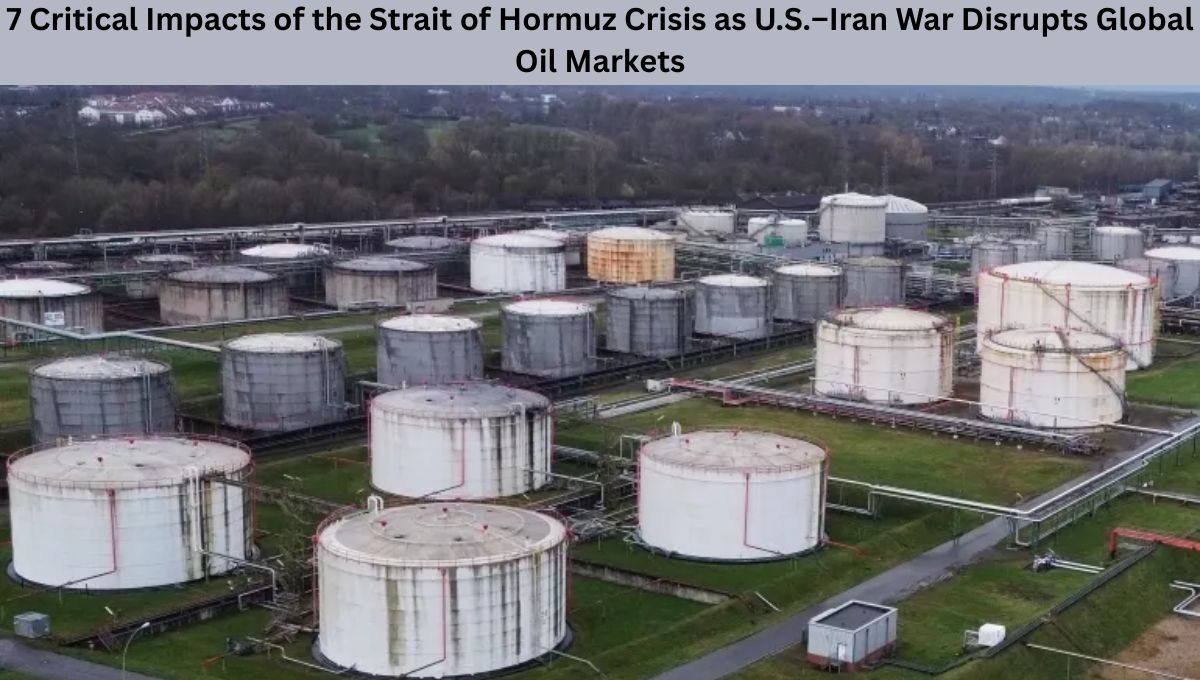
7 Critical Impacts of the Strait of Hormuz Crisis as U.S.–Iran War Disrupts Global Oil Markets and shipping routes. The escalating war between the United States and Iran has triggered one of the most significant disruptions to the global energy system in decades. At the center of the crisis lies the Strait of Hormuz, a narrow but vital waterway through which nearly 20 percent of the world’s oil supply normally passes every day.
In recent weeks, Iranian attacks on commercial vessels and a near-standstill in tanker traffic have pushed oil markets into turmoil. The United States has launched a series of military strikes targeting Iranian missile systems and military infrastructure, while Iran has vowed to continue using the Strait of Hormuz as leverage in the conflict.
Despite earlier statements from Washington suggesting that the U.S. Navy could escort oil tankers through the region, American officials now admit that the military is not yet ready to launch such an operation. The delay highlights the complexity of reopening one of the world’s most important energy corridors amid an active war.
With oil prices surging above $100 per barrel and global markets rattled, the Strait of Hormuz crisis has become a defining geopolitical event with far-reaching consequences for governments, businesses, and consumers around the world.
This article explores seven critical impacts of the Strait of Hormuz crisis, from global energy prices to military escalation and economic ripple effects.
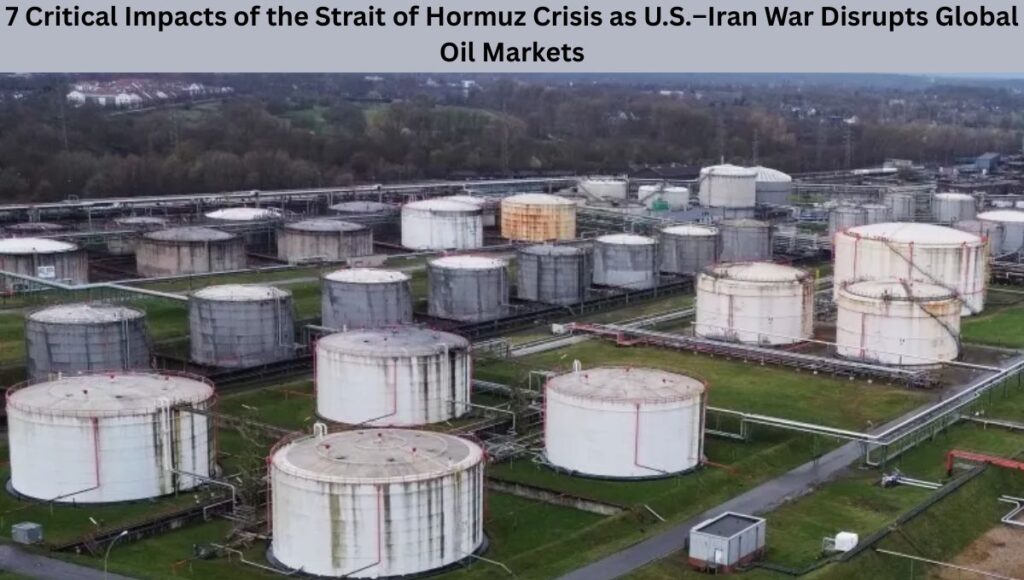
7 Critical Impacts of the Strait of Hormuz Crisis as U.S.–Iran War Disrupts Global Oil Markets
The Strategic Importance of the Strait of Hormuz
A Critical Global Energy Artery
The Strait of Hormuz connects the Persian Gulf to the Gulf of Oman and the Indian Ocean.
It is only about 21 miles wide at its narrowest point, yet it serves as the primary export route for oil from several major producers including:
- Saudi Arabia
- Iraq
- Kuwait
- the United Arab Emirates
- Qatar
- Iran
On a typical day, roughly 20 million barrels of oil pass through the strait.
Because so many countries rely on this route, any disruption can trigger immediate global consequences.
Energy markets respond rapidly to even minor threats in the region, making the strait one of the most geopolitically sensitive chokepoints in the world.
The current conflict has pushed this vulnerability into sharp focus.
1. Global Oil Prices Are Surging
Markets React to Supply Shock
Since the start of the U.S.–Iran conflict in late February, oil markets have experienced dramatic volatility.
Before the war began, global oil prices hovered around $70 per barrel. Within days of escalating hostilities and shipping disruptions in the Gulf, prices surged to nearly $120 per barrel.
Although prices have fluctuated between $80 and $100 in recent days, analysts say the market remains extremely sensitive to developments in the region.
The International Energy Agency (IEA) has already warned that the conflict could create the largest oil supply disruption in modern market history.
Why Oil Prices React So Strongly
Several factors amplify the impact:
- The Strait of Hormuz handles a large portion of global oil exports.
- Tanker traffic has slowed dramatically due to security risks.
- Insurance coverage for ships in the region has become extremely expensive.
- Many shipowners are unwilling to enter a war zone.
Even if the physical waterway remains open, these factors alone can effectively halt trade.
2. Shipping and Maritime Trade Are Under Threat
Tanker Attacks Escalate
Iranian forces and affiliated groups have increasingly targeted commercial shipping in and around the Persian Gulf.
Recent incidents include attacks on multiple vessels:
- A crude oil tanker was struck near Iraqi waters.
- A Malta-flagged chemical tanker was also hit.
- Several container ships reported projectile strikes.
- A Thai cargo vessel was seen burning near the Strait of Hormuz.
Some attacks are believed to involve uncrewed surface vehicles (USVs) or explosive drones, a tactic that has become more common in modern maritime warfare.
These attacks have dramatically increased the perceived risk for shipowners.
Insurance Costs Skyrocket
War-risk insurance premiums have surged. In peacetime, insuring a vessel in the Gulf might cost around 0.25% of the ship’s value.
Today, those premiums have jumped to 1–2%, with ships linked to the United States or Israel paying the highest rates.
For a large tanker valued at $100 million, that difference can mean millions of dollars in additional costs per voyage.
Military Focus Remains on Strikes Against Iran
Earlier in the conflict, U.S. President Donald Trump suggested that the U.S. Navy could escort oil tankers through the Strait of Hormuz.
However, U.S. Energy Secretary Chris Wright recently acknowledged that such operations cannot begin immediately.
According to Wright, American military resources are currently concentrated on:
- destroying Iranian missile systems
- targeting weapons manufacturing facilities
- eliminating maritime strike capabilities
Until these threats are significantly reduced, escort missions would place U.S. warships at extreme risk.
Escort Operations Are Complex
Running a tanker convoy system requires:
- warships
- mine-clearing vessels
- air support
- surveillance assets
In addition, the region is saturated with mobile anti-ship missile systems that can be hidden in civilian vehicles. These missiles pose a serious threat even to advanced naval vessels.
4. The Risk of Wider Military Escalation
Iran’s Leadership Remains Defiant
Iran’s new supreme leader, Mojtaba Khamenei, has publicly stated that closing the Strait of Hormuz is a strategic tool in the war.
In his first public statement since assuming leadership after the assassination of his father, Ali Khamenei, he declared that the blockade would continue as part of Iran’s “deterrent defense.”
Iran has also warned that it would welcome U.S. naval escorts, suggesting it may target American ships if they enter the area.
This raises the possibility that the conflict could escalate into direct naval battles in one of the world’s busiest shipping lanes.
5. Global Inflation Risks Are Increasing
Energy Prices Affect Everything
Rising oil prices rarely remain confined to the energy sector.
Fuel costs affect:
- transportation
- food production
- manufacturing
- aviation
- shipping
As a result, the Strait of Hormuz crisis could contribute to rising inflation across multiple economies.
In the United States alone, gasoline prices have already climbed from $2.94 per gallon last month to around $3.60.
Higher prices are also being reported across Europe and Asia. For many countries that rely heavily on imported energy, the consequences could be severe.
6. Governments Are Releasing Strategic Oil Reserves
Emergency Measures to Stabilize Markets
To prevent a full-scale supply shock, governments have begun tapping emergency reserves.
The International Energy Agency has announced the largest coordinated release of strategic oil stocks in its history.
Member nations plan to release around 400 million barrels from government reserves.
Meanwhile, the United States plans to release 172 million barrels from its Strategic Petroleum Reserve.
These measures are designed to temporarily stabilize global supply and reduce panic in energy markets.
However, analysts warn that such reserves are only short-term solutions. If the Strait of Hormuz remains disrupted for an extended period, these stockpiles may not be sufficient.
7. Insurance and Shipping Markets Face Unprecedented Risk
The U.S. Government Steps In
With private insurers withdrawing from the region, the Trump administration has proposed a new strategy.
The U.S. International Development Finance Corporation (DFC) has been tasked with providing political risk insurance for ships operating in the Gulf.
The plan could cover losses of up to $20 billion. The insurance program will operate primarily through reinsurance, meaning the government will backstop private insurers.
Challenges for the Plan
Industry experts say the plan faces several hurdles:
- The global maritime insurance market is dominated by Lloyd’s of London.
- U.S. insurers rarely operate directly in war-risk markets.
- Shipowners remain reluctant to enter active conflict zones.
In other words, insurance alone may not be enough to restore normal shipping operations.
Military Developments in the Wider Conflict
Airstrikes and Missile Attacks Continue
While the shipping crisis unfolds, military operations across the region continue to intensify.
Recent developments include:
- Israeli airstrikes on Iranian nuclear facilities near Tehran
- U.S. strikes targeting Iranian missile launchers
- Hezbollah rocket attacks on Israel
- drone and missile exchanges across multiple countries
The conflict has already cost the United States more than $11 billion in military operations within the first week.
Despite the heavy bombardment, U.S. intelligence agencies believe the Iranian government remains stable and is not at risk of immediate collapse.
The Possibility of Ground Operations
Some analysts believe that reopening the Strait of Hormuz could eventually require ground operations along the Iranian coastline.
Iran has positioned mobile anti-ship missiles along coastal areas overlooking the strait. These systems are difficult to detect and destroy from the air.
Military experts warn that eliminating them could require troops on the ground—a move that would dramatically escalate the conflict.
For now, Western governments appear reluctant to take that step.
Economic Consequences for the Global Economy
Markets on Edge
The Strait of Hormuz crisis has already triggered sharp reactions in global markets.
Major concerns include:
- rising oil prices
- supply chain disruptions
- higher shipping costs
- inflationary pressure
Countries in Europe and Asia are particularly vulnerable because they rely heavily on Gulf oil exports.
Several governments have already issued public warnings encouraging citizens to reduce energy consumption.
What Happens Next?
The trajectory of the crisis will depend on several key factors:
- Whether the U.S. military begins escorting tankers.
- Iran’s willingness to continue targeting ships.
- The effectiveness of airstrikes against missile systems.
- Diplomatic efforts to de-escalate the conflict.
If the strait remains disrupted for weeks or months, the global economy could face severe consequences.
Energy markets are likely to remain volatile until there is a clear path toward restoring safe passage through the Strait of Hormuz.
Conclusion
The Strait of Hormuz crisis has quickly become one of the most consequential geopolitical events affecting the global economy today.
As the U.S.–Iran war intensifies, the strategic waterway that carries a fifth of the world’s oil supply has turned into a focal point of military confrontation.
With tanker attacks rising, insurance markets collapsing, and oil prices surging, the conflict’s ripple effects are being felt far beyond the Middle East.
Governments are scrambling to stabilize energy markets through emergency oil releases and insurance programs, but these measures offer only temporary relief.
The coming weeks will determine whether the Strait of Hormuz can be reopened safely—or whether the crisis will deepen into a prolonged disruption with lasting consequences for global trade, energy security, and geopolitical stability.
Also Read: 10 Critical Risks if the Strait of Hormuz Closes Amid the US-Iran War
Related Posts:
- 3 Explosive Conditions Iran Sets to End War with US…

- 10 Powerful Revelations from the Trump–Putin Call on…

- 7 Critical Ways Iran’s Yuan Oil Plan Could Shake the…
- 7 Powerful Reasons the U.S. Is Letting Countries Buy…
- 10 Explosive Signals Trump Says Iran War Could End…
- 9 Explosive Claims as Trump Says US Winning Iran War