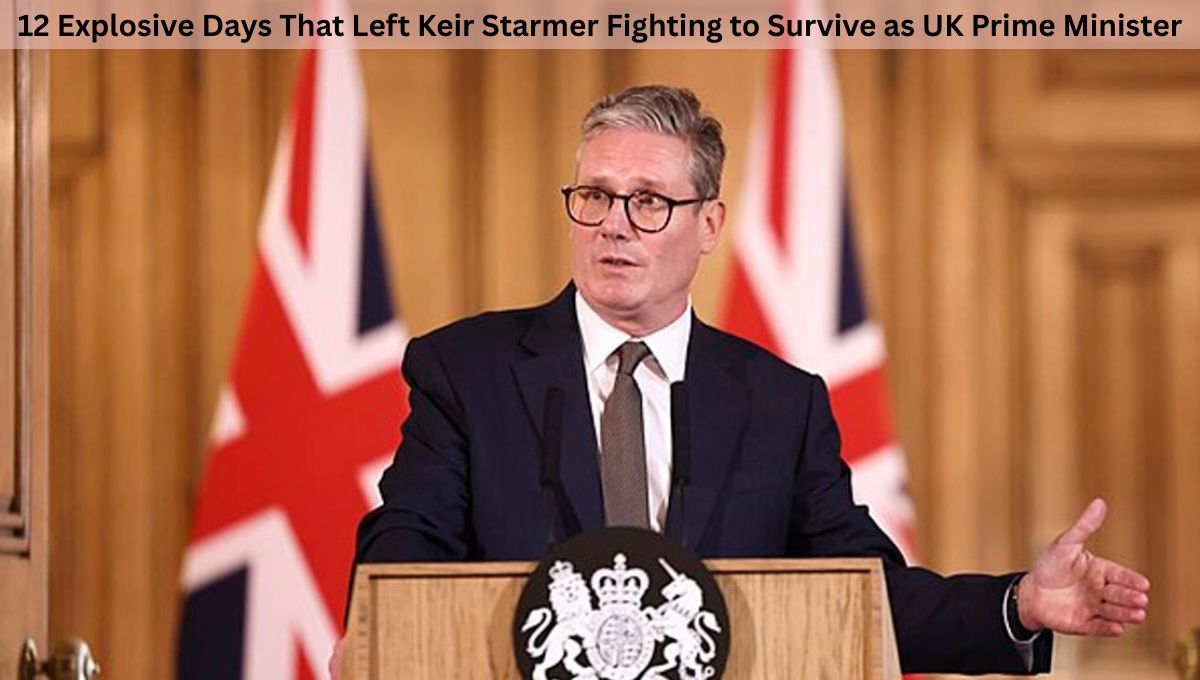
12 Explosive Days That Left Keir Starmer Fighting to Survive as UK Prime Minister amid the Epstein-linked Mandelson scandal. Keir Starmer remains Britain’s prime minister, but only just. After a day of escalating pressure that included the resignation of senior aides, public calls for his departure from within his own party, and relentless media scrutiny, Starmer survived Monday without stepping down.
Thank you for reading this post, don't forget to subscribe!By nightfall, cabinet ministers had rallied around him, Labour MPs applauded him in a closed-door meeting, and Downing Street insisted the government would press on. Yet few in Westminster believe the danger has passed.
What unfolded over February 8 and 9, 2026, was not a single political setback but a cascading crisis—one that has exposed deep divisions inside the Labour Party, raised existential questions about Starmer’s judgement, and reopened the unresolved wounds of Britain’s relationship with elite power, accountability, and scandal.
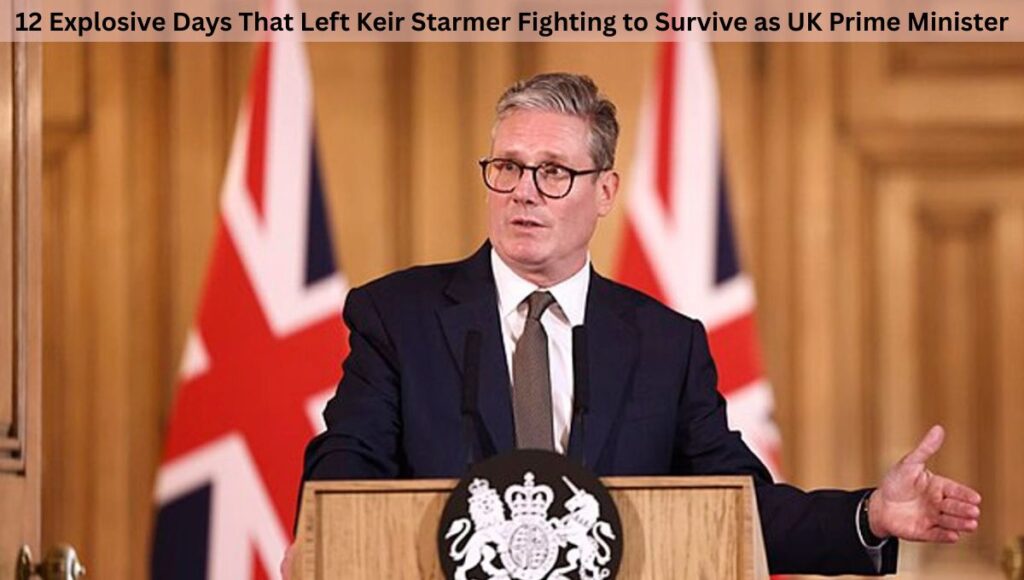
12 Explosive Days That Left Keir Starmer Fighting to Survive as UK Prime Minister
The Trigger: Mandelson, Epstein, and a Fatal Misjudgement
At the heart of the crisis lies one decision:
Keir Starmer’s appointment of Peter Mandelson as Britain’s ambassador to the United States.
Mandelson, a towering figure of the New Labour era and a longtime political survivor, was brought back into the heart of government despite his documented friendship with Jeffrey Epstein, the disgraced financier and convicted sex offender who died in a U.S. jail in 2019.
When Starmer made the appointment in late 2024, he insisted that Mandelson had reassured him about the nature of that relationship.
But the political context shifted dramatically with the release of millions of pages of Epstein-related documents by the U.S. Department of Justice earlier this year.
Those files reignited global scrutiny of Epstein’s elite connections and appeared to reveal uncomfortable details about Mandelson’s proximity to Epstein, including allegations that he may have shared sensitive information while serving as a British minister.
The revelations proved toxic.
Starmer fired Mandelson in September, insisting he had been misled. But the damage had already been done.
The appointment came to symbolise not criminal wrongdoing by Starmer himself, but a failure of judgement—often the more lethal charge in British politics.
Resignations at the Heart of No. 10
The crisis deepened rapidly over the weekend.
On Sunday, Morgan McSweeney—Starmer’s chief of staff, closest adviser, and long-time political lieutenant—resigned, taking “full responsibility” for advising the prime minister to appoint Mandelson.
“The decision to appoint Peter Mandelson was wrong,” McSweeney said. “He has damaged our party, our country and trust in politics itself.”
Less than 24 hours later, Tim Allan, Starmer’s director of communications, also quit, saying he was stepping aside “to allow a new No. 10 team to be built.”
Allan’s departure marked the fourth communications chief to leave Downing Street in under a year, reinforcing the impression of a government struggling to maintain internal stability.
Reports soon followed that Sir Chris Wormald, the cabinet secretary and most senior civil servant in the country, could also step down, adding to the sense of institutional upheaval at the centre of power.
Anas Sarwar Breaks Rank
The political shockwave reached a new level when Anas Sarwar, leader of the Scottish Labour Party, publicly called on Starmer to resign.
Speaking at a press conference, Sarwar described the situation in Downing Street as “not good enough” and said “too many mistakes” had been made.
The decision, he said, caused him “personal hurt and pain,” stressing his “genuine friendship” with Starmer and describing him as a “decent man.”
But Sarwar argued that Labour’s opportunity to defeat the Scottish National Party (SNP) in elections scheduled for May was “too important to be missed.”
“The distraction needs to end,” Sarwar said. “The leadership in Downing Street has to change.”
It was a remarkable intervention:
the first time a senior Labour figure had publicly withdrawn support from a sitting Labour prime minister less than two years after a landslide election victory.
Cabinet Closes Ranks
Almost simultaneously, Starmer’s cabinet moved to contain the damage.
As Sarwar spoke, a coordinated wave of public endorsements flooded social media and broadcast interviews.
Chancellor Rachel Reeves reminded voters that Starmer had been given a “huge mandate” only 18 months earlier.
Energy Secretary Ed Miliband said the party had “looked over the precipice” and concluded that triggering a leadership contest would plunge the country into chaos.
Home Secretary Shabana Mahmood, Foreign Secretary Yvette Cooper, Culture Secretary Lisa Nandy, and others followed suit.
Even Angela Rayner—frequently mentioned as a potential successor—offered her support, warning that the “worst possible response” would be to play internal party games amid a national scandal.
The message was clear: whatever doubts existed, the cabinet was not prepared—yet—to move against the prime minister.
Starmer Faces His MPs
The decisive moment came on Monday evening, when Starmer addressed a packed meeting of the Parliamentary Labour Party.
According to those present, the prime minister struck a defiant tone.
“Every fight I’ve been in, I have won,” he told MPs. “After having fought so hard for the chance to change our country, I’m not prepared to walk away from my mandate or my responsibility—or to plunge us into chaos.”
He acknowledged mistakes, castigated Mandelson’s “shameful behaviour,” and promised changes to how Downing Street operates.
The room responded with applause and, by the end, a standing ovation. Yet several MPs later told reporters that the meeting also featured sharp, forthright criticism.
One Labour MP described colleagues as “very direct” in questioning Starmer’s judgement and leadership.
The applause may have bought time—but not certainty.
Media Verdict: Survival, Not Recovery
Britain’s newspapers reflected the fragile nature of Starmer’s position.
“Blame Me,” declared the Daily Mirror, focusing on McSweeney’s resignation but warning that pressure on the prime minister remained.
The i Paper quoted a Scottish Labour source calling Starmer a “dead man walking.” The Daily Mail asked bluntly: “How long can Starmer cling on?”
The Guardian described McSweeney as a “campaign wizard who lost his magic touch,” while the Sun claimed Starmer had lost both his “human shield” and his “political brain.”
Even supportive outlets acknowledged that Monday may have prevented immediate collapse—but not resolved the underlying crisis.
A Government Under Strain
Starmer’s troubles did not emerge in isolation.
Since Labour’s sweeping victory in July 2024, the government has been dogged by internal disputes over welfare spending, tax commitments, and economic strategy.
Starmer’s approval ratings have slumped sharply, while the populist Reform UK party—born out of the Brexit movement—has surged in the polls.
Local and devolved elections in May, followed by a crucial byelection in Greater Manchester later this month, threaten to turn voter dissatisfaction into concrete losses.
Against that backdrop, the Mandelson affair has acted as an accelerant—converting simmering unease into open revolt.
Why Judgement Matters More Than Guilt
Starmer is not accused of any personal wrongdoing.
Yet British politics is unforgiving when leaders appear out of step with public sentiment. The Epstein files have revived deep mistrust of elite networks, secrecy, and impunity.
In that climate, Mandelson became less a person than a symbol—and Starmer’s decision to rely on him appeared tone-deaf.
Once a leader’s judgement is questioned, authority erodes quickly at Westminster. History is replete with prime ministers undone not by scandal of their own making, but by their inability to read the political moment.
The Succession Question Refuses to Go Away
With Starmer weakened, speculation about potential successors has intensified.
Labour’s rules make leadership challenges difficult, requiring nominations from around one-fifth of Labour MPs.
There is no formal confidence vote mechanism. But if momentum shifts, transitions can be swift.
Angela Rayner
A favourite among Labour’s left and grassroots activists, Rayner brings authenticity and resilience but remains shadowed by unresolved questions over her tax affairs.
Wes Streeting
A polished communicator and ambitious operator, Streeting’s ties to Mandelson and controversial positions on NHS reform complicate his appeal across the party.
Ed Miliband
The former Labour leader enjoys renewed respect as energy secretary, though memories of the 2015 election defeat still linger.
Andy Burnham
Popular and pragmatic, but not currently an MP—an obstacle under Labour rules.
Shabana Mahmood
Increasingly discussed as a serious contender, Mahmood’s profile has risen sharply amid the crisis.
Shabana Mahmood: A Quiet Contender
As home secretary, Shabana Mahmood holds one of the most demanding portfolios in government, overseeing immigration, policing, and national security.
An MP since 2010, Mahmood is known as methodical, tough-minded, and institutionally trusted.
She has backed firmer migration rules, expanded policing powers, and advanced surveillance technology—positions that resonate with Labour’s governing wing but generate friction with its left.
Betting markets and prediction platforms place her in the second tier of contenders, with implied probabilities in the high single digits. She is not a frontrunner—but she is no longer a long shot.
If she were to become prime minister, Britain would have its first Muslim leader—an historic milestone that would likely arrive quietly, as a by-product of parliamentary arithmetic rather than identity politics.
Why Starmer Survived—This Time
Starmer’s survival on Monday owed less to renewed confidence than to fear of the alternative.
Cabinet ministers openly acknowledged that launching a leadership contest would destabilise government at a moment of economic fragility, international uncertainty, and looming elections.
Supporting Starmer became, in that sense, an act of damage control.
But support born of caution is brittle.
What Comes Next
Starmer now faces an unforgiving calendar:
- A Greater Manchester byelection later this month
- Local, Scottish, and Welsh elections in May
- Ongoing police investigations and document reviews related to Mandelson
- Continued pressure from Reform UK and a hostile opposition
Each event will test whether Monday marked a turning point—or merely a pause.
Conclusion: A Premiership on Borrowed Time
Keir Starmer remains Britain’s prime minister.
But his authority has been punctured, his inner circle dismantled, and his judgement placed under a microscope. Survival, for now, does not equal security.
In British politics, crises rarely end with applause. They end when momentum runs out—or turns fatal.
For Starmer, the fight is no longer about winning arguments inside Labour. It is about proving, quickly and convincingly, that he still has the instincts required to lead.
Whether he can do so will define not only his premiership—but the future direction of British politics itself.
Also Read: 7 Critical Signals Behind Starmer’s Bold China Reset Amid US Turmoil
Also Read: Starmer fights for survival as chief of staff quits over Mandelson scandal