

Buying time for negotiations on key disputes, US, China Extend 90-Day Trade Truce to Avoid Tariff Hike. In a move that has eased global market tensions at least temporarily the United States and China have agreed to extend their ongoing trade truce for another 90 days. The extension, signed into effect by President Donald Trump on Monday, delays steep tariff hikes that were set to take place at midnight.
The agreement keeps US tariffs on Chinese goods at 30% and Chinese tariffs on American goods at 10% through November 10, 2025. Without the deal, tariffs would have surged to 54% for Chinese exports to the US and 34% for US exports to China.
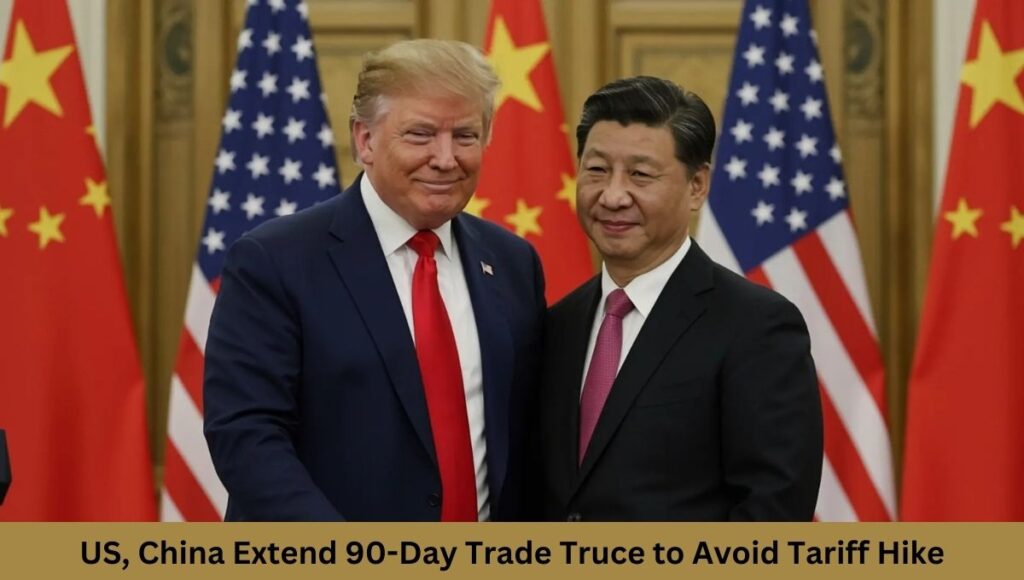
US, China Extend 90-Day Trade Truce to Avoid Tariff Hike
A Last-Minute Deal to Prevent Escalation
The announcement came just hours before the existing trade pause was due to expire.
According to the White House, the extension was designed to give negotiators time to address “trade imbalances” and “unfair trade practices,” while avoiding another round of economic escalation.
Trump called the talks “constructive,” adding:
“We’re getting along with China very well. The relationship is very good with President Xi and myself.”
China’s Ministry of Commerce confirmed the extension and framed it as a step toward “win-win cooperation,” warning that confrontation “will lead nowhere.”
Why the Extension Matters for Businesses
While the truce averts an immediate tariff shock, businesses on both sides of the Pacific remain uneasy about the lack of long-term certainty.
Beth Benike, founder of US-based baby product company Busy Baby, told the BBC:
“There’s no way to plan for the future of the business. Since I have no idea what the tariff is actually going to end up being, I have no control or idea about the pricing that’s going to work for my business.”
The unpredictability of tariff policy has made it difficult for companies to lock in supply contracts, set pricing strategies, and make investment decisions.
How We Got Here: A Volatile 2025 Trade Timeline
Tensions between Washington and Beijing have been running high throughout 2025.
- April 2, 2025 — The US raised tariffs on all Chinese imports from 34% to 84%, escalating to as high as 125% within days.
- April 2025 — China retaliated with its own steep levies, also peaking at 125%, while restricting rare earth exports and limiting access for certain US companies.
- April-May 2025 — Both sides imposed additional measures, including Beijing halting imports of Hollywood films and the US ending duty-free access for low-value Chinese shipments.
- May 2025 — A breakthrough in Geneva brought a temporary truce, lowering US tariffs to 30% and Chinese tariffs to 10%, and rolling back some non-tariff barriers.
Key Issues Still on the Negotiating Table
Even with the 90-day tariff pause, deep disagreements remain between the US and China:
- Rare Earth Minerals — The US is pressing for greater access to China’s rare earth exports, which are essential for defense manufacturing and green technology.
- Russian Oil Purchases — Washington wants Beijing to scale back oil imports from Russia, framing it as a geopolitical priority.
- Technology Restrictions — The US has limited sales of high-end chips and advanced tech to China, though Trump recently allowed chipmakers AMD and Nvidia to resume certain exports in exchange for 15% revenue-sharing with the US government.
- TikTok Ownership — The US is demanding the Chinese-owned social media platform be sold to an American company or face a ban. China has opposed this move.
Tariffs and the Russian Oil Factor
One of the more contentious points involves China’s continued purchases of Russian oil.
Treasury Secretary Scott Bessent warned Chinese officials that ongoing imports could trigger “huge tariffs” under pending legislation that allows for levies of up to 500%.
Interestingly, the Trump administration has already threatened India another buyer of Russian oil with a 50% tariff rate, sparking criticism from New Delhi over being “unfairly singled out.”
Economic Fallout Already Visible
The trade war’s toll on both economies is evident in the numbers.
US government data for June 2025 shows:
- Imports from China down nearly 50% year-on-year.
- US imports from China for the first half of 2025 totaled $165 billion, a 15% decline compared to 2024.
- American exports to China fell 20% over the same period.
These figures highlight the disruption to supply chains and the increased costs faced by businesses and consumers alike.
Why Trump Chose a Pause Instead of a Spike
The White House cited national security and economic concerns in its decision to delay tariff hikes.
Officials also noted “significant steps” taken by China to address US complaints, such as easing certain restrictions on American companies.
Trump himself appeared optimistic but still pressed Beijing to ramp up purchases of US agricultural products especially soybeans in the coming months.
Global Market Reaction
The extension brought temporary relief to global markets already dealing with inflation, volatile energy prices, and supply chain bottlenecks.
Economists warn, however, that a failure to reach a lasting agreement could trigger another round of consumer price increases and industry disruptions worldwide.
China has also stressed its role in stabilizing the global semiconductor supply chain a sector that has faced ongoing shortages.
What Happens After November 10?
If no further agreement is reached by the November deadline, tariffs could spike again, potentially reigniting the full-scale trade war seen earlier this year.
Still, both sides are signaling a willingness to continue talking.
Analysts believe that progress on technology exports, energy trade, and agricultural purchases will be key to avoiding another collapse in negotiations.
Final Takeaway
The 90-day US-China trade truce is a much-needed breather, not a resolution. While it prevents immediate economic pain, the fundamental disputes over rare earth minerals, technology restrictions, and Russian oil imports remain unresolved.
For now, businesses and policymakers worldwide will be watching closely as the clock ticks toward November a date that could either mark a breakthrough in US-China relations or the return of tariff warfare.
Also Read: China Slams U.S. Over Tariff Truce Violations, Vows “Forceful Measures”
Also Read: US-China Tariff Truce Extended Another 90 Days: Implications for Businesses
Related Posts:
- ‘Dragon and Elephant Must Come Together’: PM Modi…
- In 8 Moves, EU Targets China-Linked Refineries and…

- 7 Big Takeaways: Macron’s High-Stakes China Visit…

- U.S.–China Trade War 2025: 500% Tariff Threat Sparks…
- Can the EU and NATO Impose Tariffs on India and…

- Trump’s 20-Point Gaza Peace Plan Gains Urgent Global…
