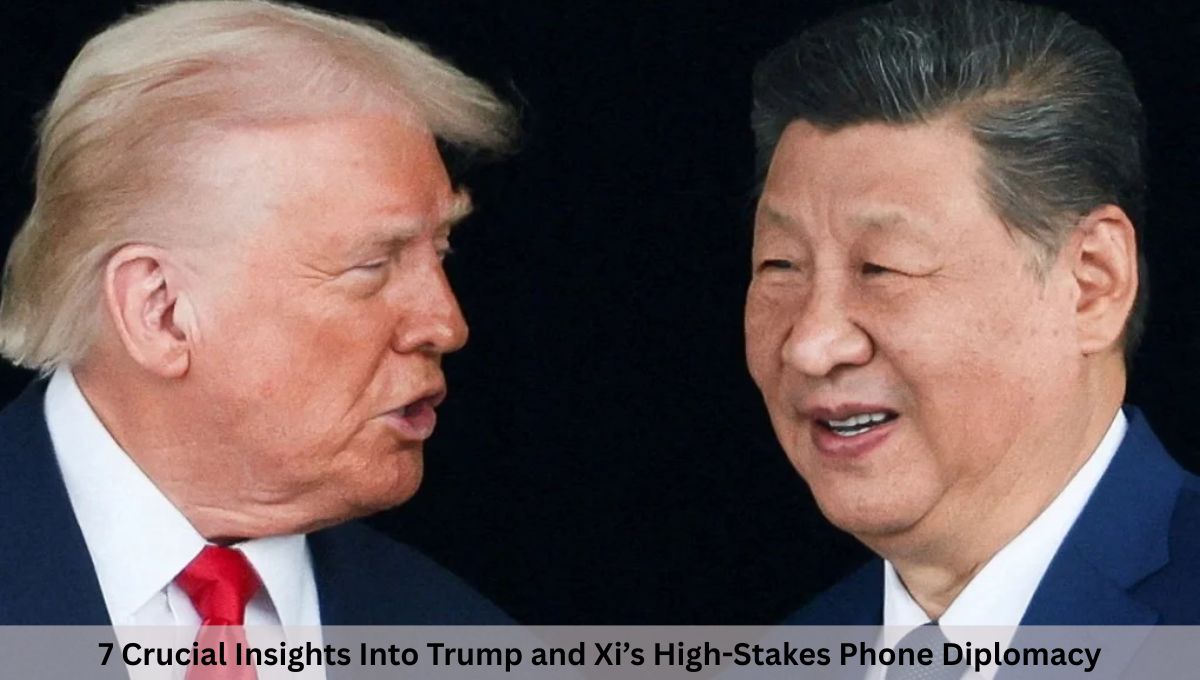
7 Crucial Insights Into Trump and Xi’s High-Stakes Phone Diplomacy on Taiwan, trade, Ukraine, Japan tensions, rare earths, and U.S. farm purchases. Tensions in the Asia-Pacific, fragile progress in trade negotiations, and conflicting strategic priorities came into sharp focus when U.S. President Donald Trump and Chinese President Xi Jinping held a closely watched phone call less than a month after their in-person summit in Busan, South Korea.
What emerged from the conversation—and what each side chose to highlight—offers a remarkable window into the geopolitical calculations shaping one of the world’s most consequential bilateral relationships.
The call, described as “very good” by Trump and “positive, friendly and constructive” by Beijing, touched on everything from Taiwan and the U.S.–China trade truce to Japan’s increasingly assertive posture in the region. Analysts suggest the call’s timing and framing reveal much deeper motives on both sides than what was stated publicly.
Below is a comprehensive breakdown of what was discussed, why it matters, and how the Trump-Xi communication is influencing regional and global diplomacy.

7 Crucial Insights Into Trump and Xi’s High-Stakes Phone Diplomacy
A Phone Call Framed By Escalating Regional Tensions
The call was initiated by the United States, according to China’s foreign ministry, and lasted about an hour. It followed weeks of escalating tensions between Beijing and Tokyo, triggered by Japanese Prime Minister Sanae Takaichi’s blunt statement that Japan could respond militarily if China attacked Taiwan.
Beijing reacted severely:
- issuing a no-travel advisory for Japan
- restricting Japanese films
- banning seafood imports
- expanding military patrols near Taiwan
Japan responded by stepping up missile deployments and coordinating more closely with the United States.
Against this backdrop, Trump placed calls to both Xi and Takaichi on the same day, signaling an attempt to prevent the dispute from spiraling while preserving delicate U.S.–China trade momentum.
What Trump Emphasized—Trade Truce, Soybeans, and “Momentum”
Trump used his post-call messaging to underscore the improving trade relationship with China, presenting the call as part of broader progress since the Busan summit.
Trump: China Will “Buy Faster and Buy More”
Aboard Air Force One, Trump told reporters that Xi had “more or less agreed” to speed up and expand purchases of American agricultural goods—especially soybeans—after months of an unofficial Chinese boycott in retaliation for U.S. tariffs.
“I think he’s going to very much surprise you on the upside,” Trump said.
The U.S. agricultural sector had been hit hard by Chinese import cuts. Trump’s message suggests he believes accelerated soybean purchases will help strengthen American farmers and stabilize rural political support.
Trade Truce Still Fragile
Both sides are now working to finalize “general licenses” enabling Chinese exports of rare earths and critical minerals to the U.S.—a key component of the October truce.
Delays in negotiating these licenses have created uncertainty across industries reliant on rare earths, including:
- automotive manufacturing
- robotics
- consumer electronics
- defense technology
Trump’s team is also weighing whether to allow the sale of advanced AI chips to China—a decision with profound implications for tech competition and national security.
What Xi Emphasized—Taiwan, Postwar Order, and Pressure on Japan
While Trump made no public mention of Taiwan, Beijing’s readout focused heavily on the issue.
Xi Links Taiwan to the Post-WWII Order
According to Chinese state media, Xi told Trump that Taiwan’s return to China was an “integral part of the post-World War II international order,” arguing that China and the U.S. must “jointly safeguard the victory of World War II” in the face of rising militarism.
This framing serves several purposes:
- It positions Taiwan’s fate as historically predetermined.
- It directly challenges Japan’s statements about military intervention.
- It implies the U.S. has responsibilities rooted in wartime cooperation.
Pressure on Japan, With Washington as the Audience
Analysts say Xi’s strong messaging was aimed not only at Trump but also at Tokyo.
Beijing wants the U.S. to rein in Japan’s increasingly bold security rhetoric. While the U.S. continues to support Japan against what Ambassador George Glass called Chinese “coercion,” the Biden and Trump administrations have long been wary of being dragged into a Japan-China conflict over Taiwan.
By highlighting the postwar order narrative, Xi is attempting to frame Japan as the destabilizing party and portray China as the defender of historical legitimacy.
Trump’s Strategic Ambiguity on Taiwan Remains Intact
Though Taiwan dominated Beijing’s public statements, Trump avoided addressing it outright.
The U.S. Position
Officially, the U.S.:
- does not recognize Taiwan as a sovereign state,
- opposes forced reunification, and
- is legally obligated to support Taiwan’s self-defense.
This forms the basis of America’s long-standing strategic ambiguity—a deliberately unclear stance on whether the U.S. would intervene militarily.
Trump’s Recent Moves
Trump has:
- approved a $330 million arms package for Taiwan
- urged Taiwan to invest more heavily in its defense
- maintained secrecy on whether the U.S. would send troops in a crisis
Beijing protested the arms sale, calling it a “gross violation” of the one-China principle.
Trump’s silence on Taiwan in his readout could signal an attempt to preserve negotiating space with China while avoiding conflict with Japan. It may also reflect a strategic choice to steer public focus toward trade, an area where Trump wants visible wins.
Japan at the Center of Multiple Diplomatic Fault Lines
Japan’s new prime minister, Sanae Takaichi, has taken an unusually hawkish stance on China and Taiwan. Her statement about potential military intervention marked one of Tokyo’s strongest positions in decades.
Xi used the Trump call to push back, while Trump used his own call with Takaichi to reassure Japan that the U.S. remains a committed ally.
The U.S. finds itself balancing three competing priorities:
- Preventing Japan–China tensions from escalating
- Maintaining Taiwan’s security
- Preserving progress on the U.S.–China trade truce
This balancing act is central to understanding the complexities surrounding the Trump-Xi communication.
Ukraine Crisis: China Stays “Neutral,” Trump Pushes for Progress
Both sides confirmed that the Ukraine war was discussed.
China’s Position
Xi repeated China’s standard messaging:
- support for “all efforts conducive to peace”
- hope that the crisis will be resolved “at its root”
- refusal to condemn Russia
- insistence that Beijing remains neutral
Western governments, however, argue that China has enabled Russia through industrial and economic support.
Trump’s Goals
The Trump administration is pushing a new diplomatic initiative aimed at ending the war. China’s involvement, even rhetorically, is seen by U.S. officials as helpful in pressuring Moscow.
For both leaders, the Ukraine issue remains an opportunity to project statesmanlike leadership without making commitments that would jeopardize strategic interests.
Fentanyl, Trade, and Farm Products: Trump’s Domestic Messaging
Trump highlighted discussions on fentanyl production—a top domestic political issue for the U.S.
He also emphasized progress on:
- soybean purchases,
- farm trade,
- and efforts to “keep agreements current and accurate.”
This domestic-focused messaging contrasts with Beijing’s priority on Taiwan and regional geopolitics. It suggests Trump sees trade and fentanyl as areas where progress can yield immediate political benefits at home.
Rare Earths and AI Chips: The Next Phase of U.S.–China Competition
Rare Earths: A Potential Breakthrough
At the Busan summit, China agreed to suspend rare earth export restrictions for one year. These minerals are essential for:
- smartphones
- electric vehicles
- semiconductors
- military hardware
The U.S. wants predictable access, while China is trying to maintain leverage without breaking the truce.
AI Chips: A Major Decision Looms
Commerce Secretary Howard Lutnick said the decision on allowing advanced AI chip sales to China “sits right on the desk of Donald Trump.”
Some advisers warn that selling such chips risks accelerating China’s AI development, undermining U.S. technological dominance.
The call did not include specific agreements on AI chips or rare earths, suggesting these remain points of quiet friction beneath the surface goodwill.
Trump Accepts Xi’s Invitation to Visit Beijing in April
One of the biggest outcomes of the call—at least from the U.S. side—was Trump’s announcement that he will visit Beijing in April and has invited Xi for a state visit to Washington later next year.
China’s readout did not mention any such visit.
This omission is significant. Diplomatically, it indicates that:
- Beijing wants to control the narrative
- China may finalize the visit later depending on the regional situation
- Xi does not want to appear to be responding to pressure
The fact that the call was reportedly initiated by China (according to analysts interpreting Beijing’s unusual phrasing) suggests that Beijing may be feeling urgency regarding Japan and Taiwan.
But withholding confirmation of Trump’s visit allows China to keep leverage.
Competing Narratives Reveal Diverging Priorities
The stark contrast between the two readouts offers insight into each leader’s priorities.
China’s Priorities
- Taiwan
- Japan’s growing military posture
- Framing Taiwan as a post-WWII issue
- Positioning the U.S. as a partner in stabilizing Japan
The U.S. Priorities
- Trade stability
- Soybean purchases
- Fentanyl enforcement
- Managing geopolitical tensions without committing
These divergent emphases show how differently each government views the same diplomatic engagement.
Why the Call Matters: A Critical Moment in Asian Geopolitics
The Trump-Xi phone call was not simply routine diplomacy. It occurred at a moment when multiple flashpoints are intersecting:
- competition over rare earths
- growing tensions over Taiwan
- Japan’s increasing strategic assertiveness
- the Ukraine war
- escalating trade and technology restrictions
- U.S. domestic political pressure
What stands out is that both leaders see value in maintaining communication—even amid mistrust and rivalry.
Outlook: What To Watch in the Coming Months
Analysts point to several indicators that will determine the trajectory of U.S.–China relations:
1. China’s Military Activity Around Taiwan
Any increase in air or naval patrols would signal Beijing’s attempt to further pressure both Japan and the U.S.
2. U.S.–Japan Strategic Coordination
Will Washington continue to support Tokyo’s tougher stance, or try to restrain it to keep China engaged?
3. Rare Earths Licensing
Failure to finalize these licenses could risk unraveling the trade truce.
4. AI Chip Export Decision
Trump’s decision will shape the next decade of U.S.–China tech rivalry.
5. Confirmation of Trump’s April Visit
China’s silence suggests contingencies remain.
Conclusion: A Diplomatic Dance With Global Consequences
The Trump-Xi phone call reflected a complicated interplay of cooperation, rivalry, and strategic messaging. While both leaders hailed progress, their contrasting interpretations reveal deeper tensions beneath the surface.
For Trump, the call is an opportunity to showcase gains for farmers, demonstrate diplomatic leadership, and stabilize a fragile trade truce. For Xi, it is a chance to assert China’s authority on Taiwan, confront Japan’s rhetoric, and reinforce China’s role as a global power.
As Trump prepares for a potential April visit to Beijing, the world’s two largest economies appear to be entering a new phase of cautious engagement—one marked by both opportunity and profound uncertainty.
Also Read: Trump and Xi Jinping Discuss TikTok’s Future and US-China Trade: A Comprehensive Update
Also Read: Beijing says US initiated Trump-Xi call, which was ‘positive, friendly and constructive’