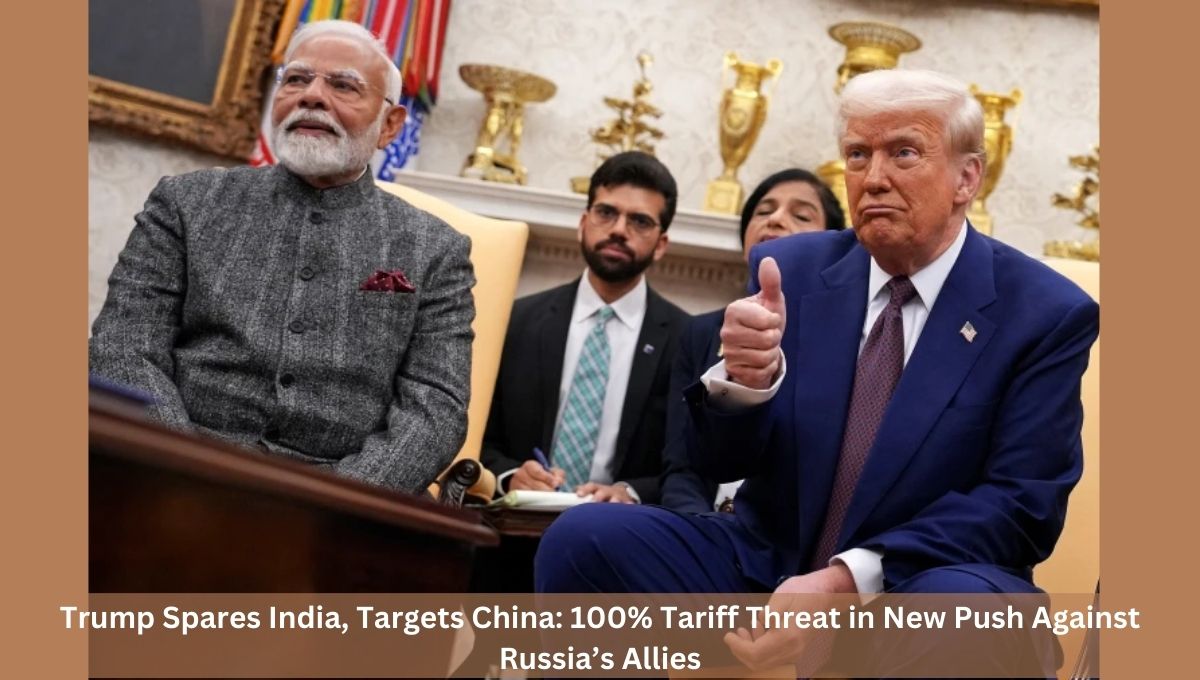
Shifting his tariff fire, Trump Spares India, Targets China: 100% Tariff Threat in New Push Against Russia’s Allies. After months of bitterly berating India for buying Russian oil and subjecting New Delhi to heavy tariffs, US President Donald Trump has recalibrated his strategy. In a fiery Truth Social post and a letter addressed to NATO members and “the world,” Trump declared that China — not India — is now the prime enabler of Russia’s war in Ukraine.
In his post, Trump thundered that NATO nations must “stop buying oil from Russia” and unite to impose “major sanctions” on Moscow. He coupled that demand with a call for devastating 50% to 100% tariffs on Beijing, describing China as the country holding a “strong grip” over Russia’s economy.
“Whether you choose violence or not, violence is coming to you. You either fight back or you die.” — Donald Trump, in his Truth Social letter to NATO.
For India, the sudden shift is a reprieve. Just weeks earlier, Trump had slapped 50% tariffs on Indian goods — including a 25% penalty linked directly to Russian oil purchases — while branding New Delhi the “Kremlin’s laundromat.” Now, Washington’s rhetoric has softened dramatically, with Trump calling Prime Minister Narendra Modi a “dear friend” and a “great Prime Minister.”
The recalibration underscores Washington’s dilemma: it cannot afford to push India further into the arms of Russia and China, even as it seeks to weaken Moscow’s war machine.
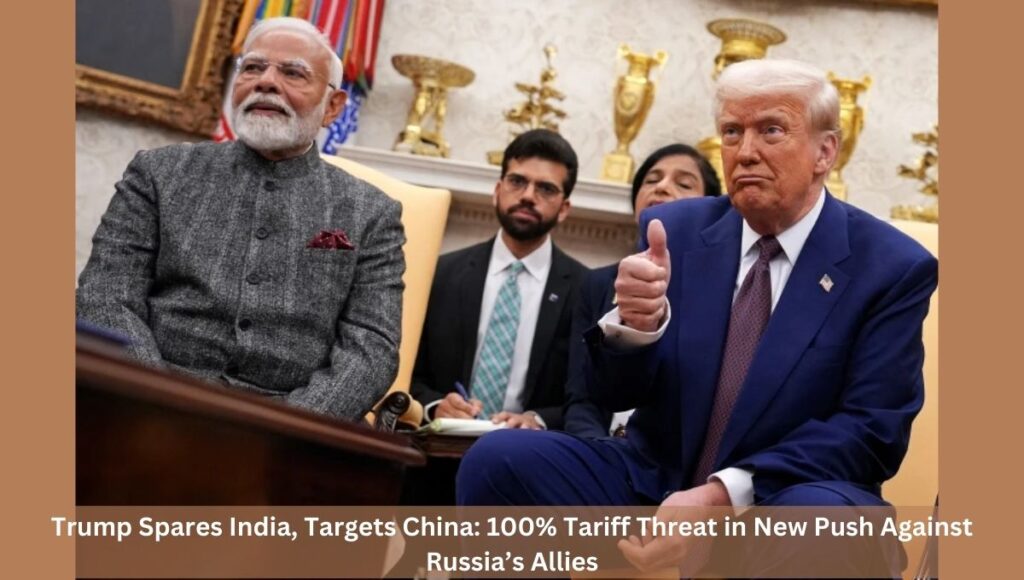
Trump Spares India, Targets China: 100% Tariff Threat in New Push Against Russia’s Allies
Trump’s Letter: “I Am Ready to Go When You Are”
Trump’s latest broadside was styled as both a letter and a rallying cry to NATO allies. His message was blunt:
- Stop buying Russian oil. Trump accused alliance members of “shocking” hypocrisy by continuing to import energy from Moscow.
- Collective sanctions. He vowed to impose “major sanctions” on Russia, but only if all NATO nations act in unison.
- Target China with tariffs. Trump demanded NATO impose 50%–100% tariffs on Chinese goods, to remain until the war in Ukraine ends.
“I am ready to do major sanctions on Russia when all NATO nations have agreed, and started, to do the same thing, and when all NATO Nations STOP BUYING OIL FROM RUSSIA,” Trump wrote. “Anyway, I am ready to ‘go’ when you are. Just say when?”
Trump argued that heavy tariffs on Beijing would weaken its grip over Russia, hastening the end of what he called a “deadly, but ridiculous war.”
From Punishing India to Praising Modi
The sharp pivot is striking given Trump’s earlier hostility toward India. Over the past year, his administration unleashed some of the harshest rhetoric against New Delhi in decades, accusing it of financing Russia’s war.
- India was branded the “Kremlin’s laundromat.”
- Trade advisor Peter Navarro accused Indian “Brahmins” of profiteering, drawing backlash for casteist undertones.
- Trump fumed that the US had “lost” India to “the darkest China” after images of Modi chatting warmly with Xi Jinping and Vladimir Putin at the SCO summit went viral.
The optics rattled Washington. Modi’s visible camaraderie with Putin — walking hand-in-hand, sharing car rides, and holding candid talks — alongside his cordial exchanges with Xi, symbolized a strengthening trilateral bond between India, Russia, and China.
Yet despite sustained pressure, New Delhi held firm:
- Trade red lines. India refused to open its agricultural and dairy sectors to US demands, citing risks to millions of farmers.
- Energy independence. India continued buying discounted Russian crude, citing national interest.
- Strategic autonomy. Modi’s government refused to let Washington dictate its foreign policy.
Faced with this resolve, the US had little choice but to change tack.
Last week, Trump abruptly softened his tone, calling Modi a “great Prime Minister” and describing India as a “natural partner.” Modi reciprocated, calling the US a “close friend” and voicing optimism about unlocking the “limitless potential” of the partnership.
Why Trump Pivoted: Strategic and Domestic Calculations
Trump’s recalibration is driven by both strategic imperatives abroad and political realities at home.
1. Strategic nightmare of a Russia-China-India bloc
Washington fears the nightmare scenario of India, China, and Russia banding together. With the SCO summit showcasing growing warmth among the three, alienating India further could have pushed it permanently into Moscow and Beijing’s orbit.
2. Domestic political backlash
At home, Trump faced criticism for his confrontational approach:
- Democrats and Republicans alike warned against undoing two decades of painstaking US-India relationship-building.
- The influential Indian-American community, increasingly leaning toward the Republican Party, bristled at the tariffs and rhetoric. Alienating them carries electoral risks.
3. China as the bigger enabler
By July, China’s imports of Russian fossil fuels reached USD 7.2 billion — double India’s USD 3.6 billion. Beijing’s role as Moscow’s primary economic lifeline became undeniable, strengthening the case for shifting US pressure toward China.
4. Trade negotiations
India has refused to yield on agriculture and dairy, but Washington knows it cannot afford a complete breakdown. By easing pressure, Trump is signaling flexibility in hopes of reviving stalled talks.
Beijing Pushes Back: Wang Yi Responds
China wasted little time in responding to Trump’s tariff threat. Foreign Minister Wang Yi, speaking in Ljubljana alongside his Slovenian counterpart, rejected Washington’s accusations:
“China does not participate in wars or plot them. War cannot solve problems, and sanctions only complicate them.”
Beijing dismissed Trump’s claim of a Chinese “grip” over Russia, framing itself instead as a peace-seeking power. But the response underscored Beijing’s unease at becoming the primary target of Trump’s tariff campaign.
NATO and G7 in the Spotlight
Trump’s demand for collective action throws the ball into NATO and the G7’s court.
- NATO dilemma. Several members — including Turkey, Hungary, and Slovakia — still buy significant volumes of Russian oil. Trump blasted this as “shocking.”
- G7 coordination. US Treasury Secretary Scott Bessent urged G7 finance ministers to impose tariffs on Russia’s enablers. Canada, Germany, France, Italy, Japan, and the UK discussed using frozen Russian assets to fund Ukraine.
- EU’s role. The EU has pledged to phase out Russian energy imports by 2028, but Trump is pressing for faster action.
Bessent stressed:
“Only with a unified effort that cuts off the revenues funding Putin’s war machine at the source will we be able to apply sufficient economic pressure to end the senseless killing.”
Also Read: Could Trump’s tariff threats force Putin into Ukraine peace deal?
Poland Drone Incident Adds Pressure
Trump’s latest message also came against the backdrop of heightened tensions in Eastern Europe. On Wednesday, multiple Russian drones violated Polish airspace — the most serious incursion into NATO territory since the war began.
- Poland shot down the drones, calling the incident deliberate.
- NATO allies scrambled jets and helicopters.
- Romania reported its airspace breached by another Russian drone, triggering an F-16 response.
Secretary of State Marco Rubio called the incursion “unacceptable and dangerous,” though Trump downplayed it, suggesting it “could have been a mistake.”
The drone episode has revived NATO fears of escalation and added urgency to Trump’s call for energy sanctions.
India’s Leverage: Strategic Autonomy Pays Off
India’s steadfastness has effectively forced Washington’s hand. By standing firm on its oil imports and refusing to yield on trade red lines, New Delhi has compelled Trump to acknowledge its leverage.
- India’s Russian oil purchases stand at USD 3.6 billion monthly — significant, but dwarfed by China’s.
- India’s importance as a counterweight to China remains undeniable for Washington.
- Modi’s government has shown it will not sacrifice national interests, even under tariff pressure.
In essence, India’s strategic autonomy has paid dividends, earning it newfound respect in Washington’s recalibrated approach.
The Road Ahead: Tariffs, Sanctions, and Uncertainty
Trump’s recalibration opens several scenarios:
- Tariffs on China. If NATO and G7 allies align, Beijing could face crippling 50–100% tariffs, escalating global trade tensions.
- Sanctions on Russia. Trump insists he is ready to devastate Russia’s finances — but only with collective NATO action.
- India-US reset. Softer rhetoric may revive stalled trade talks, though Modi’s red lines on agriculture and dairy remain non-negotiable.
- China’s counterstrategy. Beijing may deepen ties with Moscow to offset tariff shocks, further polarizing global alliances.
For now, the only certainty is that Trump’s tariff chessboard is shifting — and India, once the prime target, now finds itself courted, while China shoulders the weight of Washington’s fury.
Conclusion: A Recalibrated US Strategy
Donald Trump’s sudden pivot from punishing India to targeting China with 100% tariff threats is more than a tactical adjustment. It reflects the limits of US pressure, the leverage of Indian strategic autonomy, and the recognition that China is the real enabler of Moscow’s war economy.
By sparing India and pressing NATO to align on sanctions, Trump is betting that he can isolate Russia, weaken Beijing’s support, and keep New Delhi within Washington’s strategic orbit. Whether this recalibration succeeds will depend on NATO unity, G7 resolve, and how far China is willing to go to shield Russia.
But one thing is clear: in the contest over Russia’s war, India is no longer the villain — China is.
Related Posts:
- “Don’t Want Them To Buy Russian Oil”: Trump Urges…
- Can the EU and NATO Impose Tariffs on India and…

- Trump’s 2025 Gaza Peace Plan Signing and Historic…

- Trump Urges EU to Slap 100% Tariffs on China and…

- 5 Powerful Highlights as Trump Lands Second Nobel…

- 9 Explosive Revelations as Trump Declares His Health…