
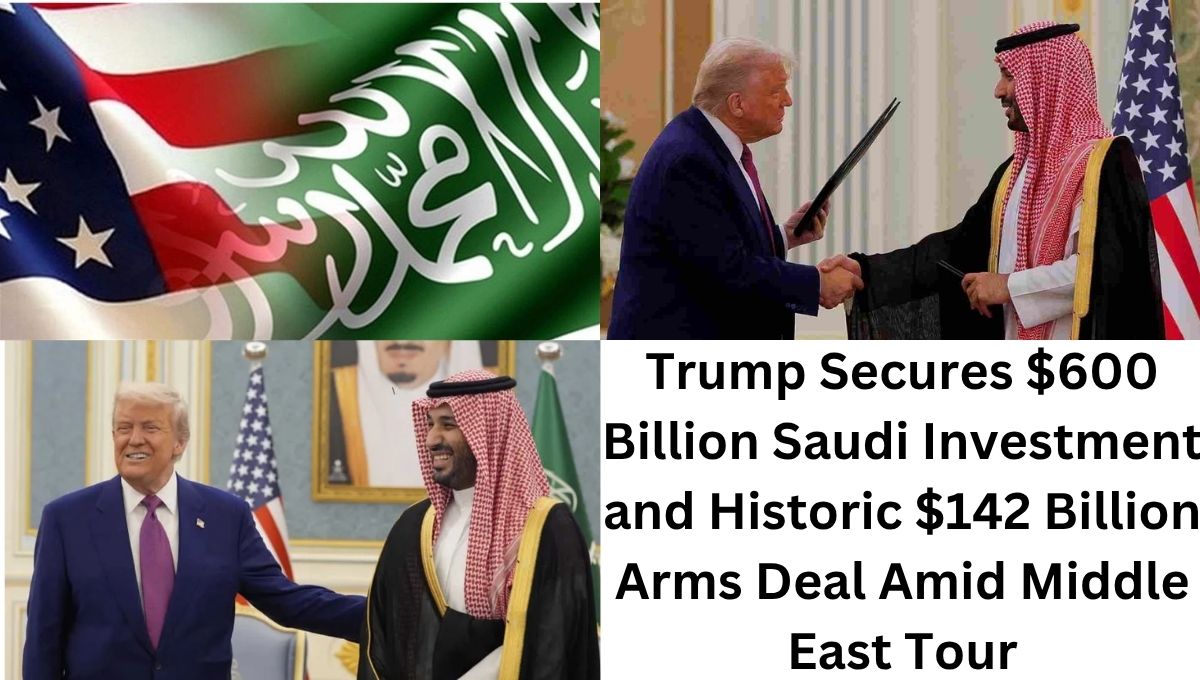
Striking landmark deal with Saudi Arabia Trump Secures $600 Billion Saudi Investment and Historic $142 Billion Arms Deal Amid Middle East Tour. In a striking show of pageantry and high-stakes diplomacy, former US President Donald Trump arrived in Riyadh to a royal welcome, punching the air as he stepped off Air Force One. The President was greeted personally by Crown Prince Mohammed bin Salman (MbS).
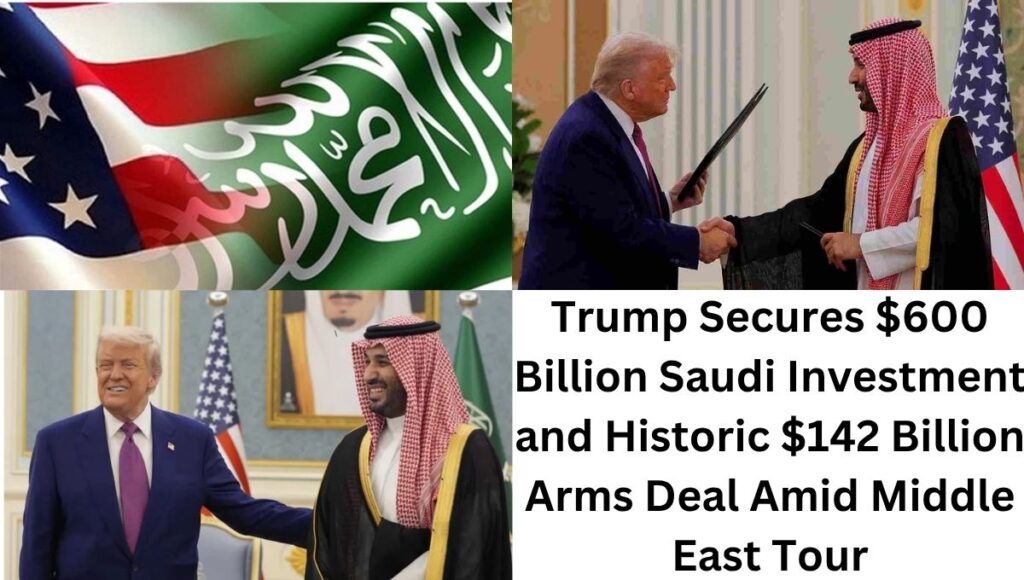
Trump Secures $600 Billion Saudi Investment and Historic $142 Billion Arms Deal Amid Middle East Tour
Trump Strikes $600B Deal with Saudi Arabia, Calls MbS a Friend
Trump secured a strategic economic partnership with Saudi Arabia worth a reported $600 billion including a historic $142 billion arms deal that the White House hailed as the largest in history. The agreement spans energy, defense, mining, and advanced technology.
It underscores the transactional nature of Trump’s “America First” diplomacy, which prioritizes business over human rights or democratic ideals.
Trump declared, “I really believe we like each other a lot,” in a meeting with MbS, calling him a friend and praising the kingdom’s rapid modernization under Vision 2030.
US-Saudi Relations Cemented with Major Defense Agreement
At the heart of the economic package is the landmark $142 billion arms deal, comprising sales from over a dozen US defense companies. The package includes advanced air and missile defense systems, border security solutions, and emerging space capabilities.
The White House emphasized the job-creation impact of the deal back home and called it a pivotal moment in the decades-long security-for-oil alliance between the two nations.
Trump’s warmth toward MbS stands in contrast to previous administrations. Ties had been strained during President Joe Biden’s term over the 2018 killing of journalist Jamal Khashoggi.
Trump has firmly distanced his approach from such controversies, stating in his Riyadh speech that the Middle East should be “defined by commerce, not chaos.”
Trump Pivots on Syria with Surprise Meeting and Sanctions Pledge
In a move raising eyebrows in Washington and beyond, Trump announced he would meet Syria’s new leader, Ahmed al-Sharaa, a former rebel commander who led forces that ousted Bashar al-Assad in 2024.
Trump revealed plans to lift sanctions on Syria, signaling a major pivot in US policy. Sharaa reportedly promised access to Syrian oil, lucrative reconstruction contracts, and even the construction of a Trump Tower Damascus as a symbolic gesture of partnership.
Critics slammed the decision, pointing to Sharaa’s past links to extremist groups. However, Trump’s team framed the move as another example of pragmatic diplomacy driven by American economic interests.
Business Titans Join Trump in Riyadh
The US-Saudi investment forum, timed with Trump’s visit, featured prominent American business leaders including Elon Musk, BlackRock’s Larry Fink, Blackstone CEO Stephen A. Schwarzman, and OpenAI’s Sam Altman. Discussions centered on tech collaboration, defense innovations, and AI-driven development.
Saudi Arabia’s deputy CEO of NEOM, Rayan Fayez, noted that over $1 billion in tech investments largely in US firms are being channeled into frontier technologies aligned with Vision 2030.
Among the biggest announcements was a $20 billion commitment to US-based AI data centers, and a $5 billion Boeing aircraft purchase.
Trump’s Foreign Policy: Dealmaking Over Democracy
Trump’s speech in Riyadh marked the clearest articulation yet of his rejection of “nation-building” and traditional human rights diplomacy. He blasted previous administrations for what he called misguided interventions and declared an end to moral grandstanding.
“The so-called nation builders wrecked far more nations than they built,” Trump said. Instead, Trump promoted his signature transactional approach: make a deal, get investment, and avoid interference in domestic affairs.
The message resonated with many in the region’s leadership keen for modernization without the scrutiny of Western liberalism.
Notably absent from Trump’s itinerary was Israel, a longtime US ally. The omission has sparked concern in Jerusalem, where officials quietly expressed unease over America’s shifting focus.
With the war in Gaza still raging, Trump is pressuring Prime Minister Benjamin Netanyahu for a ceasefire but admitted that a Saudi-Israeli normalization under the Abraham Accords framework would take time.
“I really think it’s going to be something special – but you’ll do it in your own time,” Trump said, referring to Saudi Arabia potentially recognizing Israel. The Gaza conflict, however, remains a roadblock to deeper diplomatic progress.
Qatar’s Controversial Gift Raises Eyebrows
Adding to the spectacle, Trump reportedly accepted a proposed gift from Qatar’s ruling family a luxury Boeing 747-8 jet, dubbed an “aerial palace.”
The jet, which could be retrofitted as a new Air Force One and later housed at Trump’s presidential library, has drawn criticism from congressional Democrats, who decry the move as unprecedented and unethical.
In true Trump fashion, he dismissed the criticism online, branding his opponents as “World Class Losers!!!” and asserting the jet is a “transparent transaction” that benefits the American people.
Conclusion: A New Era of Middle East Diplomacy
Trump’s whirlwind Middle East tour marks a stark shift in US foreign policy. Anchored in investment, commerce, and political pragmatism, his dealings with Saudi Arabia, Syria, and Gulf leaders reflect a departure from traditional alliances and moral imperatives.
With the signing of a $600 billion Saudi investment pledge and a $142 billion arms deal, Trump has positioned himself as a master dealmaker on the world stage elevating economic cooperation while sidelining the long-standing emphasis on democracy and human rights.
Also Read: Trump Visits Saudi Arabia Seeking $1 Trillion Investment Boost for U.S. Economy
Also Read: Weapons industry cheers as Trump inks Saudi $142B arms deal
Related Posts:
- Donald Trump’s Lavish UK State Visit: From Kate…

- 7 Shocking Revelations from Trump’s Defense of MBS…
- Donald Trump’s Historic Second UK State Visit:…

- 7 Stunning Signs Trump and Musk Are Repairing Their…

- 7 Powerful Ways the US–Saudi $1 Trillion Partnership…
- Saudi Arabia's 'Sleeping Prince' Dies After 20-Year Coma
