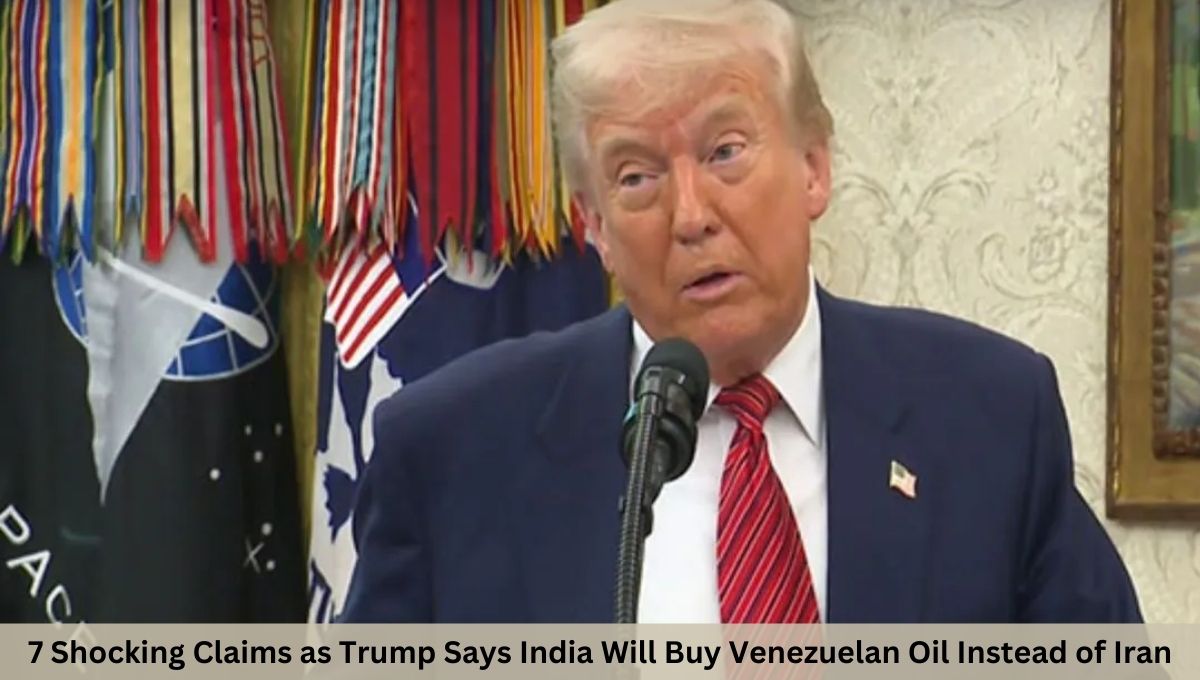
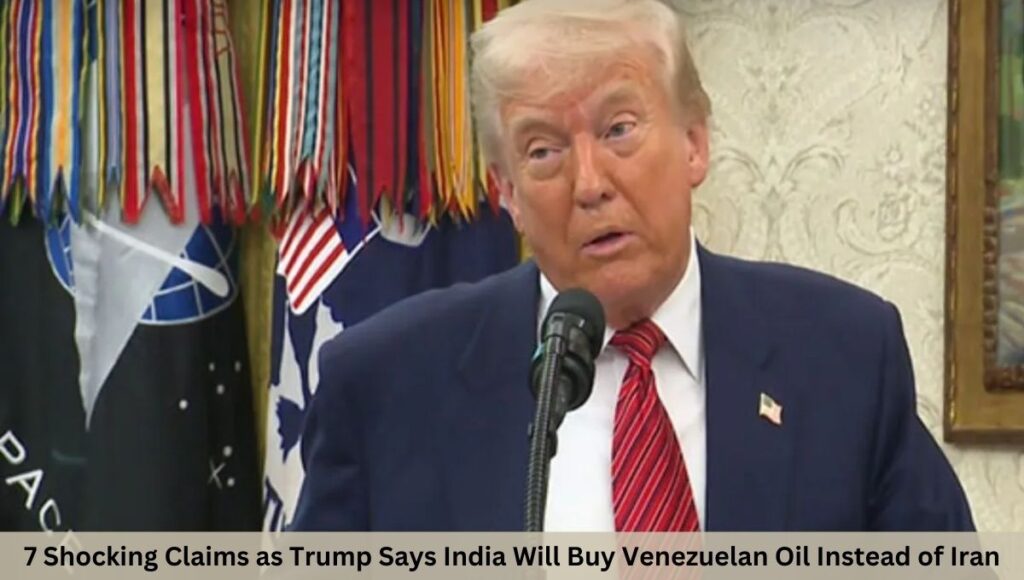
7 Shocking Claims as Trump Says India Will Buy Venezuelan Oil Instead of Iran, Igniting Political Backlash. US President Donald Trump has once again set off global debate by claiming that India has agreed to buy Venezuelan oil instead of crude from Iran — a statement that New Delhi has neither confirmed nor denied so far.
Speaking to reporters aboard Air Force One while traveling from Washington to Florida, Trump said, “We’ve already made that deal, the concept of the deal. India is coming in, and they’re going to be buying Venezuelan oil as opposed to buying it from Iran.”
The remark has triggered political reactions in India, raised questions about Washington’s control over Venezuela’s oil sector, and highlighted the shifting geopolitics of global energy markets at a time when sanctions, tariffs, and strategic alliances are being rapidly recalibrated.
7 Shocking Claims as Trump Says India Will Buy Venezuelan Oil Instead of Iran
Trump’s Claim: What Exactly Did He Say?
Trump’s statement suggests that India is prepared to replace Iranian crude with Venezuelan oil — a notable assertion given that India has not imported significant volumes of Iranian oil since 2019 due to US sanctions related to Tehran’s nuclear programme.
Trump framed the development as part of a broader US-led strategy to redirect oil flows away from sanctioned or politically sensitive suppliers such as Iran and Russia.
According to Trump:
- India will buy Venezuelan oil “instead of Iran”
- The deal is already agreed upon “in concept”
- China could also enter into similar arrangements for Venezuelan crude
However, crucially, no official confirmation has come from the Indian government.
India Hasn’t Bought Iranian Oil for Years
One of the key inconsistencies highlighted by analysts is that India already stopped importing Iranian oil in 2019 under pressure from US sanctions.
Before sanctions, Iran was one of India’s largest crude suppliers, offering favorable pricing and freight terms.
After cutting Iranian imports:
- Indian refiners initially turned to US oil
- Later shifted heavily to discounted Russian crude following Western sanctions on Moscow after its invasion of Ukraine in 2022
- Russia eventually became India’s largest oil supplier
This context raises questions over Trump’s framing that Venezuelan oil would replace Iranian crude, when Iranian imports are already negligible.
Venezuela Back in Play After US Sanctions Shift
Trump’s comments come amid a significant shift in Washington’s Venezuela policy.
The US government recently lifted some sanctions on Venezuela’s oil industry, making it easier for US companies and allies to trade Venezuelan crude.
According to sources cited by Reuters:
- The US has informed India that it may soon resume Venezuelan oil purchases
- The move is intended to help India reduce dependence on Russian oil
- Washington is seeking to curb Russian oil revenues linked to the Ukraine war
A Bloomberg report also showed that Venezuelan crude shipments to the US surged in January, with:
- Around 275,000 barrels per day heading to US refineries
- Deliveries more than doubling compared to December
- Shipments to China falling to zero during the same period
India’s Russian Oil Pivot Under Pressure
India’s oil strategy since 2022 has been shaped largely by economics rather than politics. Russian crude, sold at deep discounts due to Western sanctions, became highly attractive to Indian refiners.
At its peak:
- India imported over 1.2 million barrels per day of Russian oil
- Russia overtook Iraq and Saudi Arabia as India’s top supplier
However, US pressure intensified in 2024 and 2025:
- Trump imposed a 25% tariff on countries buying Venezuelan oil in March 2025
- Later doubled duties on Indian exports to 50% over Russian oil purchases
- Warned of further tariff hikes if India did not curb imports
By late 2025, data showed India gradually cutting Russian oil imports, with projections suggesting:
- Imports falling below 1 million bpd
- Potential decline to 500,000–600,000 bpd in coming months
Congress Questions Why Trump Is Making India’s Announcements
Trump’s remarks quickly drew political fire in India, particularly from the Congress party.
Congress leader Jairam Ramesh questioned why key foreign policy and economic decisions appear to be announced by the US president rather than India’s own government.
Sharing Trump’s remarks on X, Ramesh said:
“He told us Op Sindoor had been halted. He told us India had stopped buying Russian oil. And now this.”
He added:
“President Trump continues to give us information on what our own government has done or will be doing.”
The opposition has demanded clarity from the Modi government on whether:
- Any oil deal with Venezuela exists
- India has agreed to specific volumes or timelines
- Such decisions were influenced by tariff threats
Piyush Goyal Responds: ‘Not My Subject’
Union Commerce Minister Piyush Goyal refrained from confirming or denying Trump’s claim.
In an interview, Goyal said:
“I don’t know anything about oil, as that is not my subject.”
He dismissed opposition criticism, suggesting it reflected a lack of trust in India’s institutions rather than substance.
However, his comments did little to clarify the existence or scope of any Venezuela-related oil agreement.
Modi–Rodriguez Call Adds to Speculation
Fueling speculation further was a recent phone call between Prime Minister Narendra Modi and Venezuela’s acting President Delcy Rodríguez.
Key points from the conversation:
- Agreement to take India–Venezuela relations to “new heights”
- Discussion on energy, trade, investment, agriculture, technology, and health
- Emphasis on cooperation within the Global South
This was the first leadership-level contact since the US captured former Venezuelan President Nicolás Maduro in January, an event Trump claims placed Venezuela’s oil sector effectively under US oversight.
While energy cooperation was mentioned, no specific oil deal was announced.
US Claims Control Over Venezuela’s Oil Industry
Trump has repeatedly claimed that the United States is now effectively running Venezuela’s oil sector after the capture of Maduro. He has said that Washington intends to control Venezuela’s oil sales and revenues indefinitely.
This raises critical global questions:
- Who controls pricing and allocation of Venezuelan crude?
- Would Indian purchases be routed through US companies?
- Could future political shifts in Washington alter access again?
Analysts warn that while Venezuelan oil could diversify India’s supply mix, it also introduces new layers of geopolitical risk.
China Also Mentioned in Trump’s Remarks
Trump also suggested China could strike a deal to buy Venezuelan oil, saying:
“China is welcome to come in and would make a great deal on oil.”
This indicates Washington’s broader strategy of repositioning Venezuelan crude within global markets — not as a sanctioned asset, but as a US-controlled supply lever.
Why This Matters for Global Energy Markets
The controversy highlights several major global trends:
- Sanctions are being weaponized to reshape energy flows
- Traditional oil alliances are weakening
- Emerging economies like India are under growing pressure to align energy policy with geopolitics
For India, the challenge lies in balancing:
- Energy security
- Cost competitiveness
- Strategic autonomy
Any confirmed move toward Venezuelan oil would mark another shift in India’s post-Ukraine energy realignment.
Bottom Line: Claim, Not Confirmation
As of now:
- Trump claims a deal exists
- US officials signal openness to Venezuelan oil exports
- India has not officially confirmed any agreement
- Political and market reactions remain mixed
Until New Delhi makes a formal announcement, Trump’s statement remains a claim rather than a confirmed policy shift — but one that underscores the intense geopolitical pressure shaping global oil markets in 2026.
Also Read: 7 Explosive Choices Facing Trump as Iran Standoff Nears Breaking Point
Also Read: Trump says India will start buying oil from Venezuela ‘as opposed to Iran’