Amid the ongoing Ukraine war, Russia Warns US, Japan, South Korea Over North Korea Alliance. In a sharp rebuke to growing trilateral military cooperation between the United States, South Korea, and Japan, Russian Foreign Minister Sergey Lavrov has issued a strong warning:
do not build alliances aimed at isolating North Korea.
The statement, delivered during Lavrov’s high-profile visit to Pyongyang, underscores the expanding Russia–North Korea military alliance and signals a serious shift in Asia-Pacific security dynamics.
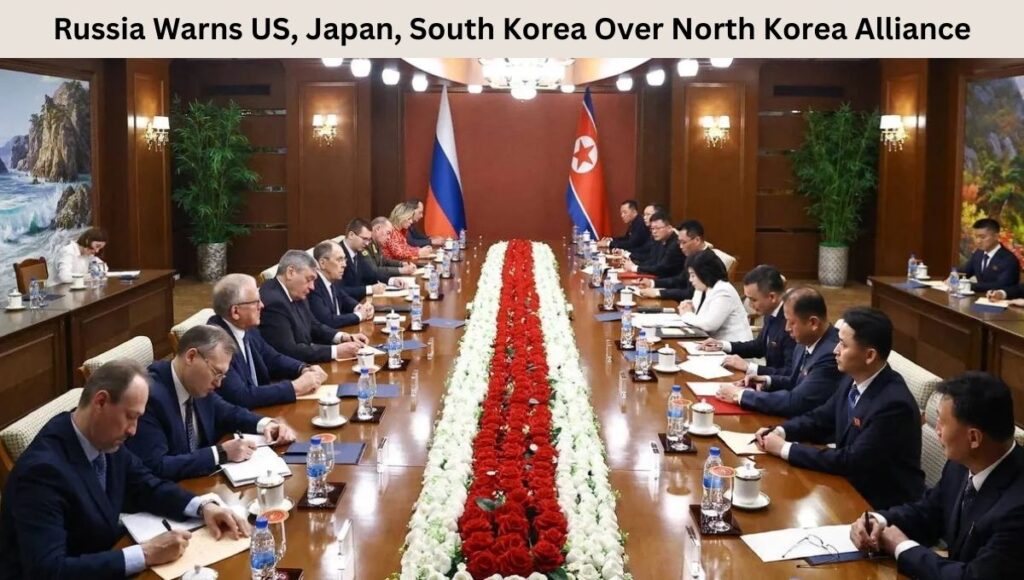
Russia Warns US, Japan, South Korea Over North Korea Alliance
Lavrov’s Visit to North Korea: Strategic Messaging From Moscow
Arriving in the eastern port city of Wonsan, Lavrov was received by North Korean leader Kim Jong Un in a carefully staged diplomatic encounter that featured images of both leaders smiling aboard a luxury yacht.
Wonsan, home to key missile facilities and the new Kalma beach resort, served as the perfect backdrop for a visit that was as symbolic as it was strategic.
“We exchanged views on the Ukrainian crisis. Our Korean friends confirmed their firm support for all the objectives of the special military operation,” Lavrov said.
The visit follows Russian President Vladimir Putin’s rare 2024 trip to North Korea, where the two countries signed a mutual defense pact and pledged deeper military cooperation.
Kim Jong Un Pledges “Unconditional Support” for Russia’s War in Ukraine
According to KCNA, Kim Jong Un reiterated “unconditional support for all measures” taken by Russia in Ukraine, emphasizing solidarity with Moscow amid rising global tensions.
The North Korean leader expressed confidence that the Russian military and people would triumph, defending their national interests and sovereignty.
“The steps taken by our two allies in response to global changes will contribute greatly to peace and security in the world,” Kim stated.
This powerful show of allegiance marks a shift from historical ambivalence to full-fledged military partnership between Pyongyang and Moscow.
North Korean Troop Deployment to Ukraine: An Escalating Commitment
As confirmed by Ukrainian intelligence and Western defense officials, North Korea has already deployed more than 11,000 troops to assist Russia in Ukraine.
Many of these forces played key roles in defending Russia’s Kursk region during a Ukrainian cross-border offensive.
Lavrov thanked Kim for “heroic” contributions in stabilizing the Russian border, noting that Pyongyang would send an additional 6,000 military engineers and builders for reconstruction.
Over 4,000 North Korean soldiers have been killed or wounded, revealing the intensity of North Korea’s involvement in active combat zones far beyond its borders.
Technology in Exchange for Troops? Analysts Raise Alarms
Experts argue this deepening alliance is not just based on shared ideology but on a strategic barter system.
According to Professor Robert Kelly of Pusan National University, North Korea is likely receiving advanced Russian military technology, including warhead guidance systems and drone tech, in exchange for manpower and artillery.
“North Korea is gaining something it cannot develop locally advanced tech that could bolster its nuclear and missile programs,” said Kelly.
With a per-soldier payment structure in place, Pyongyang appears to be leveraging its troops for military upgrades, making this alliance particularly dangerous for regional stability.
Arms and Ammunition: Pyongyang Supplies the Kremlin
In addition to troops, North Korea has become a critical weapons supplier for Russia. A recent UN report stated that Pyongyang sent over 100 ballistic missiles and 9 million artillery shells to Russia in 2024 alone.
North Korean artillery manuals have even been translated into Russian, showcasing a growing interoperability between their militaries.
Ukrainian intelligence chief Kyrylo Budanov estimates that 40% of Russian ammunition now originates from North Korea.
Lavrov’s Warning to the US, South Korea, and Japan
In one of the most direct confrontations during his visit, Lavrov condemned the growing US–South Korea–Japan alliance, which has conducted multiple joint air drills involving U.S. nuclear-capable bombers in the Korean Peninsula.
“We warn against exploiting these ties to build alliances directed against anyone, including North Korea and, of course, Russia,” Lavrov stated at a press conference.
Lavrov’s comments reflect Moscow’s concern that a new anti-North Korea coalition could threaten not just Pyongyang’s sovereignty but Russia’s eastern flank.
Russia Defends North Korea’s Nuclear Program
Lavrov also voiced explicit support for North Korea’s nuclear weapons program, a stance that sharply contrasts with Western policy.
“The technologies used by North Korea are the result of the work of its own scientists. We respect North Korea’s aspirations and understand the reasons why it is pursuing nuclear development,” Lavrov said.
This endorsement may embolden Pyongyang to continue expanding its missile tests, further alarming neighboring countries and the broader international community.
Economic Cooperation and Russian Tourism to North Korea
Beyond military cooperation, Lavrov and Kim discussed expanding economic and tourism ties. Russia pledged to increase tourist flows to North Korea, with the Kalma coastal resort being presented as a new destination for Russian travelers.
Lavrov confirmed plans to resume direct flights between Moscow and Pyongyang and continue work on a bridge over the Tumen River, which would connect Russia, North Korea, and China.
“Wonsan is a good tourist attraction. We hope it becomes popular with Russians as well,” Lavrov said.
Regional Diplomacy: Russia’s Influence Spreads Through Asia
Lavrov’s visit to North Korea followed high-level meetings in Kuala Lumpur with US Secretary of State Marco Rubio at the ASEAN summit.
After Pyongyang, Lavrov traveled to China for the Shanghai Cooperation Organisation (SCO) meeting.
In a significant development, Lavrov confirmed that Belarus has invited North Korea to join an upcoming Eurasian Security Architecture conference in Minsk.
Moscow views this gathering as a counterweight to NATO, further expanding its anti-Western diplomatic network in Asia and Eurasia.
Western Reaction: Growing Alarm Over Tech Transfers
In Washington, Seoul, and Tokyo, alarms are ringing over possible Russian transfers of sensitive weapons technology to North Korea.
The concern is that North Korea could acquire long-range missile guidance systems, drone tech, or even warhead reentry technology, exponentially increasing the threat posed by its arsenal.
“This is not just about troops or ammo it’s about real-time, battlefield-enhanced nuclear capability,” said one senior NATO official on condition of anonymity.
Trump Resumes Military Aid to Ukraine
The timing of Lavrov’s visit also coincides with renewed US military aid to Ukraine. President Donald Trump, after a brief pause, confirmed a new shipment of Patriot air defense systems as part of a NATO-coordinated support package.
Ukrainian President Volodymyr Zelenskyy thanked the U.S. and announced the arrival of envoy Keith Kellogg to Kyiv, affirming continued Western resolve to counter Russian aggression.
Russia’s Intensifying Attacks on Ukraine
Just days before Lavrov’s visit to North Korea, Russia launched one of its largest aerial assaults on Ukraine, firing 26 cruise missiles and 597 drones in a single night.
Ukrainian forces intercepted most projectiles, but casualties were reported in Chernivtsi and other cities.
Another wave of attacks 728 drones and 13 missiles came the following day, signaling Moscow’s escalating pressure on Ukraine’s defense systems.
What’s Next: More Troops, More Tech, More Tension
South Korean intelligence has warned that North Korea may deploy more troops in July or August, with another Kim-Putin summit potentially in the works.
Lavrov’s trip confirms that Russia and North Korea are rapidly aligning militarily, diplomatically, and economically.
With both countries seeking to undermine Western alliances, a new Cold War-era alignment seems to be taking shape one where mutual defense treaties, battlefield experience, and nuclear posturing could destabilize Asia for years to come.
Conclusion: The Moscow–Pyongyang Axis and the New Asian Order
The growing alliance between Russia and North Korea solidified through troop deployments, weapons deals, and strategic diplomacy represents a seismic shift in global geopolitics. As the West rallies behind Ukraine and reinforces security pacts in East Asia, Russia and North Korea are redrawing the lines, asserting their place in a new, multipolar world order.
With Kim Jong Un vowing unconditional support and Russia offering critical military technologies, the partnership is no longer symbolic it’s operational. The emerging Moscow–Pyongyang axis poses one of the most serious security challenges in the region since the Korean War. As tensions continue to rise and alliances harden, the future of peace in East Asia and beyond now rests on how these fault lines evolve in the months ahead.
Also Read: Kim Jong Un Launches Luxury Beach Resort as North Korea Bets on Tourism
Also Read: Russia warns US, South Korea & Japan against military buildups around North Korea