7 Explosive Claims: Putin’s Sacred War Rhetoric Shocks the World, triggering fierce backlash from global church leaders. Russian President Vladimir Putin has once again blurred the line between faith, state power, and military aggression—this time by explicitly likening Russia’s war effort in Ukraine to the mission of Jesus Christ.
Speaking during an Orthodox Christmas service attended by Russian servicemen and their families, Putin declared that Russian soldiers were carrying out a “sacred” and “holy” mission, acting “as if on the Lord’s orders.”
The remarks, delivered from a church located on the grounds of a GRU-linked military facility near Moscow, have triggered outrage among religious leaders, analysts, and international observers.
As the war approaches its fourth year, Putin’s language signals a deepening ideological shift:
the invasion of Ukraine is no longer framed merely as a geopolitical necessity, but as a divinely sanctioned civilizational struggle.

7 Explosive Claims: Putin’s Sacred War Rhetoric Shocks the World
Orthodox Christmas at a Military Church
A Carefully Chosen Setting
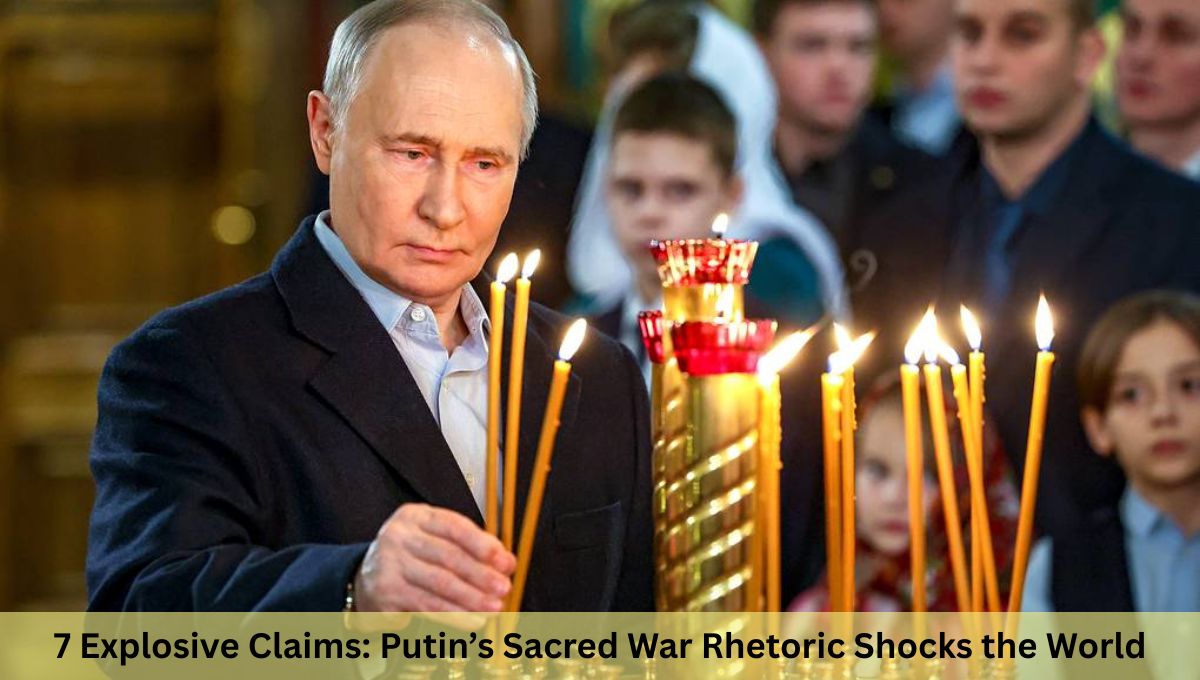
The Kremlin said Putin attended a midnight Orthodox Christmas service at the Church of St. George the Victorious in the Moscow region.
While the location was not officially disclosed at first, journalists and investigators later identified the church as being located within the Senezh Special Purpose Centre—home to GRU military unit 92154.
This was no ordinary Christmas appearance. Putin stood among uniformed intelligence officers, senior GRU commanders, and their families.
Video footage released by the Kremlin showed the president in a dark suit, without a tie, as clergy conducted the liturgy surrounded by Russia’s military elite.
The symbolism was unmistakable: Orthodoxy, the armed forces, and the state fused into a single narrative.
“As If on the Lord’s Orders”
Putin’s Core Message
In remarks published by the Kremlin, Putin drew a direct parallel between Jesus Christ and Russian soldiers fighting in Ukraine.
“We often call the Lord the Savior because He came to Earth to save all people,” Putin said. “In the same way, Russia’s warriors have always carried out this mission—defending the Fatherland, saving the Motherland and its people.”
He repeated the theme several times, stressing that throughout Russian history, soldiers had been regarded as people fulfilling a “holy mission,” entrusted by God himself.
The president also addressed the children of military personnel present at the service, telling them they had every right to be proud of their parents, as Russians had “always” taken pride in their warriors.
From Political War to Sacred Duty
Religion as Justification
Putin’s remarks marked a deliberate escalation in rhetoric. By invoking God’s will, he reframed the invasion of Ukraine not as a political choice or strategic calculation, but as a moral and spiritual obligation.
This narrative shift serves several purposes:
- It sanctifies military violence.
- It discourages internal dissent by portraying opposition as immoral.
- It transforms casualties into religious sacrifice rather than political cost.
In effect, the Kremlin is recasting the war as a holy duty—one beyond debate or compromise.
Unity Across Faiths—or Militarized Faith?
Putin claimed that the joy of Christmas was shared by all Russian troops, including those of other religions, stressing unity within the armed forces.
“We rejoice with them when they celebrate their holidays,” he said. “Victory is always one for all.”
However, critics argue that this rhetoric masks a deeper militarization of religion, where faith is selectively deployed to reinforce loyalty to the state and justify prolonged conflict.
Backlash from Global Church Leaders
‘More Like the Anti-Christ’
Putin’s remarks provoked sharp condemnation from Christian leaders outside Russia, particularly in Ukraine and Europe.
Father Myroslav Pushkaruk of the Ukrainian Orthodox Church dismissed Putin’s claims outright.
“Trying to do this with power and violence, which is not about love, not about Christian values, is more like the Anti-Christ,” he said.
Former Bishop of Leeds Nick Baines echoed the criticism, stating: “Seen from a Christian perspective, you don’t use unholy means to pursue a holy mission.
When that unholy means involves slaughtering people and invading their country, it becomes indefensible.”
Accusations of Heresy and Idolatry
The ‘Russian World’ Ideology
The Synod of the Ukrainian Orthodox Church has previously condemned Putin’s “Russian World” ideology as heretical. The doctrine suggests that Russia, Ukraine, and Belarus form a single spiritual and civilizational space—“Holy Russia.”
More than 90 church leaders from across Europe condemned the ideology at a conference in Helsinki, warning that it distorts Christianity to justify territorial expansion.
Father Taras Khomych, a Catholic priest and senior lecturer in religious studies, described Putin’s language as “idolatry” and “a distortion of Christianity.”
“It exalts war, destruction and death in order to lay the foundations for territorial claims,” he said. “This is a devilish way of using the word of God.”
Christmas Amid Missiles and Airstrikes
Words and Warfare Collide
Even as Putin spoke of salvation and holiness, Russian forces launched fresh night-time strikes across Ukraine. Missiles hit residential areas in Dnipro, injuring civilians, including children aged eight and sixteen.
Schools and kindergartens were damaged, and hospitals in Lviv temporarily lost power due to ongoing attacks on energy infrastructure.
The timing was stark. While Christmas is traditionally associated with peace and reconciliation, Russia’s actions underscored the gap between rhetoric and reality.
The GRU Connection Raises Alarms
Why the Location Matters
The church where Putin attended the service is located on the grounds of a GRU special operations base linked by European intelligence agencies to covert activities across Europe.
Military unit 92154 has been associated with alleged sabotage operations, including railway explosions in NATO member Poland and a broader network accused of parcel-bomb attacks using commercial shipping services.
Putin’s presence at a GRU-linked site—combined with religious rhetoric—sent a clear message of endorsement to Russia’s intelligence and covert operations apparatus.
Propaganda, Not Piety
Ukraine’s Counter-Disinformation Response
Ukraine’s Center for Countering Disinformation described Putin’s Christmas appearance as systematic propaganda.
“Instead of words about reconciliation—glorification of war,” the CCD said. “Instead of family warmth—demonstrative closeness to the army.”
The agency warned that the Kremlin is preparing Russian society for a long war by embedding militarism into religious and cultural traditions, including targeting children and youth with ideological messaging.
A War of Ideology Before a War of Tanks
Father Taras Khomych warned that peace efforts would fail unless the ideological roots of the conflict are addressed.
“The war of Russian aggression started with the war of ideology,” he said. “The full-scale invasion was just the consequence.”
As US-backed peace talks continue in Paris, analysts say Putin’s increasingly radical language suggests he has little interest in compromise.
Why This Matters Beyond Ukraine
Putin’s framing of the war as divinely sanctioned raises broader concerns:
- It lowers the threshold for escalation.
- It makes negotiations politically dangerous for the Kremlin.
- It deepens polarization between Russia and the West.
- It risks inspiring extremist narratives beyond Russia’s borders.
By placing the war in a sacred context, Putin is not merely fighting for territory—he is fighting for historical destiny.
Conclusion: Faith as a Weapon of War
Vladimir Putin’s comparison of Russian soldiers to Jesus Christ marks one of the most extreme examples yet of religious rhetoric being weaponized to justify modern warfare.
As missiles fall on Ukrainian cities and peace remains elusive, the Kremlin’s message is clear:
this is not just a war of borders or politics, but a battle framed as holy, eternal, and unquestionable.
For critics, that framing is precisely what makes it so dangerous.
Also Read: 5 Explosive Signals in Zelensky’s “What’s Next” Hint to Putin
Also Read: Putin Compares Russian Soldiers to Jesus Christ in Orthodox Christmas Speech