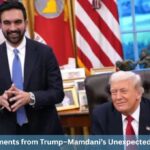
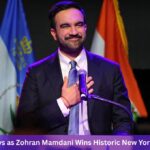
7 Striking Insights into How Zohran Mamdani Disarmed Donald Trump with cultural tact, strategic communication, and political realism. The political world expected fireworks when New York City Mayor-elect Zohran Mamdani walked into the Oval Office for his first meeting with US President Donald Trump. Their campaign-season insults had been unusually personal.
Mamdani branded Trump a “fascist” and “despot,” while Trump called him a “communist lunatic,” a “jihadist,” and a danger to New York. But what unfolded before cameras was something entirely different — warm smiles, conciliatory tones, and mutual flattery. For many observers, the cordial meeting was strategically rich, culturally revealing, and politically disruptive.
It also exposed deeper truths about the shifting architecture of American politics, the role of diasporic identity in communication, and the unique position Mamdani occupies as one of the most unconventional figures to ever lead New York City.
This extensive analysis breaks down the many layers of the Mamdani–Trump moment:
the South Asian “uncle diplomacy” that shaped his demeanor, the strategic calculations behind Trump’s warmth, the reaction across the political spectrum, and the shockwaves now complicating New York Republican Elise Stefanik’s gubernatorial ambitions.
It also weaves in Congress leader Shashi Tharoor’s notable praise for the Mamdani–Trump meeting — a rare moment of bipartisan admiration across continents. Below is a comprehensive deep dive into how this symbolic meeting reshaped narratives, alliances, tensions, and expectations.

7 Striking Insights into How Zohran Mamdani Disarmed Donald Trump
The Unexpected Warmth of the Oval Office Encounter
The White House meeting between Zohran Mamdani and Donald Trump had been anticipated as a confrontation. Instead, the president seemed delighted. At one point, Trump even complimented Mamdani’s looks and said he shared “many of the same ideas” as the democratic socialist mayor-elect.
The media captured Trump patting Mamdani’s arm, smiling broadly, and positioning himself as an unexpectedly supportive figure. This was a stark contrast to February’s infamous shouting match between Trump and Ukrainian President Volodymyr Zelensky, or Trump’s tense accusations of “white genocide” during his meeting with South African President Cyril Ramaphosa.
Why the change in tone?
To some analysts, the answer was simple: political self-interest. Trump’s popularity in parts of New York had grown due to voter frustration over cost of living. Aligning himself with a charismatic, newly elected mayor — one embraced by sections of the working class — carried political benefit.
But this explanation alone fell short. Many South Asian Americans offered another perspective, one rooted not in politics, but in familiarity.
The “Uncle Disarmament Strategy” — A Diasporic Skill on Full Display
For countless South Asian viewers, Mamdani’s body language struck an intimate chord. His subtle smile, his respectful head tilt, and his calm, unflappable tone brought back memories of navigating older, overbearing family elders — the archetypal “aunties” and “uncles” of the diaspora.
The Cultural Technique: Tactical Deference
Indian diarist Kedar Gadgil described Mamdani’s approach as “the desi art of letting the elder talk while quietly keeping the steering wheel of our own intent.”
It is a strategy millions of South Asians use:
- letting authority figures dominate the conversation
- appearing agreeable without yielding values
- projecting respect even while disagreeing internally
- letting elders feel their influence without conceding agency
Times of India journalists noted that South Asians “immediately recognized” the maneuver — the quiet strength of allowing an elder to speak freely while keeping one’s own agenda intact.
The South Asian Muscle Memory
Yamuna Meleth, an actor raised by Indian immigrant parents, described this as “Desi training.”
“There is a patience instilled in you — trained to let advice go in one ear and out the other.”
Afshana Haque, a therapist specializing in South Asian clients, echoed this sentiment:
“It’s similar to navigating aunties at a party telling us who to marry or what career to choose — while staying polite.”
In the Oval Office, Mamdani used this cultural fluency masterfully. When Trump asked him to confirm whether NYC “loved” the president, Mamdani politely pivoted to affordability — his signature political message. His tone stayed respectful, but the message remained firm.
For many South Asians, the scene felt deeply relatable.
Mamdani Stands Firm: “Trump Is Still a Fascist and a Despot”
Despite Trump’s warmth, Mamdani made it unequivocally clear that he had not softened his stance toward the president.
On NBC’s Meet the Press, he stated:
“Everything I’ve said in the past, I continue to believe.”
Mamdani emphasized that cooperation and criticism are not mutually exclusive:
- He wasn’t in the Oval Office to flatter Trump.
- He wasn’t there to “make a stand” or perform.
- He was there to deliver results for New Yorkers on affordability and safety.
This reaffirmation carried political weight. It signaled that his courteous tone in the meeting was strategic, not ideological.
This paradox — sharp criticism paired with respectful engagement — resonated widely. It also fueled debate about political maturity, cultural nuance, and the evolving dynamics of American public life.
Shashi Tharoor Praises the Mamdani–Trump Meeting as a Democratic Model
Across the world, Indian politician Shashi Tharoor — often seen as a leading intellectual voice in the Congress party — weighed in with unexpected praise.
Tharoor highlighted the meeting as an example of how political rivals should behave after elections:
“Fight passionately in elections. But once it’s over, learn to cooperate in the common interest.”
Tharoor’s comments also reflected on the polarized climate in India, where even neutral remarks are attacked as praise. He emphasized the importance of balance over ideological purism — echoing Mamdani’s own approach.
This cross-border endorsement reinforced the broader theme: democratic maturity requires both conviction and cooperation.
Trump’s Embrace Creates Political Turbulence for Elise Stefanik
While Mamdani came out of the meeting with new visibility and strategic capital, not everyone on the political stage benefited.
Stefanik’s Governor Bid Hits a Messaging Crisis
Elise Stefanik, the New York Republican mounting a gubernatorial campaign, has built her platform on tying Democratic Governor Kathy Hochul to Mamdani. Her message: Mamdani is a “dangerous,” “antisemitic,” “communist,” and “jihadist.”
But Trump — her own political patron — did not repeat the incendiary labels.
Instead, he:
- called Mamdani attractive
- said they shared similar ideas
- refused to call him a jihadist
- suggested he would feel “comfortable” living in New York under Mamdani
For Stefanik, whose campaign leans heavily on demonizing the mayor-elect, Trump’s praise was politically destabilizing.
MAGA Influencers Panic
Right-wing activist Laura Loomer posted bluntly:
“Dems just need to run clips of today to defeat Elise.”
Republican consultants described the moment as a “nightmare scenario” for a GOP candidate in a deep blue state.
Trump’s unpredictability — a hallmark of his political persona — turned the narrative upside down overnight.
Republican Strategy Shifts: Make Mamdani the 2026 Boogeyman
Despite Trump’s friendliness, Republican forces nationwide view Mamdani as a prime target for 2026 midterms.
The New York GOP sent out fundraising emails just days after the White House meeting with the subject line:
“NYC has fallen.”
The email declared that the city had been “taken over by a radical socialist.”
Polls already show Mamdani to be polarizing statewide, particularly among suburban voters and Jewish communities. GOP strategists plan to:
- paint Democrats as aligned with extreme leftism
- use Mamdani as a symbol of that alleged extremism
- energize base voters in Long Island and the Hudson Valley
Even Republican allies like Gerard Kassar of the Conservative Party suggested Trump’s warmth was temporary:
“Let’s give this guy a chance. But Trump’s comments aren’t set in stone.”
Many expect Trump to turn on Mamdani abruptly, depending on future disagreements.
Democratic Challenges Ahead: Governing a Massive City Machine
While Mamdani’s political instincts impressed many, he still faces immense operational challenges.
Limited Executive Experience
Mamdani has never managed a bureaucracy anywhere close to the scale of New York City government, which oversees:
- 300,000 workers
- the nation’s largest municipal budget
- complex public safety structures
- major housing and infrastructure networks
His learning curve is steep.
Rift Within the Democratic Party
His candidacy caused fractures:
- Senate Majority Leader Chuck Schumer did not endorse him
- Suburban moderates view him skeptically
- Jewish voters overwhelmingly disapprove
These tensions affect both governance and coalition-building.
Pressure on Governor Hochul
Mamdani’s push to tax the wealthy puts Hochul in a difficult position — especially amid economic uncertainty and volatile federal dynamics.
Her administration is already preparing contingency plans in case Trump deploys the National Guard to NYC, a threat the president has raised multiple times.
The Dance of Political Personality: Why Trump Responded to Mamdani
Several analysts believe Trump’s warm behavior stemmed from recognizing in Mamdani:
- charisma
- confidence
- media-savvy messaging
- a Queens-bred style of communication
- firmness delivered politely
Trump appreciates winners — and Mamdani had just won decisively. He also admires bold personalities, even when they clash with him ideologically.
Susan Del Percio, a Republican consultant, captured it well:
“Trump is your friend until he’s not, and your enemy until he’s not. He’s transactional.”
In Mamdani, Trump may have seen someone who understands that dynamic.
The Symbolism: What the Meeting Meant for South Asians & Third Culture Kids
Beyond political analysis, the encounter held cultural power. South Asian communities saw in Mamdani:
- a familiar demeanor
- a balance of respect and clarity
- the ability to navigate difficult elders
- cultural diplomacy refined since childhood
This was not just political theater. It was a moment of representation — the Desi diaspora recognizing itself in a global arena.
It also revisited an essential truth: cultural intelligence is a form of political intelligence.
Beyond the Optics — The Future of the Mamdani–Trump Relationship
The relationship remains unpredictable.
Trump has already:
- threatened to cut federal aid
- threatened to deploy the National Guard
- reversed positions with little warning
Republicans predict future clashes are inevitable. Democrats suspect Trump’s warmth is temporary. Independents remain unsure whether cooperation will continue.
What is clear, however, is that:
- the meeting reframed Mamdani’s national image
- Trump’s endorsement (however fleeting) boosted his early momentum
- the encounter changed the political landscape in both parties
Conclusion: A Moment That Redefined More Than Just Optics
Zohran Mamdani’s meeting with Donald Trump was far more than a surprising photo-op. It was a masterclass in communication, cultural dexterity, and political strategy — revealing how tone and demeanor can reshape even the most antagonistic relationships.
From the South Asian diaspora’s recognition of “uncle disarmament,” to Shashi Tharoor’s praise for political cooperation, to the upheaval it created in Elise Stefanik’s gubernatorial messaging, the encounter was simultaneously personal, cultural, and strategic.
It showed that:
- political disagreements need not erase civility
- cultural fluency can act as soft power
- even the most unpredictable figures respond to respect
- and in politics, nothing is static — especially alliances
As Mamdani prepares to take charge of one of the world’s most complex cities, and as Trump continues shaping national politics, this meeting may be remembered as an inflection point — a reminder that sometimes, the smallest gestures reveal the largest truths.
Also Read: Trump Calls Zohran Mamdani a “Pure Communist” as NYC Mayoral Race Turns Volatile
Also Read: Trump’s Mamdani embrace complicates Elise Stefanik’s path to governor