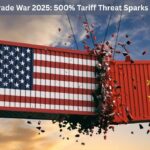
U.S. Sanctions: China Rejects Measures, Vows to Defend National Interests – reigniting U.S.-China trade conflict. When high-stakes diplomacy meets economic brinkmanship, the fallout can be global. Recently, China has firmly rejected U.S. restrictions and sanctions, pledging to defend its legitimate rights and interests. In a social media post, Chinese Foreign Ministry Spokesperson Lin Jian said: “threatening high tariffs is not the right way to deal with China.”
This standoff comes amid a renewed threat by President Donald Trump to impose 100 percent tariffs on Chinese imports and China’s escalation of export controls on rare earth minerals. The stakes are enormous: from supply chains for electronics and defense, to global stock markets, to the fate of a potential meeting between President’s Xi Jinping and Trump.
In this article, we dig into the tensions, the strategic moves on both sides, and what this could mean for the global economy.

U.S. Sanctions: China Rejects Measures, Vows to Defend National Interests
Background: U.S.–China Trade Tensions Take a Sharp Turn
A Brief Recap of Earlier Phases
The U.S. and China have had a roller-coaster trade relationship over recent years. The Trump administration’s first term saw steep tariffs imposed on Chinese goods, Beijing retaliating in kind, and protracted negotiation cycles.
In 2025, the tension cooled slightly after a temporary “truce,” but the rivalry never went away. The U.S. continued restricting sensitive technologies, blacklisting Chinese firms, and tightening export controls on semiconductors.
China, in turn, began using its dominance in rare earth processing and magnet technology as strategic leverage in global supply chains.
Trump’s New Tariff Threat
On October 10, 2025, President Trump announced that the U.S. would impose an additional 100 percent tariff on Chinese imports, on top of existing duties. He also promised new export controls on “critical software.”
The move followed China’s more aggressive export controls on rare earths, which Washington viewed as a provocative escalation.
Although Trump later softened his tone—writing, “The U.S.A. wants to help China, not hurt it!”—the threat triggered a sharp sell-off in global markets and alarm across supply chains.
China’s Response: Rejecting Sanctions, Vowing Countermeasures
China has not responded meekly. In a series of statements, Beijing has:
- Firmly rejected U.S. restrictions and sanctions, calling them hypocritical and unfair.
- Framed the U.S. tariff threat as “threatening high tariffs is not the right way to engage with China.”
- Pledged to take necessary measures to protect its legitimate rights and interests.
- Defended its rare earth export curbs as legitimate and not blanket bans—saying civilian-use applications meeting criteria would still be approved.
- Told Washington to “correct its approach” and stick to commitments from prior diplomacy.
China also warns that if the U.S. pushes ahead unilaterally, it will respond “resolutely.”
Why Rare Earths Are a Flashpoint
China’s Dominance in Rare Earths
Rare earth elements (REEs) and their derivatives—especially in magnets—are critical to sectors like semiconductors, electric vehicles, renewable energy, and defense systems. China processes roughly 90 % of the world’s refined rare earths and dominates magnet manufacturing.
This dominance gives Beijing strategic leverage: it can impose licensing constraints, delay approvals, or strategically withhold exports.
In its latest measures (effective December 1), China expanded licensing rules so that even products with as little as 0.1 % Chinese-sourced rare earth content may require Chinese export approval—even if processed elsewhere.
The Foreign Direct Product Rule (FDPR) Twist
A striking feature in China’s new controls is the adoption of an FDPR-style mechanism: even foreign-produced goods that use Chinese tech or rare earth sources could be regulated by Beijing.
This mirrors the U.S. approach of using FDPR to control chip exports, and shows China is applying similar strategic leverage over global supply chains.
Risk to Defense and High Tech Supply Chains
Because rare earths are essential for guidance systems, turbines, radars, microelectronics, and more, China’s tighter export controls threaten U.S. and allied defense supply chains. Experts warn the strategic gap may grow.
The licensing delays are already material: since September 2025, manufacturers report tougher scrutiny and slower export license approvals. Western companies are sounding the alarm over disruptions, cost inflation, and longer lead times.
Market Reactions and Global Impact
Stock Markets Take a Hit
On the day of the tariff announcement, U.S. major indexes tumbled: the S&P 500 dropped ~2.7%, triggering global contagion.
China’s markets also declined: Shenzhen fell ~0.74%, and Hong Kong’s Hang Seng dropped ~1.5%.
Gains in Rare Earth Producers
In contrast, shares of U.S. rare earth companies surged, as investors anticipated supply bottlenecks. Notably:
- MP Materials and USA Rare Earth rose ~20 % amid the uncertainty.
- Some analysts see this as strategic positioning in the scramble to diversify supply.
Supply Chain Disruptions
The new export rules and licensing delays are already causing tension across industries:
- Electronics, renewables, EVs, and defense firms dependent on magnets or rare earths face delays or higher costs.
- Some Western firms are scrambling to find alternative supply chains or preemptively stockpile critical minerals.
- The uncertainty intensifies global inflation risks and heightens geopolitical supply chain competition.
Also Read: Shocking Impacts of Trump’s 100% Tariffs on China
Diplomatic Chess: Threats, Tone Shifts, and the Xi–Trump Meeting
Mixed Signals from Washington
While Trump escalated with tariff threats, he later adopted a more conciliatory tone, claiming the U.S. “wants to help China, not hurt it.”
Vice President JD Vance further walked the line, warning Beijing to “choose the path of reason” but underscoring U.S. leverage if provoked.
The shift reflects internal tension in U.S. policy: balancing hardline stances with a need to prevent full-blown trade collapse.
China’s Tactical Pause—But Open to Dialogue
Despite its defiant posture, China has not fully shut doors to talks. Its commerce ministry says it supports dialogue but rejects coercion.
Beijing has also refrained from immediately imposing new tariffs on U.S. goods, perhaps signaling room for negotiation.
Will Xi and Trump Still Meet?
A face-to-face meeting between Presidents Xi Jinping and Trump was slated for the APEC summit in South Korea at month’s end.
However, Trump has cast doubt on whether the meeting will proceed, citing China’s rare earth measures as a sticking point.
Chinese analysts say the ball is in Washington’s court: if the U.S. backs off coercive tactics, the meeting may yet happen.
Some U.S. officials remain optimistic, expecting the summit to go ahead and serve as a potential reset.
The Underlying Strategic Calculus
Analysts suggest China’s move is partly pre-meeting choreography: by tightening controls now, Beijing strengthens its negotiating hand.
Some U.S. observers interpret China’s escalation as signaling internal vulnerability—and an attempt to “pull everybody else down.”
Others argue the primary fault lies with Trump’s coercive escalation, which undid months of careful détente.
Risks, Scenarios, and What Comes Next
Escalation vs. De-escalation
Escalation Path:
- The U.S. imposes the promised 100 % tariff.
- China retaliates with reciprocal tariffs, regulatory restrictions, or blacklisting.
- Supply disruptions intensify, especially in high-tech and defense sectors.
- Global markets reel under volatility.
De-escalation Path:
- Washington delays or moderates tariff imposition in response to diplomatic overtures.
- Beijing extends licensing to critical civilian goods, maintains dialogue.
- Xi–Trump summit serves as platform to reset terms.
- A fresh negotiation phase with new guardrails on technology, trade, and export controls.
The window for diplomacy is narrow—many measures outlined by both sides are scheduled to take effect in November–December.
Secondary Countries Caught in the Crossfire
Other countries—especially those dependent on Chinese rare earths—may feel the pain:
- Firms in Europe, Japan, and India may face higher costs or delayed deliveries.
- States seeking to build alternative supply chains (e.g. mining in Africa, Southeast Asia) will be under added pressure.
- Countries allied with the U.S. or China may be coerced to pick sides in trade or defense alignment.
The Strategic Imperative for Resilience
Experts argue the crisis underscores a structural vulnerability: overreliance on a dominant supplier in critical materials.
A recent study warns that systemic trade risk suppresses comparative advantage in rare-earth dependent industries—especially when supplier concentration is high.
Another modeled framework maps how non-kinetic disruptions (like export restrictions) can degrade strategic systems over time.
To mitigate risk, countries and firms may need to:
- Accelerate development of independent or allied supply chains
- Incentivize domestic processing capacities
- Build stockpiles and redundancy
- Tighten oversight on dual-use licensing
Impact on Developing Nations
For emerging economies, ripple effects may include:
- Higher import costs for electronics and renewable equipment
- Supply chain delays and inflation in sectors dependent on rare earth materials
- Political pressure from both superpowers to take sides
- Opportunity to become new nodes in diversified supply chains
In Conclusion
China’s unequivocal rejection of U.S. sanctions and tariff threats is not just rhetoric—it’s a signal that Beijing is prepared to leverage its strategic heft in rare earths, resist coercion, and defend what it calls its “legitimate interests.”
Yet both sides remain tethered to diplomacy: Trump’s softened messaging, China’s promises to approve civilian licenses, and the looming Xi–Trump summit all suggest the possibility of de-escalation. Still, the situation is precarious.
Missteps could pull global supply chains into chaos, reigniting the trade war of past years with higher stakes. The coming weeks—especially actions taken around November 1 and December 1 deadlines—may determine whether confrontation wins out or whether dialogue reclaims the field.