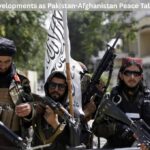
Afghanistan–Pakistan War 2025: Inside the 48-Hour Ceasefire — who called for peace first? An uneasy calm prevails along the Durand Line — the rugged, disputed border dividing Afghanistan and Pakistan — after both countries agreed to a 48-hour ceasefire. The temporary truce came following a week of deadly border clashes that left hundreds of soldiers and civilians dead, sparking fears of a prolonged regional conflict. While both nations now claim peace, a bigger question looms large: Who blinked first — Islamabad or Kabul?

Afghanistan–Pakistan War 2025: Inside the 48-Hour Ceasefire
A War Born of Old Fault Lines
The recent Afghanistan–Pakistan war erupted from long-standing tensions over the Durand Line, a border drawn by colonial British officials in 1893 that has divided ethnic Pashtun communities across both sides for over a century.
Neither side fully recognizes the demarcation. For the Taliban-led Islamic Emirate of Afghanistan, the line remains an illegitimate colonial boundary. For Pakistan, it is a recognized international border.
Those old grievances ignited anew in early October when border skirmishes turned into full-fledged air and ground battles.
How the Conflict Escalated
According to Afghan and Pakistani sources, fighting first broke out near Spin Boldak, a strategic crossing point between Kandahar and Pakistan’s Balochistan province.
Within hours, Pakistani fighter jets and drones targeted Taliban positions, while Afghan forces retaliated with mortar fire and cross-border raids, overrunning several outposts.
By midweek, explosions shook Kabul and Kandahar, sending residents fleeing and hospitals overflowing with the wounded.
Afghanistan’s Taliban administration accused Pakistan of launching airstrikes that killed at least 15 civilians and injured over 100. Pakistan’s Inter-Services Public Relations (ISPR) claimed its forces destroyed Taliban posts, killing 20 to 30 fighters and preventing incursions across the border.
Neither side’s death toll could be independently verified. But international monitors, including the UN and humanitarian agencies, confirmed large-scale civilian displacement and casualties.
Competing Narratives: Who Called for Ceasefire First?
Both Islamabad and Kabul have presented sharply differing accounts of how the ceasefire came about.
Afghan officials insist that Pakistan was the one to ask for peace after suffering heavy losses in the border war.
“The fighting stopped because the Mujahideen inflicted a heavy defeat on them [Pakistani forces],” said Ali Mohammad Haqmal, head of information in Afghanistan’s Spin Boldak district, as quoted by Tolo News.
Taliban fighters later displayed captured weapons, vehicles, and even trousers of Pakistani soldiers, claiming they had overrun outposts and forced troops to flee.
Zabihullah Mujahid, spokesperson for the Taliban government, echoed that sentiment on social media, writing that the ceasefire was reached “at the request and insistence of the Pakistani side.”
Also Read: Afghanistan–Pakistan Border Clashes 2025: Key Facts Behind the Deadly Escalation
Pakistan’s Version
Islamabad’s version of events was the exact opposite.
According to Pakistan’s Foreign Office, the truce was implemented “at the Taliban’s request and with mutual consent.”
A report in Dawn, a leading Pakistani newspaper, cited a senior military official claiming that Afghanistan sought the ceasefire after facing a “powerful response” from Pakistan’s air and ground forces.
The official added that the agreement took effect at 6 p.m. local time and would remain in force for 48 hours — contradicting Kabul’s claim that it was an open-ended truce.
Reuters, CNN, and the Associated Press all confirmed that both sides blamed each other for initiating peace talks, each insisting it had the upper hand.
Qatar’s Quiet Role in Brokering Peace
Neither Afghanistan nor Pakistan initially acknowledged the involvement of an external mediator. But multiple diplomatic reports later confirmed that Qatar — a close ally of both governments — played a key role in brokering the ceasefire.
According to Dawn, Qatar’s Minister of State for Foreign Affairs Abdulaziz Al-Khulaifi personally communicated with Pakistan’s Deputy Prime Minister and Foreign Minister Ishaq Dar soon after the truce was announced.
Dar thanked Qatar for its “consistent support and positive role,” while Doha’s message commended Pakistan’s constructive engagement in promoting regional peace.
Afghan sources suggested that Pakistan reached out to both Qatar and Saudi Arabia amid fears that the fighting could spiral out of control.
“For God’s sake, stop Afghans from fighting,” Pakistani officials reportedly told mediators, according to Tolo News.
Scenes from the Battlefield: ‘Pants Parade’ and Viral Videos
As the ceasefire took hold, images and videos from Afghanistan flooded social media, many showing Taliban fighters celebrating what they called victory over Pakistan.
One viral photograph, shared by BBC journalist Daud Junbish, showed Taliban soldiers holding up the trousers of Pakistani troops allegedly left behind at abandoned posts near the Durand Line.
“‘Empty trousers’ recovered from abandoned military posts of Pakistani army near Durand Line displayed in eastern Nangarhar province,” Junbish wrote on X.
Other videos showed Taliban-affiliated militiamen parading rifles and tanks captured from Pakistani forces, riding through Kandahar and Nangarhar in pickup trucks, waving the Emirate’s white flag.
While News18 and several Afghan journalists reported the displays, none of the footage could be independently verified. Nonetheless, the “pants parade” quickly became a symbolic humiliation for Islamabad in the information war that accompanied the border conflict.
Civilian Toll and Humanitarian Fallout
The border war wreaked havoc on civilian populations along both sides of the Durand Line.
In Kabul, the Italian humanitarian group Emergency NGO reported receiving five dead and 35 injured at its surgical hospital within hours of the clashes.
“We started receiving ambulances filled with wounded people… shrapnel wounds, blunt trauma, and burns,” said Dejan Panic, Emergency’s country director.
Thousands of families were displaced from Spin Boldak and Chaman, where the fiercest battles took place. Aid workers warned of a looming humanitarian crisis as both governments restricted cross-border movement and electricity outages crippled services in parts of Afghanistan.
Regional and Global Reactions
The international community reacted swiftly, urging restraint.
UN rights chief Volker Türk welcomed the ceasefire and called on both sides to “prevent further harm to civilians and commit to a lasting peace.”
Richard Bennett, the UN special rapporteur for Afghanistan, expressed “deep concern” over civilian deaths and displacement.
Neighboring powers China and Russia issued statements calling for de-escalation and dialogue, while US President Donald Trump — who recently unveiled a Middle East peace plan — hinted that Washington could “assist in mediation if needed.”
Also Read: UN urges Pakistan, Afghanistan to end hostilities to protect civilians
Pakistan’s Blame Game and India’s Uninvited Mention
Despite the truce, officials in Islamabad appeared keen to shift blame onto India, accusing New Delhi of backing the Taliban through covert channels — a claim with no evidence and denied by Kabul.
Pakistan’s Defence Minister Khawaja Asif told Geo News,
“I have my doubts the ceasefire will hold because the Taliban are being sponsored by Delhi. Right now, Kabul is fighting a proxy war for Delhi.”
Afghanistan dismissed the accusation as baseless, asserting that Pakistan was attempting to divert domestic attention from its military setbacks and the growing challenge of Tehreek-e-Taliban Pakistan (TTP) militants operating within its borders.
The TTP Factor: A Thorn in Pakistan’s Side
For years, Pakistan has accused Afghanistan of harbouring militants from the TTP, whom Islamabad labels “Fitna al-Khawarij.” These groups have carried out numerous attacks inside Pakistan, targeting military convoys and police stations.
Afghanistan denies providing refuge to these fighters, countering that Pakistan shelters Islamic State-linked cells and uses them to justify cross-border strikes.
The latest clashes, analysts say, were not just about border control but about mutual distrust and long-standing suspicions surrounding proxy warfare and militant sanctuaries.
How the Earlier Truce Fell Apart
This was not the first time Pakistan and Afghanistan agreed to a ceasefire this year.
A similar truce, reached after Pakistan’s Operation Sindoor in May, collapsed within days. That earlier conflict ended only after Pakistan’s Director General of Military Operations (DGMO) contacted his Indian counterpart to de-escalate tensions along the Line of Control (LoC).
In contrast, the current Afghanistan–Pakistan ceasefire needed external mediation from Qatar — highlighting both the lack of trust and the absence of direct diplomatic channels between the two neighbours.
On October 9, Afghanistan accused Pakistan of bombing sites in Khost, Jalalabad, and Paktika, which Pakistan neither confirmed nor denied. Two days later, coordinated Taliban attacks on Pakistani posts in Chaman killed 23 soldiers. Islamabad’s retaliatory strikes allegedly killed up to 200 Afghans — triggering outrage in Kabul and international condemnation.
Durand Line: The Border That Refuses to Settle
At the heart of the conflict lies the Durand Line, the 2,640-kilometre boundary that cuts through mountains, deserts, and tribal lands.
For Afghanistan’s Taliban government, the line remains a colonial relic imposed without consent. For Pakistan, it is a sovereign border recognized internationally.
The border’s ambiguity has fuelled decades of cross-border militancy, smuggling, and tribal unrest. Every attempt to fence or formalize it — including Pakistan’s recent fortification efforts — has led to resistance from local Pashtun tribes and the Afghan leadership.
Analysis: Who Really Blinked First?
While both sides continue to project confidence, available evidence suggests Pakistan may have been the first to seek mediation.
- Diplomatic Channels: Pakistan’s outreach to Qatar and Saudi Arabia — acknowledged in multiple reports — implies urgency from Islamabad’s side.
- Qatari Communication: Doha’s praise for Pakistan’s “constructive engagement” came only after Pakistani officials responded positively to mediation.
- Timing of Announcement: Pakistan’s Foreign Office announced the ceasefire within an hour of deadly explosions in Kabul, suggesting it was seeking to limit escalation.
Given these indicators — and Pakistan’s historical pattern of seeking third-party mediation in crises — analysts argue that Islamabad blinked first, accepting a ceasefire to prevent further military and reputational damage.
Meanwhile, the Taliban, buoyed by viral images of captured Pakistani equipment, framed the truce as a symbol of their battlefield strength.
Fragile Calm Along the Durand Line
As of Thursday, no fresh violence was reported overnight, according to Pakistani officials in Peshawar. Additional paramilitary forces were deployed to prevent new militant attacks that could jeopardize the fragile truce.
In Kandahar and Kabul, residents reported sporadic power outages due to damaged electrical infrastructure. Afghan officials said reconstruction and clearing operations were underway in border areas hit by airstrikes.
Still, fears of renewed fighting persist. With no established mechanism for dialogue, and deep-seated mistrust between the two governments, experts warn that this ceasefire could be short-lived — much like previous ones.
What Lies Ahead for the Region
The Afghanistan–Pakistan conflict has ramifications that go beyond their shared border.
- It threatens to destabilize the wider South Asian security architecture, already strained by tensions between India and Pakistan.
- It risks pushing Afghanistan deeper into isolation, as its Taliban rulers face growing pressure from all sides.
- And it could embolden militant groups exploiting the porous frontier to regroup and launch attacks.
Without a sustained peace process — and with mutual accusations still flying — the current truce may only be a pause before the next escalation.
Conclusion: The War of Narratives Continues
Whether Pakistan sought the ceasefire or Afghanistan did, both sides emerged from the confrontation with wounds and warnings.
For Pakistan, the conflict exposed vulnerabilities in border defense and growing frustration with Kabul’s leadership. For the Taliban, it demonstrated both military defiance and diplomatic limits — as even a battlefield win required external mediation.
As UN officials and regional powers urge restraint, the Durand Line remains what it has long been — a border of fire and fragility. For now, guns have fallen silent. But in this uneasy calm, the war of narratives rages on.
Related Posts:
- Pakistan’s Bold Airstrikes in Kabul: Af-Pak Crisis…

- Pakistan–Afghanistan Border Conflict 2025: Ceasefire…

- Afghanistan–Pakistan Border Clashes 2025: Key Facts…

- Pakistan–Afghanistan Ceasefire 2025: What to Know…

- 5 Key Takeaways as Pakistan–Afghanistan Peace Talks…

- 7 Major Developments as Pakistan-Afghanistan Peace…