
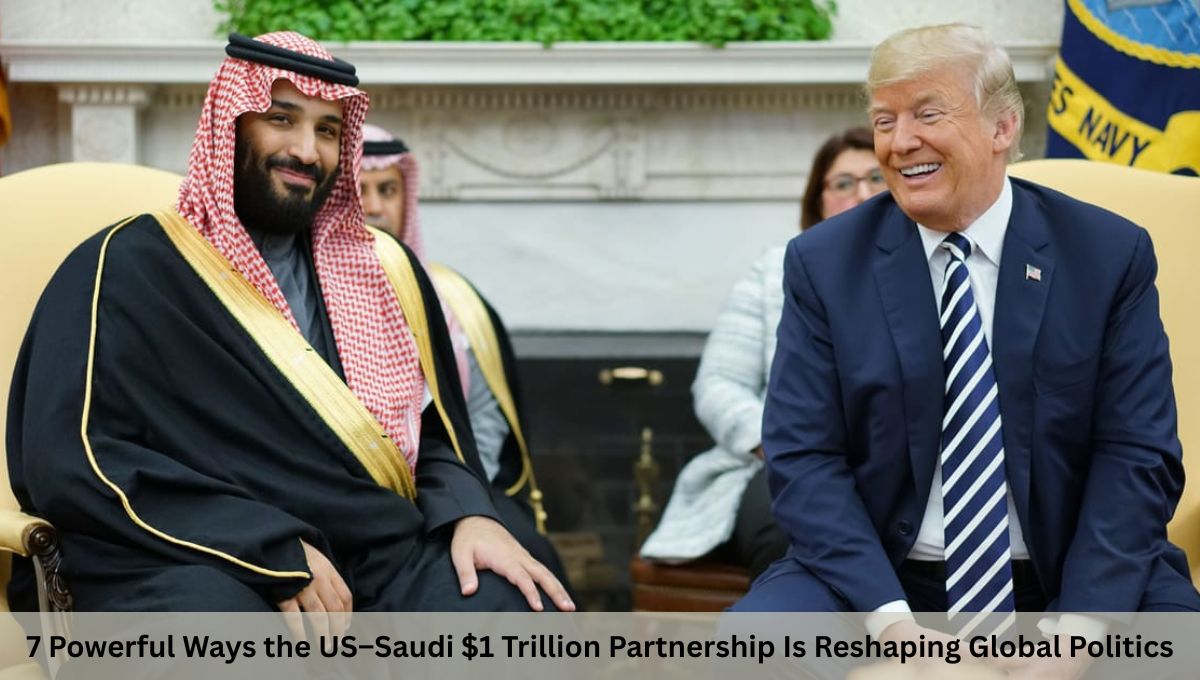
7 Powerful Ways the US–Saudi $1 Trillion Partnership Is Reshaping Global Politics, signalling a dramatic reset in US–Saudi relations since the Khashoggi crisis. The strategic relationship between the United States and Saudi Arabia has entered one of its most transformative phases in decades.
In a landmark White House visit—the first since the 2018 killing of journalist Jamal Khashoggi—Saudi Crown Prince Mohammed bin Salman (MBS) announced a sweeping package of public and private sector commitments exceeding $1 trillion, a dramatic rise from the $600 billion pledged just six months earlier.
The agreements span nuclear energy, artificial intelligence, critical minerals, defense cooperation, capital markets, and major technology partnerships, signaling a new era in US–Saudi relations under President Donald Trump’s return to the Oval Office.
The visit also served as MBS’s formal reentry onto the world stage, a bid to position himself as both a modernizer and power broker in a region undergoing rapid realignment from Gaza to Tehran to Khartoum.
This article breaks down the deals, the politics, and the deeper meaning behind a $1 trillion reset that could redefine global power dynamics for decades.
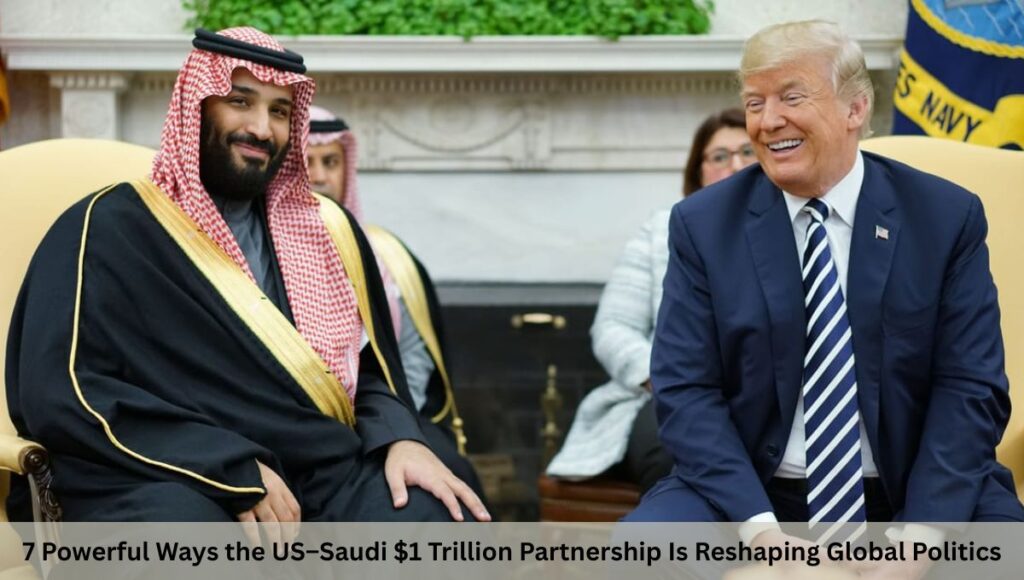
7 Powerful Ways the US–Saudi $1 Trillion Partnership Is Reshaping Global Politics
A White House Reunion With Global Stakes
MBS’s return to Washington was heavy with symbolism: a dramatic revival of a relationship that once seemed beyond repair. After Khashoggi’s murder in 2018—an assassination US intelligence linked to the crown prince—much of the West recoiled. President Joe Biden vowed to make Saudi Arabia a “pariah.”
Yet seven years later, realpolitik has reasserted itself.
Energy, defense partnerships, critical mineral supply chains, AI cooperation, and soaring global instability have pushed the US and Saudi Arabia back together. Trump’s return to the presidency accelerated this shift, re-opening the door to deep strategic cooperation.
The White House ceremony and gala dinner were followed by a rapid translation of government agreements into private sector commitments at the US-Saudi Investment Forum at the Kennedy Center—bringing together CEOs, investors, and officials from both nations.
The clear message:
The US and Saudi Arabia are shaping the next chapter of global energy, technology, and defense.
ENERGY SECTOR: A Nuclear Partnership Redefined
Landmark Nuclear Cooperation Pact
One of the most consequential agreements was a new US-Saudi nuclear cooperation pact.
It lays the foundation for decades of collaboration, ensuring that American firms remain preferred partners in building Saudi Arabia’s civilian nuclear energy program.
But the US drew a firm line:
No uranium enrichment and no reprocessing, both of which could provide pathways toward nuclear weapons capability.
US Energy Secretary Chris Wright confirmed the restriction publicly, signaling the seriousness of US nonproliferation demands—even as it grants Riyadh access to advanced technology.
Saudi Aramco’s $30 Billion Agreements
Saudi Aramco signed 17 memoranda of understanding with major US companies worth more than $30 billion. These deals reinforce the long-standing energy relationship, even as the kingdom diversifies away from oil under Vision 2030.
CRITICAL MINERALS: Securing the Supply Chains of the Future
Few sectors have become as strategically vital as critical minerals, essential for electric vehicles, wind turbines, missiles, jet engines, and semiconductors.
Washington and Riyadh announced a new critical minerals framework, expanding collaboration and reducing dependency on Chinese supply chains—an exposure highlighted by the US-China trade war.
MP Materials’ Saudi Rare Earths Refinery
In a landmark move:
- MP Materials
- The US Department of Defense, and
- Saudi mining giant Maaden
will jointly build a rare earths refinery in Saudi Arabia.
The joint venture ownership:
- 49% – MP Materials + US DoD
- 51% – Maaden
This facility will refine both heavy and light rare earths for use in US and Saudi defense industries, electric vehicles, and allied markets.
It represents a direct challenge to China’s dominance of global refining—one of the most strategically important shifts in the minerals landscape.
ARTIFICIAL INTELLIGENCE: The New Cornerstone of the Alliance
No sector received more energy, excitement, and investment at the US-Saudi Investment Forum than artificial intelligence.
The US and Saudi Arabia signed a groundbreaking AI Memorandum of Understanding, giving Riyadh structured access to America’s technological leadership while leveraging Saudi Arabia’s abundant land, energy, and financial capital to build some of the world’s largest computing clusters.
Nvidia, AMD, Cisco, Humain: A New AI Ecosystem
Nvidia confirmed it is working with Saudi Arabia on supercomputer development.
A major three-way joint venture was unveiled between:
- AMD
- Cisco Systems
- Saudi startup Humain
The partnership will begin with a 100-megawatt data center, fully powered by renewable energy and operational by 2026.
Even more significant:
Generative video startup Luma AI has already contracted to purchase the entire computing capacity of the new cluster.
The long-term target:
1 gigawatt of new data centers across the Middle East by 2030.
Musk + Huang: The AI Power Circle
Elon Musk and Nvidia CEO Jensen Huang appeared together, confirming:
- Musk’s xAI and Saudi Arabia are collaborating on a 500-megawatt AI supercomputing project.
This marks Saudi Arabia as one of the fastest-rising global hubs for next-generation AI infrastructure.
STRATEGIC DEFENSE AGREEMENT: An 80-Year Alliance Reinforced
Trump and MBS signed a new strategic defense agreement strengthening one of the world’s oldest and most important security partnerships.
Key elements include:
- Easier pathways for US defense firms operating in Saudi Arabia
- New burden-sharing commitments
- Assurance that Riyadh views Washington—not China—as its primary security partner
Though the agreement does not reach the level of a NATO-style mutual defense treaty (which Riyadh initially sought), it still significantly deepens cooperation.
F-35 FIGHTER JETS: A Major Policy Shift
One of the most dramatic announcements was that President Trump has approved the future delivery of F-35 fighter jets to Saudi Arabia.
Saudi Arabia has requested 48 F-35 aircraft, marking:
- The first sale of the stealth jet to Riyadh
- A major shift in longstanding US policy
- A decision with far-reaching implications for Israel, which until now has been the sole operator of the F-35 in the Middle East
In addition, Saudi Arabia agreed to buy 300 American tanks, further boosting US defense exports.
Also Read: 7 Powerful Reasons Trump’s F-35 Deal with Saudi Arabia Is Rewriting Middle East Geopolitics
TRADE & CAPITAL MARKETS: Anchoring an Economic Transformation
Washington and Riyadh signed new agreements aimed at:
- Expanding US exports
- Lowering barriers for US companies operating in the kingdom
- Streamlining investment approvals
- Modernizing capital markets regulation
- Strengthening engagement with global financial institutions
At the forum, Trump announced $270 billion in business deals across dozens of companies.
US Commerce Secretary Howard Lutnick declared these agreements would allow American firms to “lead globally in innovation, safety, and deployment.”
A High-Stakes Political Reset: MBS’s First Visit Since the Khashoggi Crisis
The political symbolism of the visit stands alongside the financial commitments.
MBS’s return to the White House marks a dramatic rehabilitation—once unthinkable after the Khashoggi murder.
From pariah to power broker
Saudi Arabia’s crown prince has spent the past seven years:
- Repairing ties with Iran
- Supporting Gaza ceasefire negotiations
- Restoring Syria to the Arab League
- Setting himself up as a mediator in Sudan’s brutal conflict
The evolution is stark:
From a leader criticized as reckless and impulsive, to one increasingly seen as a consequential regional strategist.
SOCIAL REVOLUTION AT HOME: A Kingdom Transformed
Inside Saudi Arabia, MBS has overhauled the social landscape at breathtaking speed:
- Women now drive, work, and mingle publicly
- Religious police have been defanged
- Ultra-conservative codes have faded
- Entertainment flourishes in previously unimaginable ways
- Pop stars, fashion icons, and global celebrities perform in Riyadh
Jennifer Lopez, Camila Cabello, Halle Berry, Monica Bellucci—names once unthinkable in the kingdom—now grace Saudi stages and events.
At the same time, dissent has been sharply curtailed. Critics have been silenced, rival princes sidelined, and elites brought to heel.
The message:
Reform is real—but on the crown prince’s terms.
THE MBS ERA: A Pre-Coronation Moment
Analysts describe the visit as a “pre-coronation moment.” MBS will be the first Saudi monarch descended from a grandson of founder King Abdulaziz, breaking with traditional succession patterns.
His vision is sweeping:
- Transform the Saudi economy
- Build a global AI powerhouse
- Reduce dependence on oil
- Expand defense capabilities
- Position Saudi Arabia as a central player in Asia, Africa, and Europe
His face dominates malls, highways, and media coverage. His initiatives define national policy.
Whether his economic vision will succeed remains hotly debated—critics point to risks in giga-project spending, youth unemployment, and volatile oil markets. But the ambition is undeniable.
SPORTS, CULTURE & GLOBAL INFLUENCE: Buying the Future
Saudi Arabia’s global influence campaigns have extended to sports and entertainment:
- LIV Golf’s shock merger with the PGA Tour
- Cristiano Ronaldo, Neymar, and dozens of global stars joining the Saudi Pro League
- Hosting the 2029 Asian Winter Games
- Winning the bid for the 2034 FIFA World Cup
These moves aim to diversify the economy, rebuild national identity, and project soft power across continents.
THE SUDAN FACTOR: Trump Agrees to Step In
In one unexpected moment at the White House, MBS asked Trump to intervene in Sudan’s devastating civil war. Trump replied that he would begin “working” on it immediately.
The request underscores Saudi Arabia’s role as a central mediator in African conflicts—and Washington’s renewed willingness to coordinate with Riyadh on regional crises.
The Meaning of a $1 Trillion Pivot
The scale of the agreements signals profound geopolitical change:
- AI is becoming the new oil, and Saudi Arabia aims to be its global capital.
- Critical minerals are the new battleground, and the US wants to secure non-Chinese supply chains.
- Nuclear energy and defense cooperation are knitting the two nations closer than at any time since the 1970s.
- The F-35 sale signals an extraordinary military realignment.
- Vision 2030 is impossible without US technology—and the US benefits enormously from Saudi investment.
As Paul Salem of the Middle East Institute observed:
“AI is the oil of the 21st century, and America needs Gulf energy and capital.”
In that equation, Washington and Riyadh have rediscovered the strategic glue that has bound them together for 80 years.
Conclusion: A Partnership Reborn—And Redefined
The US–Saudi relationship has survived wars, oil shocks, terror attacks, and political crises. The $1 trillion agreements unveiled this week mark one of its most consequential resets yet.
MBS arrives as both a reformer and an autocrat, a visionary and a polarizing figure—but unmistakably as the leader steering the Middle East’s most ambitious transformation.
Trump, meanwhile, sees Saudi Arabia as a cornerstone of his foreign policy, one that fuels American industry, reinforces US security interests, and reshapes global supply chains.
Together, they have set in motion a partnership that will influence energy, AI, defense, and geopolitics for decades to come. The world will be watching—not only what comes next, but how fast it arrives.
Also Read: From $1 trillion spending to F-35s, U.S.-Saudi pledges aren’t done deals yet
Related Posts:
- 7 Shocking Revelations from Trump’s Defense of MBS…
- 7 Stunning Signs Trump and Musk Are Repairing Their…

- Saudi Arabia's 'Sleeping Prince' Dies After 20-Year Coma

- 7 Powerful Signals as India Joins G7 Critical…

- 7 Ways Saudi Investments Are Transforming US Tech
- In 8 Moves, EU Targets China-Linked Refineries and…
