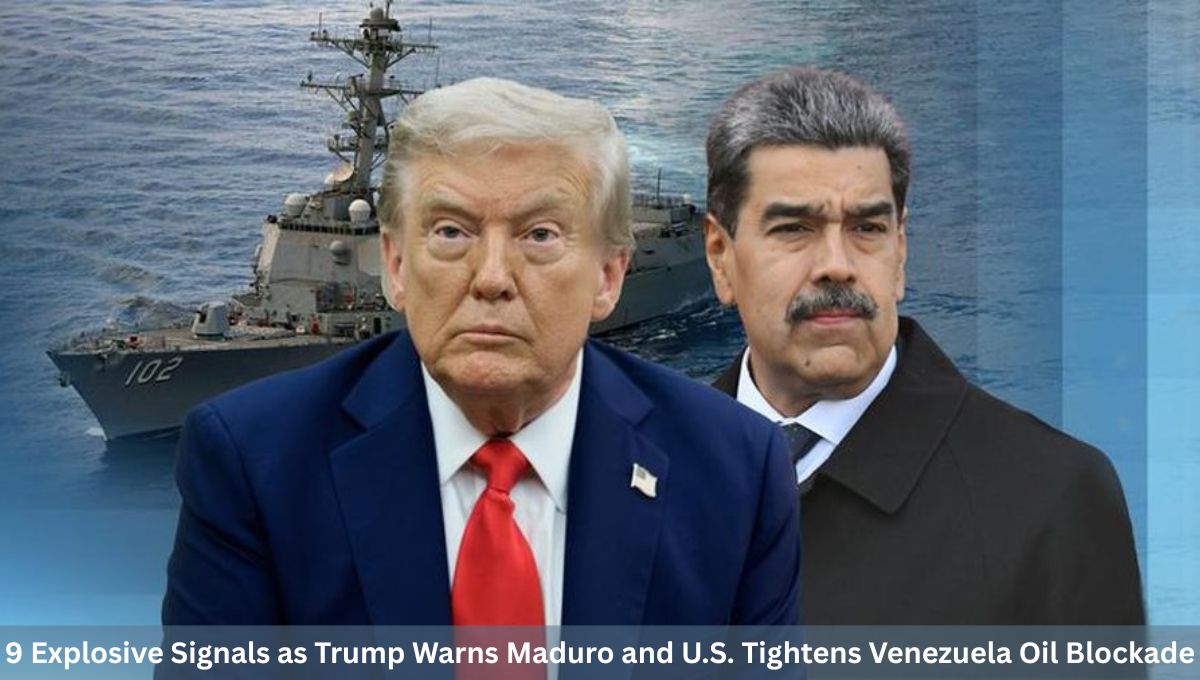
9 Explosive Signals as Trump Warns Maduro and U.S. Tightens Venezuela Oil Blockade, raising global energy concerns. Tensions between Washington and Caracas have entered a volatile new phase after United States President Donald Trump delivered one of his most explicit warnings yet to Venezuelan President Nicolás Maduro.
Speaking from his Mar-a-Lago resort in Florida, Trump suggested that Maduro would be “smart” to step down and warned that if the Venezuelan leader chose to “play tough,” it could be the last time he ever does.
The remarks came as the U.S. Coast Guard intensified efforts to intercept oil tankers linked to Venezuela’s so-called “shadow fleet,” dramatically escalating a pressure campaign that now extends beyond sanctions into direct maritime enforcement.
Russia and China have responded forcefully, condemning Washington’s actions as violations of international law and backing Venezuela’s call for an emergency United Nations Security Council meeting.
What began as a stated anti-drug operation has evolved into a multi-front confrontation involving military force, energy markets, international shipping lanes, and great-power rivalry.

9 Explosive Signals as Trump Warns Maduro and U.S. Tightens Venezuela Oil Blockade
Trump’s Warning: ‘It Would Be Smart for Him to Step Down’
Standing alongside Secretary of State Marco Rubio and Defense Secretary Pete Hegseth, Trump was asked directly whether the goal of the administration’s actions was to force Maduro from power.
“Well, I think it probably would,” Trump replied. “That’s up to him what he wants to do. I think it’d be smart for him to do that. But again, we’re gonna find out.”
Trump’s rhetoric quickly escalated.
“If he wants to do something, if he plays tough, it’ll be the last time he’s ever able to play tough,” the president said, underscoring a willingness to intensify pressure further.
The warning marked one of the clearest public acknowledgments that Washington’s campaign is no longer limited to sanctions enforcement or counter-narcotics operations, but is increasingly aimed at regime change.
U.S. Coast Guard Pursues Venezuela’s ‘Dark Fleet’
Trump’s comments coincided with active U.S. maritime operations in the Caribbean and eastern Pacific. For a second consecutive day, the U.S. Coast Guard pursued a third oil tanker it described as part of Venezuela’s “dark fleet,” vessels accused of using deceptive practices to evade American sanctions.
“It’s moving along, and we’ll end up getting it,” Trump said.
The United States has already seized two tankers and nearly four million barrels of Venezuelan crude in recent weeks. Trump said the seized oil and ships would be kept under U.S. control.
“Maybe we’ll sell it. Maybe we’ll keep it. Maybe we will use it in the strategic reserves,” he said. “We’re keeping it. We’re keeping the ships also.”
The administration has framed the seizures as lawful enforcement against sanctions evasion, but critics argue the actions amount to a de facto blockade.
From Sanctions to Blockade: A Shift in U.S. Strategy
Earlier this month, Trump openly described U.S. actions as a “blockade” of Venezuelan oil shipments. That language alarmed international observers, as blockades are traditionally associated with acts of war under international law.
Homeland Security Secretary Kristi Noem reinforced the administration’s intent in a television interview, stating that the operations were meant to send a message that “the illegal activity that Maduro is participating in cannot stand, he needs to be gone.”
The U.S. has also demanded that Venezuela return assets seized from American oil companies years ago, further tying energy disputes to broader political objectives.
Maduro Fires Back: ‘Focus on Your Own Problems’
Venezuelan President Nicolás Maduro responded sharply, dismissing Trump’s warnings and accusing Washington of aggression and imperial ambition.
Speaking on state television, Maduro said Trump would be better served by addressing domestic challenges rather than threatening Venezuela.
“He would be better off in his own country on economic and social issues, and he would be better off in the world if he took care of his country’s affairs,” Maduro said.
Venezuela has repeatedly denied U.S. allegations of drug trafficking and insists that Washington’s true objective is to seize control of the country’s vast oil reserves, the largest proven reserves in the world.
Caracas has labeled the tanker seizures acts of “international piracy.”
Military Strikes and Rising Death Toll
Alongside maritime enforcement, the U.S. has carried out more than two dozen military strikes on vessels it claims are involved in drug trafficking near Venezuela. According to reports, over 100 people have been killed in these strikes since early September.
Shortly after Trump’s remarks, the U.S. military confirmed another fatal strike on a “low-profile vessel” suspected of carrying drugs in international waters.
Human rights groups and U.S. lawmakers have raised serious concerns about the legality of these actions, noting that the government has offered limited evidence that the targeted vessels were indeed carrying narcotics.
Russia Steps In: ‘Full Support and Solidarity’
Russia has emerged as one of Venezuela’s strongest diplomatic defenders amid the escalating crisis. Russian Foreign Minister Sergei Lavrov expressed “deep concern” over U.S. operations in the Caribbean during a phone call with Venezuelan Foreign Minister Yván Gil.
Moscow warned of potential consequences for regional stability and international shipping. A Russian foreign ministry statement said Moscow “reaffirmed its full support for and solidarity with the Venezuelan leadership and people in the current context.”
Adding to the tension, a European intelligence official revealed that Russia has begun evacuating the families of diplomats from Caracas, suggesting Moscow views the situation as increasingly dangerous.
China Condemns Seizures as ‘Serious Violation of International Law’
China has also strongly condemned U.S. actions, particularly the seizure of oil tankers carrying crude bound for the Chinese market.
Foreign Ministry spokesperson Lin Jian said Beijing “opposes any actions that violate the purposes and principles of the United Nations Charter and infringe upon the sovereignty and security of other countries.”
“Venezuela has the right to develop independently and engage in mutually beneficial cooperation with other nations,” Lin said, adding that China supports Venezuela’s efforts to safeguard its legitimate interests.
China is Venezuela’s largest oil customer, purchasing approximately 76 percent of its crude exports.
The Centuries Seizure: A Flashpoint with Beijing
The seizure of the Panama-flagged tanker Centuries has become a focal point of U.S.-China tensions. The vessel was carrying roughly two million barrels of Venezuelan Merey crude and was reportedly bound for China.
Maritime analysts say the U.S. may have relied on the 2002 Salas-Becker agreement, which allows U.S. authorities to board Panamanian-flagged vessels with limited notice.
Experts warn that the legal mechanism used in the Centuries seizure could enable further interceptions, particularly of ships carrying oil intended for Chinese refiners.
How Squeezing Venezuela Hits China Strategically
Energy analysts note that Venezuelan crude plays a specific role in China’s refining system. The heavy, discounted oil is well-suited to Chinese refineries and offers Beijing a cost-effective alternative to supplies from Russia and the Middle East.
“By squeezing Venezuelan oil, you’re not only putting pressure on the Maduro regime, you’re also impacting China strategically,” said retired U.S. Coast Guard captain Aaron Roth.
Without Venezuelan oil, China may be forced to source more expensive crude elsewhere, potentially creating leverage for Washington in broader U.S.-China negotiations.
Shadow Fleets, Spoofing, and Sanctions Evasion
According to maritime intelligence firm Kpler, Venezuela relies on a network of shadow tankers that use deceptive practices such as AIS spoofing, false flags, and ship-to-ship transfers to avoid detection.
Out of 23 shadow tankers currently operating near Venezuela, several are Panama-flagged, placing them at higher risk of seizure under U.S. enforcement frameworks.
Satellite imagery and port records have documented extensive efforts to conceal vessel movements, reinforcing U.S. claims of systematic sanctions evasion.
United Nations Security Council Confrontation Looms
The escalating crisis prompted Venezuela to request an emergency meeting of the United Nations Security Council, backed by Russia and China.
In a letter read on state television, Maduro warned that the U.S. blockade would disrupt global oil and energy supplies.
“The blockade and piracy against Venezuelan energy trade will affect oil and energy supply, increase instability in international markets, and hit the economies of Latin America, the Caribbean, and the world,” the letter said.
Energy Markets on Edge
Venezuela currently produces around 900,000 barrels of crude per day, accounting for roughly one percent of global supply. While modest, disruptions to Venezuelan exports could tighten heavy crude markets and raise prices, particularly for developing economies.
Analysts warn that continued seizures could inject volatility into global energy markets already strained by geopolitical conflicts elsewhere.
Life on the Ground: A Nation Under Pressure
Away from diplomatic showdowns, ordinary Venezuelans continue to bear the brunt of economic collapse. Near the El Palito refinery, residents recalled a time when tankers filled the bay and prosperity flowed from oil exports.
“Before, up to nine or ten tankers would wait out there,” said Manuel Salazar, a longtime beach worker. “Now, look, one.”
Rising food prices and shrinking incomes have turned holiday gatherings into austere affairs, reflecting the deep human cost of the standoff.
New Laws Target ‘Piracy’ Cooperation
Venezuela’s National Assembly has advanced legislation that would criminalize cooperation with foreign seizures of Venezuelan assets. The proposed law includes prison sentences of up to 20 years for those accused of supporting blockades or “acts of piracy.”
The move signals Caracas’ intent to deter internal dissent and foreign collaboration as pressure mounts.
Conclusion: A Crisis with Global Consequences
Trump’s warning to Maduro marks a decisive escalation in a conflict that now extends far beyond Venezuela’s borders. With the U.S. seizing oil tankers, Russia and China rallying behind Caracas, and global energy markets watching nervously, the standoff risks spiraling into a broader geopolitical confrontation.
Whether the pressure forces Maduro from power or hardens alliances against Washington remains uncertain. What is clear is that Venezuela has once again become a flashpoint where energy, sovereignty, and great-power rivalry collide—with consequences that may soon be felt far beyond the Caribbean.
Also Read: 7 Explosive Signals: Sanctioned Tanker Defies Trump’s Venezuela Blockade
Also Read: US pursues 3rd tanker off Venezuelan coast