
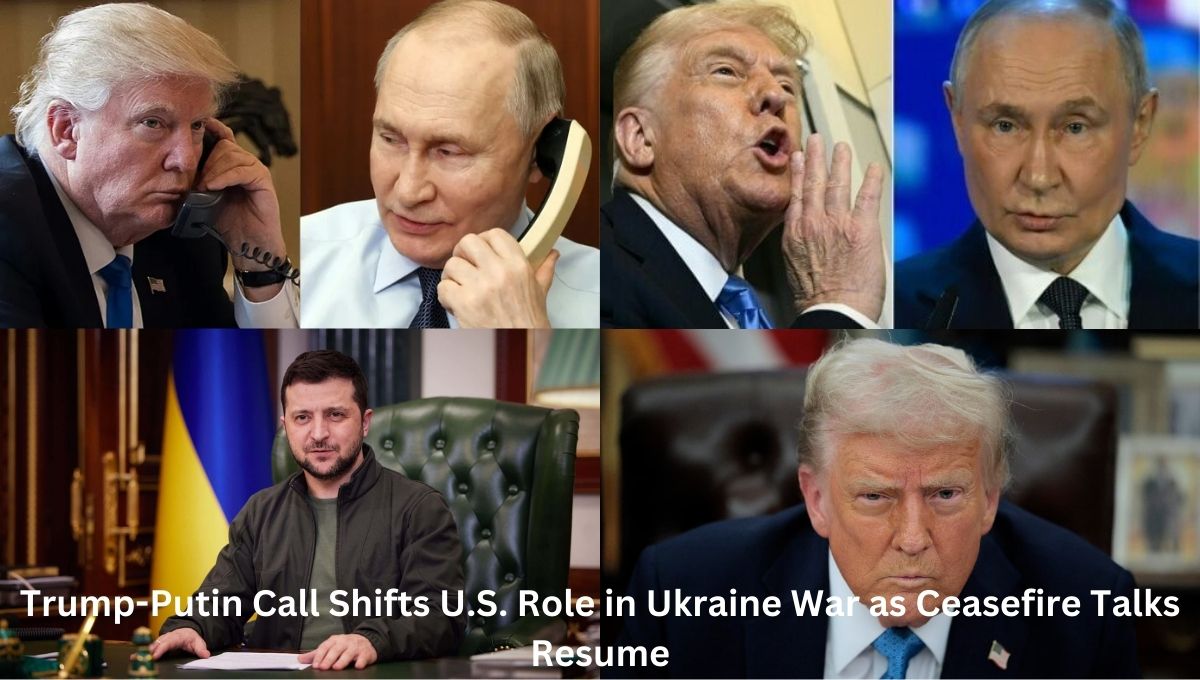
In a surprising turn of events, Trump-Putin Call Shifts U.S. Role in Ukraine War as Ceasefire Talks Resume. U.S. President Donald Trump and Russian President Vladimir Putin engaged in a two-hour phone call on Monday that has reignited hope for a potential ceasefire in the ongoing Russia-Ukraine war. Trump, who once claimed he could broker peace “within 24 hours,” now seems to be taking a more subdued role urging Russia and Ukraine to negotiate directly, possibly with the help of the Vatican.
Trump-Putin Call Shifts U.S. Role in Ukraine War as Ceasefire Talks Resume
A Two-Hour Call That Could Change the Course of the War
A major diplomatic call between U.S. President Donald Trump and Russian President Vladimir Putin signals potential movement toward a Ukraine ceasefire but also reveals a diminishing American role in the conflict.
Trump described the call as “excellent,” later posting on Truth Social that “Russia and Ukraine will immediately start negotiations” aimed at securing a ceasefire and eventually a long-term peace agreement.
Trump’s Changing Tone: From Peace Broker to Bystander
The tone from Trump represents a notable pivot. Previously, he positioned himself as the central figure capable of ending the war quickly. Just last week, he floated the idea of in-person talks with Putin.
But in his latest comments, he distanced himself from any leadership role, instead stating, “This is not my war.”
He now advocates for direct negotiations between Kyiv and Moscow, with the Vatican floated as a potential venue.
While Trump’s informal rapport with Putin was evident Russian aide Yuri Ushakov noted that the two leaders addressed each other by first name the former president’s downshift from mediator to passive supporter has raised eyebrows globally.
Ceasefire Discussions and Prisoner Exchanges
The most tangible outcome of the Trump-Putin call was the reported agreement to begin technical negotiations for a 30-day ceasefire, particularly focusing on Black Sea maritime operations.
This would mark a significant reduction in active conflict in a strategically critical region.
Additionally, the two leaders discussed prisoner exchanges. Russia proposed a swap of nine detainees from each side, while Ukraine has committed to a broader exchange involving up to 1,000 prisoners per side.
These are small but concrete steps that could pave the way for broader peace efforts.
Putin’s Strategy: Delay, Blame NATO, and Control the Narrative
Following the call, Putin reiterated familiar grievances, blaming NATO’s eastward expansion for the conflict.
From Sochi, he emphasized addressing the “root causes” of the war language that positions the Kremlin not as an aggressor, but as a reactive force to Western encroachment.
Despite agreeing to draft a memorandum of understanding with Ukraine, Kremlin spokesman Dmitry Peskov stated that no deadlines would be set.
This lack of urgency suggests Russia is in no rush to end the conflict and is using diplomacy to buy time and deflect new sanctions.
Trump’s Realpolitik: Optics Over Outcomes
Trump’s current posture reflects a pragmatic some say transactional approach to foreign policy. Rather than committing to long-term involvement, he’s hinted at lifting sanctions and promoting “unlimited” trade with Russia should peace talks progress.
Conversely, no new punitive measures were announced should talks fail. This signals a shift toward realpolitik valuing strategic outcomes over ideological stances.
According to Treasury Secretary Scott Bessent, Trump is “results-driven,” warning that failure to negotiate in good faith could still trigger sanctions targeting Russia’s oil and energy sectors.
European Concerns: America’s Withdrawal Could Embolden Moscow
Trump’s diplomatic pivot has not gone unnoticed in Europe. Leaders from the UK, France, Germany, and Italy were briefed ahead of the Trump-Putin call, but many expressed frustration at what they perceive as a diminishing U.S. role.
German Chancellor Friedrich Merz stated the EU would pursue additional sanctions on Russia regardless of U.S. backing.
European Commission President Ursula von der Leyen warned that American disengagement could destabilize the entire region.
Behind the scenes, some diplomats reportedly feel “shocked” at how quickly the U.S. is stepping back.
Former Swedish Prime Minister Carl Bildt called the latest developments an “undoubted win for Putin,” who continues to gain ground militarily while projecting openness to peace.
Ukraine’s Position: Open to Talks, But Seeking Guarantees
Ukrainian President Volodymyr Zelensky offered cautious support for the ceasefire negotiations, insisting that Ukraine must remain at the center of all discussions.
He emphasized the importance of continued U.S. involvement and criticized Russia’s “low-level delegation” at recent talks in Istanbul.
Zelensky remains open to peace talks in Turkey, the Vatican, or Switzerland, and has proposed a direct meeting with Putin a proposal Moscow continues to ignore.
Despite that, Ukraine has agreed to the large-scale prisoner exchange in a goodwill gesture.
Vatican as a Peace Venue: A Symbolic Move?
Vice President JD Vance confirmed that the Vatican may host the next round of talks, a move reportedly encouraged by Trump. Pope Leo has expressed willingness to mediate, and both sides appear open to the idea in principle.
However, critics say the involvement of the Vatican while symbolically powerful might lack the geopolitical heft to enforce any deal.
Still, Trump views the Pope as a neutral figure who might facilitate compromise where politicians cannot.
Is U.S. Support for Ukraine at Risk?
Perhaps the most pressing concern is whether U.S. support for Ukraine is slipping. Both Vice President Vance and Secretary of State Marco Rubio have warned that the U.S. may withdraw its backing if negotiations fail.
“If this doesn’t lead to results, we walk,” said Vance. “This is not our war.”
This rhetoric alarms both Kyiv and NATO allies, who fear that a U.S. withdrawal could tip the balance of power in favor of Moscow and encourage further Russian advances.
Conclusion: A Turning Point or Just a Pause?
The Trump-Putin call may not have ended the war in Ukraine, but it has altered the diplomatic dynamics.
While early signs such as ceasefire talks and prisoner exchanges offer a glimmer of hope, the broader picture remains fraught with uncertainty.
With the U.S. taking a more passive role and Putin continuing to steer the narrative, the path to peace may depend more on geopolitical optics than genuine compromise.
Whether this is a turning point in the Ukraine war or simply a pause before escalation remains to be seen.
Also Read: Russia and Ukraine Agree to Largest Prisoner Swap Since 2022, But Ceasefire Remains Elusive
Also Read: Trump steps back from Ukraine peace push after Putin phone call
Related Posts:
- Cardinal Kevin Farrell Becomes Acting Head of…

- Impacts of the Trump-Putin Call on Ukraine’s 2025 Strategy
- 7 Powerful Measures: Trump Sanctions Russian Oil…

- Who Will Lead the Catholic Church Next? A Look at…

- Can the EU and NATO Impose Tariffs on India and…

- 20-Point Breakthrough: Trump-Led Peace Plan That…
