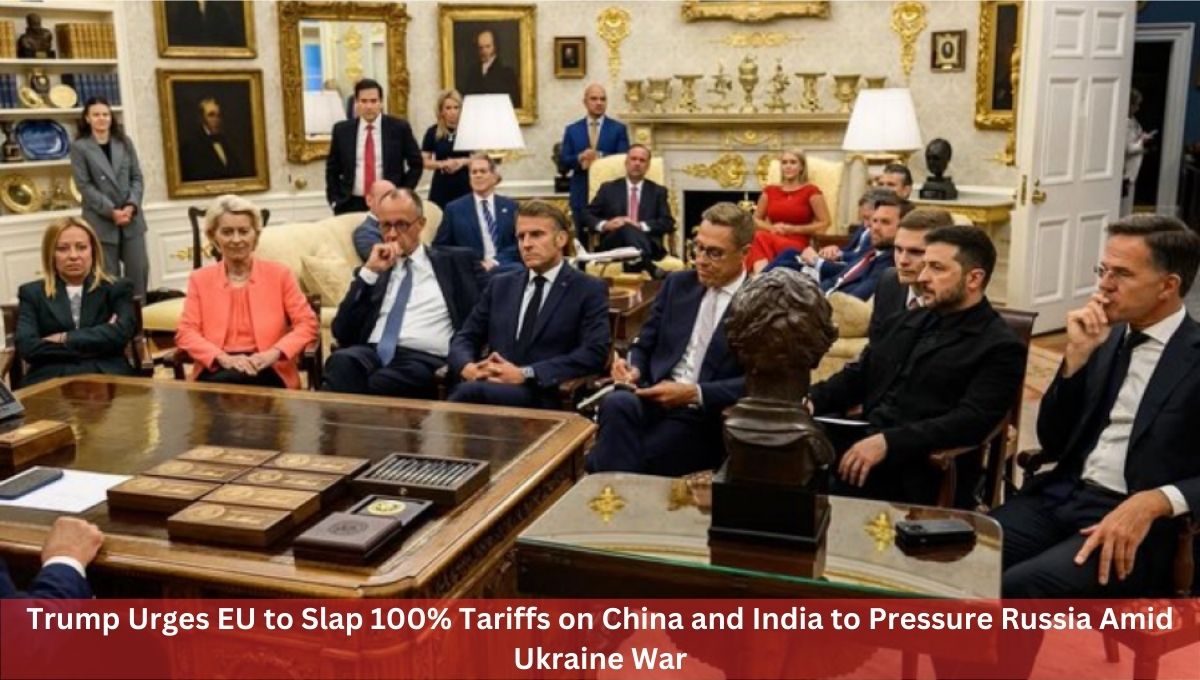
Trump Urges EU to Slap 100% Tariffs on China and India to Pressure Russia Amid Ukraine War, saying they are the two biggest buyers of Russian oil. The economic battle lines over the Russia-Ukraine war are hardening. In a bold move that could reshape transatlantic strategy, US President Donald Trump has urged the European Union to impose tariffs of up to 100% on China and India.
Both countries are among the largest buyers of Russian oil, and Washington believes their continued purchases are keeping Moscow’s war economy alive. Trump’s request, conveyed during a meeting between senior US and EU officials in Washington this week, underscores a dramatic push to move beyond sanctions and employ tariffs as a weapon of geopolitical pressure.
If Brussels accepts Trump’s proposal, it would mark a sharp departure from the EU’s traditional reliance on sanctions to isolate Russia, shifting toward an aggressive tariff-based approach aimed at curbing the Kremlin’s revenues.

Trump Urges EU to Slap 100% Tariffs on China and India to Pressure Russia Amid Ukraine War
Trump’s Tariff Demand
According to US officials and EU diplomats, Trump made the extraordinary request via a conference call with EU sanctions envoy David O’Sullivan and other European officials visiting Washington for sanctions coordination.
One US official, speaking anonymously, summed up Washington’s message:
“We’re ready to go, ready to go right now, but we’re only going to do this if our European partners step up with us.”
Trump’s remarks were first reported by the Financial Times and later confirmed by outlets including Reuters and the BBC.
The proposal comes as Russia intensifies its strikes on Ukraine, including the largest aerial bombardment since the war began, which killed more than 20 civilians in Donbas and damaged key infrastructure in Kyiv.
Also Read: Can the EU and NATO Impose Tariffs on India and China as Trump Demands to Pressure Russia?
Why Target China and India?
Both China and India are central to Russia’s energy export strategy:
- China is the largest single buyer of Russian oil, with imports reaching record levels since 2022.
- India, which previously bought little Russian crude, has become the second-largest importer, purchasing discounted supplies to fuel its growing economy.
Together, these countries account for a massive share of Russia’s oil sales. Western officials argue that without curbing this flow, sanctions will never be enough to cripple Moscow’s war machine.
Trump’s calculation is blunt: if China and India stop buying Russian oil under the weight of punitive tariffs, the Kremlin will lose its main source of revenue.
A Shift from Sanctions to Tariffs
The EU has so far relied on sanctions packages—18 rounds since 2022—with measures targeting Russian banks, individuals, technology imports, and oil shipments.
Tariffs, however, represent a different tool:
- Sanctions restrict trade and financial flows, often with legal carve-outs.
- Tariffs impose steep costs on imports but do not necessarily ban them outright.
If the EU adopted Trump’s suggestion, it would mark a strategic pivot from isolating Russia through sanctions to punishing its trading partners through tariffs.
One EU diplomat told Reuters:
“They are basically saying: ‘We’ll do this, but you need to do it with us.’”
Trump’s Trade War Approach
The tariff strategy fits squarely into Trump’s longstanding worldview, where tariffs are a primary instrument of foreign policy.
- Earlier this year, Trump raised tariffs on Indian goods by 25 percentage points, bringing the total to 50%, citing New Delhi’s purchases of Russian crude.
- Tariffs on Chinese goods currently stand at about 30%, though Trump has previously floated steeper hikes before moderating under market pressure.
- Now, Trump wants to push both China and India toward 100% tariffs in coordination with Europe.
A US official, quoted by the Financial Times, put it plainly:
“The obvious approach here is, let’s all put on dramatic tariffs and keep the tariffs on until the Chinese agree to stop buying the oil. There really aren’t many other places that oil can go.”
EU’s Reluctance
For Brussels, the request poses a serious dilemma.
The EU has deep trade ties with both China and India:
- China is the EU’s second-largest trading partner, after the United States.
- India has become a crucial partner in Europe’s diversification strategy away from Russian energy and Chinese manufacturing dominance.
Shifting from sanctions to tariffs would risk escalating trade conflicts with two of the world’s biggest emerging markets—something many European capitals are reluctant to do.
At the same time, the EU remains under pressure to show that its sanctions regime is effective. Despite 18 rounds, Russia’s economy has adapted, partly through its energy exports to Beijing and New Delhi.
Also Read: Why the European Union won’t hit China with the 100% tariffs that Trump wants
Trump’s Mixed Signals on India
Trump’s approach to India has been particularly inconsistent.
- On one hand, he has slammed New Delhi for “fueling the Russian war machine” and imposed secondary tariffs on Indian exports.
- On the other, he has repeatedly praised Prime Minister Narendra Modi and described India as a “great partner.”
On Tuesday, hours after urging Brussels to punish India with 100% tariffs, Trump posted on his Truth Social platform that the US and India were working to resolve trade barriers.
He said he looked forward to speaking with Modi in the coming weeks, predicting a “successful conclusion” to negotiations.
Modi responded optimistically, calling the US and India “close friends and natural partners.”
Russia’s Escalation in Ukraine
Trump’s tariff push comes amid a dramatic escalation on the battlefield.
- Over the weekend, Russia launched its largest aerial assault since the invasion began, deploying more than 810 drones and 13 missiles.
- Ukraine said it intercepted hundreds of drones but confirmed that a government complex in Kyiv was struck.
- In Donbas, at least 20 civilians were killed by a Russian glide bomb while queuing for pensions.
These attacks have underscored the urgency in Washington to find new ways to pressure Moscow into negotiations.
Trump’s Struggle to Deliver Peace
Trump has long claimed he could broker peace “within hours”, but so far, his efforts have faltered:
- A highly anticipated summit in Alaska between Trump and Putin last month ended without progress.
- Deadlines Trump set for Moscow to hold talks with Ukraine have come and gone without results.
- Putin has continued to escalate attacks, showing no willingness to compromise.
Frustration in Washington is mounting, with officials like Treasury Secretary Scott Bessent urging a harder economic line.
US-EU Coordination
The EU delegation in Washington this week, led by David O’Sullivan, has been discussing joint measures with American counterparts.
Possible options include:
- Tariffs on China and India, if Europe agrees.
- Expanded sanctions on Russia’s shadow fleet of oil tankers.
- Tighter restrictions on Russian banks, oil majors, and traders.
Any EU measures, however, would require unanimous support from all member states, and countries like Hungary have frequently blocked tougher action on Russia’s energy sector.
Sanctions vs Tariffs: The Strategic Divide
At the heart of the debate lies a fundamental question: sanctions or tariffs?
- Sanctions: The EU’s tool of choice, designed to target Russia directly while limiting collateral damage to trade partners.
- Tariffs: Trump’s preferred approach, targeting Russia’s enablers (China and India) by making trade with the West prohibitively expensive.
Adopting Trump’s plan would represent a radical shift in EU strategy, potentially opening a new front in the global trade wars.
Contradictions and Risks
Trump’s proposal also highlights the contradictions in US policy:
- While demanding 100% tariffs on India and China, Trump simultaneously promises to boost US-India trade.
- He criticizes Europe for failing to fully decouple from Russian gas—even though 19% of EU gas imports still come from Moscow—yet seeks European alignment on punitive tariffs.
- His earlier escalation of tariffs on China caused market turmoil, forcing him to partially roll back duties just months later.
Such contradictions raise questions about the sustainability of Trump’s tariff-first approach.
Global Reactions and Outlook
So far, neither Beijing nor New Delhi has publicly responded to Trump’s latest demands.
- China is unlikely to shift course, as energy cooperation with Moscow is central to its strategy of counterbalancing the West.
- India continues to defend its Russian oil purchases as essential for national energy security, even as it strengthens ties with Washington in other areas.
For Europe, the decision could define the next phase of its Russia strategy. Accepting Trump’s plan would deepen transatlantic unity but risk sparking trade wars with key global partners.
Rejecting it would preserve trade stability but risk widening the gap between Washington and Brussels at a time when unity is crucial.
Conclusion
President Donald Trump’s call for 100% tariffs on China and India marks one of the boldest escalations yet in the West’s economic confrontation with Russia. By shifting focus from direct sanctions on Moscow to punishing its biggest oil buyers, Trump aims to cut off the Kremlin’s financial lifeline and force President Vladimir Putin to the negotiating table.
But the approach carries significant risks from potential trade wars with Beijing and New Delhi to divisions within Europe over how far to go.
As the Russia-Ukraine war enters its third year, the debate over sanctions versus tariffs could shape not just the outcome of the conflict, but also the future of global trade and transatlantic unity.