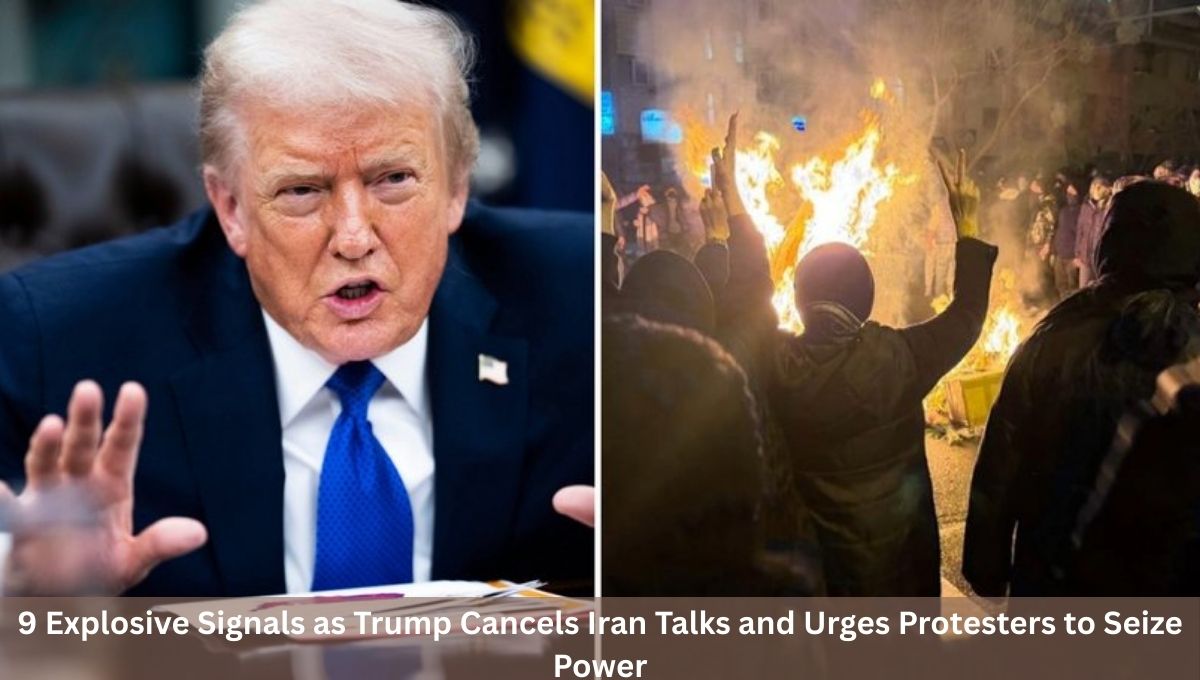
9 Explosive Signals as Trump Cancels Iran Talks and Urges Protesters to Seize Power while Iran’s crackdown intensifies.The political crisis in Iran entered a dangerous new phase this week after United States President Donald Trump announced the cancellation of all meetings with Iranian officials and publicly urged Iranian protesters to “take over your institutions”, sharply escalating Washington’s rhetoric amid a violent crackdown in the Islamic Republic.
In a series of social media posts and media interviews, Trump warned of “very strong action” if Iranian authorities proceed with executing protesters, while offering vague assurances that “help is on the way.” His remarks have triggered sharp reactions from Tehran, alarmed U.S. allies, and sent global oil prices sharply higher, underscoring the broader geopolitical stakes.
With thousands reportedly dead, an ongoing internet blackout, and growing international outrage, analysts warn that the confrontation risks spiraling into regional instability or direct military confrontation—with uncertain consequences for Iran, the Middle East, and the global economy.

9 Explosive Signals as Trump Cancels Iran Talks and Urges Protesters to Seize Power
Trump Cancels All Iran Meetings Amid Protest Bloodshed
President Trump revealed on Tuesday that he had scrapped all scheduled or planned engagements with Iranian officials, citing what he called the “senseless killing of protesters” by Tehran’s security forces.
“I have cancelled all meetings with Iranian Officials until the senseless killing of protesters STOPS,” Trump wrote on his Truth Social platform. “HELP IS ON ITS WAY. MIGA!!!”
The White House did not immediately clarify what meetings were being canceled, nor whether they involved direct negotiations, intermediaries, or diplomatic backchannels.
Iranian officials later claimed that some indirect communications with U.S. envoys were still ongoing, though Washington did not confirm this.
The announcement marked a decisive shift from tentative diplomacy to open political confrontation, as Trump paired the move with explicit encouragement for protesters to challenge Iran’s governing institutions.
‘Take Over Your Institutions’: Trump’s Unprecedented Call
In language rarely used by a sitting U.S. president toward another sovereign state, Trump directly addressed Iranian demonstrators, urging them to seize control of the country’s political and security apparatus.
“Iranian Patriots, KEEP PROTESTING – TAKE OVER YOUR INSTITUTIONS!!!” Trump posted.
“Save the names of the killers and abusers. They will pay a big price.”
The remarks immediately drew condemnation from Tehran, which accused Washington of inciting violence, destabilization, and regime change.
Iran’s UN ambassador warned that the United States would bear responsibility for civilian casualties resulting from what he described as foreign interference.
Diplomats and analysts noted that the statement went well beyond expressions of solidarity and entered the realm of explicit encouragement of institutional overthrow, a position likely to inflame tensions and strengthen hardliners within Iran’s ruling establishment.
‘Help Is on the Way’: Trump Refuses to Clarify
Central to Trump’s messaging was a repeated but ambiguous promise that “help is on the way.” When questioned by reporters about what that help entailed—whether diplomatic, economic, cyber, or military—the president refused to elaborate.
“You’re going to have to figure that one out,” Trump said.
“I’m sorry.”
The lack of specificity has fueled intense speculation among analysts, allies, and adversaries alike. Possible interpretations range from expanded sanctions and cyber operations to airstrikes or covert action, though U.S. officials have publicly insisted that no major military deployments are currently underway.
This deliberate ambiguity, observers say, appears designed to maximize psychological pressure on Tehran while preserving flexibility for Washington.
Trump Warns of ‘Very Strong Action’ Over Executions
The rhetoric intensified further after reports emerged that Iranian authorities may execute protesters accused of “moharebeh”, or waging war against God—a charge that carries the death penalty.
In an interview with CBS News, Trump issued a blunt warning:
“If they hang them, you’re going to see some things. We will take very strong action if they do such a thing.”
Trump added that he had not yet received “accurate numbers” on how many protesters had been killed but said the reports were deeply alarming.
Human rights organizations say executions would mark a dramatic escalation in Iran’s response and could trigger international sanctions, isolation, or military retaliation.
Rising Death Toll and Conflicting Figures
The true scale of the violence inside Iran remains difficult to verify due to a near-total internet blackout that has now lasted more than five days.
However, multiple rights groups have reported staggering casualty figures:
- The Human Rights Activists News Agency (HRANA) says more than 2,400 people have been killed.
- The Norway-based Iran Human Rights (IHR) group has confirmed at least 734 deaths, warning the real number is likely far higher.
- Iranian officials have acknowledged the deaths of more than 100 security personnel, without providing a civilian death toll.
IHR reports that fewer than half of Iran’s provinces and less than 10 percent of hospitals are currently accessible for verification, suggesting that fatalities could be in the thousands.
Internet Blackout Masks the Crackdown
Iran’s government has severely restricted digital communications, cutting off internet access nationwide and limiting phone services to outbound calls only.
Rights groups and journalists say the blackout is being used to conceal the scale of the crackdown, disrupt protest coordination, and prevent footage from reaching the outside world.
Despite the restrictions, some activists have turned to satellite internet services, including Elon Musk’s Starlink, which a U.S.-based organization said was being made available free of charge in Iran.
Tehran has accused the United States and Israel of using such technologies to coordinate unrest, though no evidence has been presented publicly.
Iran Accuses US and Israel of Fomenting Unrest
Iranian officials have repeatedly blamed foreign powers for the protests.
Top military commander Abdolrahim Mousavi claimed that the U.S. and Israel had deployed members of ISIL (ISIS) inside Iran to carry out attacks, offering no evidence.
Foreign Minister Abbas Araghchi alleged that Iranian authorities possessed recordings of voices from abroad directing “terrorist agents.”
In a post on X, Ali Larijani, head of Iran’s Supreme National Security Council, accused Trump and Israeli Prime Minister Benjamin Netanyahu of being the “main killers of the people of Iran.”
The accusations reflect Tehran’s long-standing narrative that foreign interference, rather than domestic grievances, is driving unrest.
Economic Roots of the Protests
The protests began in late December, initially triggered by soaring inflation, currency collapse, and economic hardship. Over time, they evolved into broader demonstrations calling for systemic political change and an end to clerical rule.
Iran’s economy has been battered by years of sanctions, mismanagement, and declining oil revenues. The recent U.S. announcement of 25 percent tariffs on any country doing business with Iran has further heightened economic pressure.
China, Iran’s largest oil customer, sharply criticized the move, warning it would disrupt global trade and energy markets.
Oil Markets React to Trump’s Warning
Global energy markets responded swiftly to Trump’s comments and the escalating unrest.
- U.S. crude oil rose 2.77% to $61.15 per barrel
- Brent crude climbed 2.51% to $65.47 per barrel
Iran is a major OPEC producer, and traders are increasingly concerned that prolonged unrest or foreign intervention could disrupt supplies, particularly if sanctions tighten or infrastructure is targeted.
Analysts warn that even limited military action could send oil prices sharply higher, fueling inflation worldwide.
European and Regional Diplomacy Intensifies
European governments have voiced growing alarm over the situation.
France, Germany, the United Kingdom, and Italy summoned Iranian ambassadors, while the European Union vowed additional sanctions against those responsible for abuses.
“The rising number of casualties in Iran is horrifying,” said European Commission President Ursula von der Leyen.
Meanwhile, Qatar and France have sought to de-escalate tensions through quiet diplomacy. Qatar’s prime minister spoke with Iran’s national security chief, reiterating support for peaceful solutions and dialogue.
Analysts Warn of Dangerous Consequences
Foreign policy experts caution that U.S. military intervention—even if limited—could backfire.
Ali Vaez of the International Crisis Group warned that decapitating Iran’s leadership could create a power vacuum filled by more repressive elements of the Revolutionary Guard.
“If the president creates a total vacuum at the top, the country could descend into violent chaos like Libya, Syria, Yemen, or Iraq,” Vaez said.
Other analysts note that Iran’s security apparatus remains cohesive and resilient, reducing the likelihood of immediate regime collapse despite the scale of the protests.
Does Trump Have Real Military Options?
Despite Trump’s warnings, U.S. military capacity in the region is currently more limited than in previous crises.
Several aircraft carriers and missile defense systems have been redeployed to other regions, including the Caribbean and the Pacific. Senior officials say there are no plans for a major troop buildup in the Middle East.
Possible options include:
- Precision airstrikes
- Cyber operations
- Targeted sanctions
- Covert actions
However, lawmakers from both parties have raised concerns about the lack of a clear objective and the risk of another prolonged conflict.
A High-Stakes Moment for Iran and the World
As protests continue and rhetoric escalates, Iran stands at a critical crossroads. The regime insists it has regained control, while protesters and rights groups say repression is intensifying.
Trump’s decision to cancel diplomacy, threaten force, and openly encourage institutional takeover has injected unprecedented volatility into the crisis. Whether the coming days bring negotiation, escalation, or confrontation remains unclear.
What is certain is that the outcome will shape not only Iran’s future but the stability of the Middle East—and the global economy—for years to come.
Also Read: 7 Explosive Signs Iran Is Near a Breaking Point as Protests Turn Bloody
Also Read: ‘Main Killers Are…’: Iran Security Chief’s Sharp Retort After Trump’s ‘Help On It’s Way’ Post