
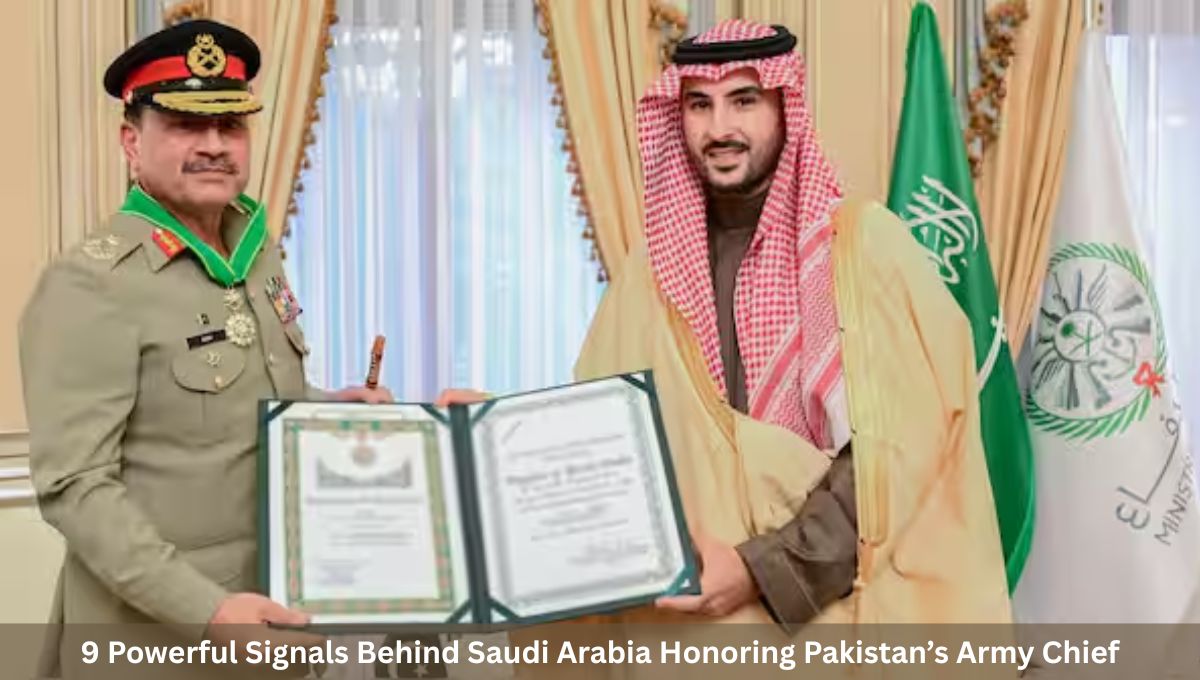
9 Powerful Signals Behind Saudi Arabia Honoring Pakistan’s Army Chief Asim Munir with the King Abdulaziz Medal. Saudi Arabia has conferred its highest national honour on Pakistan’s most powerful military leader, signaling a significant deepening of defence, strategic, and geopolitical ties between Islamabad and Riyadh at a time of major realignments across the Middle East.
Pakistan’s Chief of Defence Forces and Army Chief, Field Marshal Syed Asim Munir, was awarded the King Abdulaziz Medal of the Excellent (First) Class during an official visit to Riyadh, according to statements from Saudi Arabia’s Ministry of Defence, the Saudi Press Agency (SPA), and Pakistan’s military media wing, ISPR.
The award, granted under a royal decree by King Salman bin Abdulaziz Al Saud, recognizes Munir’s role in strengthening bilateral relations, advancing defence cooperation, and contributing to regional peace and security.

9 Powerful Signals Behind Saudi Arabia Honoring Pakistan’s Army Chief
The Ceremony in Riyadh
The medal was formally presented by Saudi Defence Minister Prince Khalid bin Salman at his office in Riyadh on Sunday.
According to SPA, the honour was bestowed following a direct royal order from King Salman. Prince Khalid congratulated Field Marshal Munir on his appointment as Pakistan’s army chief and wished him success in his leadership role.
The Saudi defence minister praised Munir’s professionalism and strategic outlook, emphasizing his commitment to reinforcing the longstanding, brotherly relationship between the two countries.
High-Level Attendance
The ceremony and subsequent meeting were attended by senior defence officials from both sides.
Saudi attendees included:
- Deputy Minister of Defence Prince Abdulrahman bin Mohammed bin Ayyaf
- Chief of the General Staff Lieutenant General Fayyad bin Hamed Al-Ruwaili
- Senior officials from the Saudi defence establishment
The Pakistani delegation included:
- Pakistan’s Ambassador to Saudi Arabia, Ahmed Farooq
- Major General Muhammad Jawad Tariq
- Brigadier General Mohsin Javed
The presence of senior military leadership underscored the strategic nature of the visit.
What the King Abdulaziz Medal Represents
The King Abdulaziz Medal of Excellence is Saudi Arabia’s highest civilian and national honour. It is rarely awarded to foreign military leaders and is typically reserved for individuals who have made exceptional contributions to the Kingdom’s security, diplomacy, or global standing.
In Field Marshal Munir’s case, Saudi authorities cited:
- Strengthening Saudi–Pakistan friendship
- Advancing joint defence and military cooperation
- Developing strategic and institutional ties
- Contributions toward regional peace and stability
Pakistan’s military described the award as a recognition of Munir’s leadership and his central role in enhancing defence coordination and counterterrorism cooperation.
A Landmark Moment in Pakistan–Saudi Relations
Pakistan and Saudi Arabia have maintained close relations for decades, rooted in shared religious ties, economic cooperation, and security collaboration. However, recent developments suggest the relationship has entered a more formal and strategic phase.
In September, both countries signed a Strategic Mutual Defence Agreement, declaring that:
“Any aggression against either country shall be considered an aggression against both.”
This pact has since become a cornerstone of Pakistan’s growing outreach to Saudi Arabia and the broader Middle East.
Pakistan’s Expanding Role in the Middle East
The honour conferred on Asim Munir comes amid a noticeable shift in Pakistan’s foreign and security policy orientation — from a predominantly South Asia–focused approach toward deeper engagement with West Asia and the Middle East.
Beyond Saudi Arabia: A Broader Outreach
Pakistan’s diplomatic and military engagement has intensified across several Middle Eastern states.
Iran
Pakistan’s Foreign Minister Ishaq Dar recently held talks with Iranian Foreign Minister Seyyed Abbas Araqchi, with both sides emphasizing:
- Expansion of bilateral relations
- Regional peace and stability
- Continued diplomatic coordination
Pakistan has strong incentives to maintain stability along its western border, particularly in Balochistan, which borders Iran and remains sensitive to regional unrest.
Iraq
Pakistan has also deepened contacts with Iraq. Outgoing Iraqi Prime Minister Mohammed Shia al-Sudani discussed:
- Pakistani labor in Iraq
- Prisoner exchanges
- Trade and energy cooperation
- Military training and defence manufacturing
Iraq has reportedly expressed interest in cooperation on oil, energy, and military industrialization, including the transfer of military manufacturing technology.
Why the Middle East Matters More to Pakistan Now
Several strategic factors explain Pakistan’s growing focus on the Middle East:
1. Economic Lifelines
Saudi Arabia has repeatedly supported Pakistan during financial crises, including assistance to prevent default on foreign debt payments.
2. Energy Security
Engagement with Saudi Arabia, Iraq, and Iran enhances Pakistan’s access to energy resources and long-term energy security.
3. Military and Strategic Depth
Defence partnerships offer Pakistan:
- Training opportunities
- Joint exercises
- Intelligence cooperation
- Arms and manufacturing collaboration
4. Diplomatic Leverage
A stronger Middle Eastern profile allows Pakistan to diversify its strategic partnerships beyond South Asia.
Asim Munir’s Rising Influence
Field Marshal Asim Munir is widely regarded as Pakistan’s most powerful military chief in decades.
His recent promotion to the newly created post of Chief of Defence Forces was aimed at improving coordination among:
- The Army
- The Navy
- The Air Force
Munir rose to prominence following Pakistan’s response to a brief but intense confrontation with India earlier this year, when Islamabad said it repelled Indian actions during a four-day escalation.
That confrontation eased after US President Donald Trump announced a full and immediate ceasefire between the nuclear-armed rivals.
Pakistan, the US, and the Trump Factor
Pakistan’s Middle East outreach may also reflect an effort to align more closely with Washington under the Trump administration.
According to Reuters, Pakistan faces pressure from the US to potentially contribute troops to a Gaza stabilization force as part of US-backed ceasefire and reconstruction efforts.
Such a move would be controversial domestically but could elevate Pakistan’s role as a key Muslim-majority military power capable of contributing to regional security frameworks.
Pakistan and the Gaza Question
Pakistan has been under growing international attention regarding Gaza. Islamabad has consistently supported Palestinian causes and has been vocal against the war in Gaza.
At the same time, Pakistan’s military leadership faces the challenge of balancing:
- Domestic public opinion
- Relations with Saudi Arabia and the US
- Regional stability considerations
Saudi Arabia’s recognition of Munir may strengthen Islamabad’s standing as a potential interlocutor in future diplomatic or stabilization efforts.
Strategic Implications for Iran
Pakistan’s deepening ties with Saudi Arabia inevitably raise questions about its relationship with Iran, a regional rival of Riyadh.
However, Pakistan appears keen to avoid destabilization in Iran, particularly given:
- Shared borders
- Security concerns in Balochistan
- Risks of regional spillover
Islamabad has emphasized diplomacy and regional consultations, positioning itself as a stabilizing actor rather than a partisan one.
Saudi Arabia’s Perspective
From Riyadh’s standpoint, strengthening ties with Pakistan offers several advantages:
- Access to a large, experienced military
- Long-standing counterterrorism cooperation
- Strategic depth amid regional uncertainty
- A reliable partner outside traditional Western alliances
Saudi Arabia has long relied on Pakistani military personnel for training and advisory roles, particularly in protecting critical infrastructure and holy sites.
Symbolism Beyond the Medal
While the King Abdulaziz Medal is an honour, its symbolism extends far beyond ceremony.
It reflects:
- Saudi confidence in Pakistan’s military leadership
- A shared vision for regional security
- Mutual recognition of strategic importance
Pakistan’s military described the award as evidence of “the shared determination of both nations to strengthen further strategic cooperation in pursuit of regional and global peace.”
Domestic Impact in Pakistan
At home, the award enhances Asim Munir’s stature as a globally recognized military leader. It reinforces the military’s central role in shaping Pakistan’s foreign and security policy at a time of economic and political challenges.
The honour may also strengthen the army’s narrative of international legitimacy and strategic relevance.
Conclusion
Saudi Arabia’s decision to confer its highest national honour on Pakistan’s army chief is more than a diplomatic gesture. It is a clear signal of deepening strategic alignment, expanding defence cooperation, and Pakistan’s growing role in Middle Eastern geopolitics.
As Islamabad looks beyond South Asia toward West Asia, the recognition of Field Marshal Asim Munir reflects a broader shift in Pakistan’s foreign policy priorities — one that could have lasting implications for regional security, diplomacy, and power balances across the Middle East.
Whether Pakistan can successfully balance its expanding Middle Eastern role with domestic pressures and regional rivalries remains to be seen.
What is clear, however, is that Riyadh now sees Islamabad as an indispensable strategic partner in an increasingly volatile region.
Also Read: Pakistan-Saudi Arabia Defense Pact: Nuclear Umbrella and Regional Implications
Also Read: Why Saudi Arabia give its highest civilian honour to Pakistan’s Defence Chief Asim Munir?
Related Posts:
- Israel Awards Highest Honor to Trump in 2025 for…

- Trump Honors Late Activist Charlie Kirk With…

- Afghanistan–Pakistan War 2025: Inside the 48-Hour Ceasefire

- 9 Critical Pressures Trapping Pakistan’s Army Chief…

- Trump Keeps Pakistan PM Shehbaz Sharif & Army…

- Pakistan’s Bold Airstrikes in Kabul: Af-Pak Crisis…
