
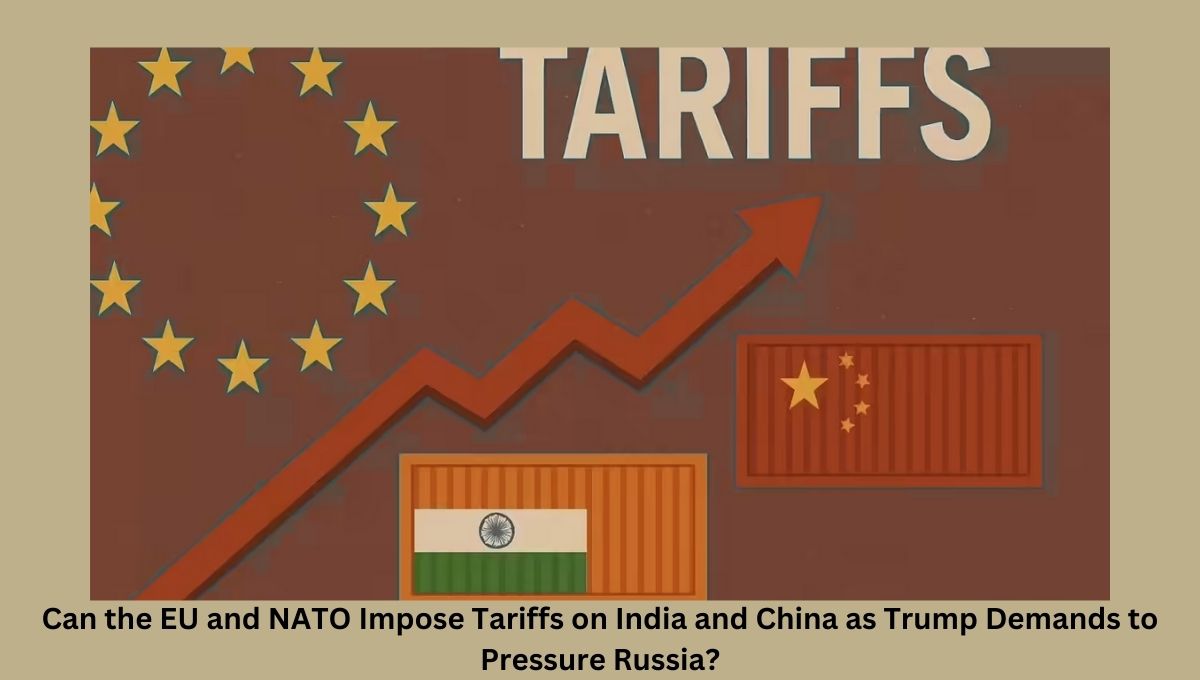
To weaken Moscow’s economy and to force Putin to end the Ukraine war, Can the EU and NATO Impose Tariffs on India and China as Trump Demands to Pressure Russia? US President Donald Trump has escalated pressure on NATO and the European Union (EU), calling for tariffs of up to 100 percent on China and India over their purchases of Russian oil. The move, which Trump argues is crucial to forcing Russian President Vladimir Putin to end the war in Ukraine, has sparked fierce debate in Washington, Brussels, and Beijing.
While Trump insists that punitive tariffs would choke Moscow’s war chest and fast-track peace negotiations, economists and European officials warn that such drastic measures could destabilize global trade, increase consumer prices, and test NATO unity. The question remains: can the EU and NATO realistically impose these tariffs, and what would the consequences be?

Can the EU and NATO Impose Tariffs on India and China as Trump Demands to Pressure Russia?
Trump’s Tariff Push: Linking China, India, and Russia
Trump’s proposal emerged during a recent meeting between US and EU officials. He argued that China and India — the two largest buyers of Russian oil — are keeping Moscow’s economy afloat and allowing Putin to sustain the war in Ukraine.
- China’s role: In 2024, Beijing imported 109 million tonnes of Russian crude, about 20 percent of its total oil imports.
- India’s role: New Delhi imported 88 million tonnes of Russian crude, accounting for 35 percent of its oil supply.
Trump has already slapped an extra 25 percent tariff on India’s Russian oil-linked imports, but has so far refrained from hitting China as his administration navigates a fragile trade truce with Beijing. Instead, he wants NATO and the EU to take the lead.
In a fiery letter posted on Truth Social on September 13, Trump demanded joint tariffs of 50–100 percent on China, insisting they should remain in place until the war ends.
“NATO’s commitment to WIN has been far less than 100%, and the purchase of Russian Oil by some has been shocking,” Trump wrote.
“Anyway, I am ready to ‘go’ when you are. Just say when?”
Why Is Trump Targeting NATO and the EU?
Trump’s strategy relies on united economic warfare against Moscow. While Washington has already imposed heavy sanctions on Russian banks, energy, and oligarchs, Trump wants European countries to go further.
Europe’s Energy Shift Since 2022
When Russia launched its full-scale invasion of Ukraine in February 2022, the EU imported 45 percent of its natural gas from Russia. That figure is now down to 13 percent, reflecting a painful but determined shift toward alternative suppliers.
Yet Trump argues that this reduction is not enough. He wants a total halt to Russian energy imports and steep tariffs on China to choke off Moscow’s lifeline.
NATO’s Security Concerns
The call for tariffs also comes amid escalating tensions between NATO and Russia:
- More than a dozen Russian drones breached Polish airspace last week.
- Another drone entered Romanian airspace, forcing Bucharest to scramble fighter jets.
- France and Germany announced they would move additional military assets eastward.
For Trump, this heightened security risk underscores the urgency of economic pressure to match military deterrence.
Legal Challenges: Does Trump Even Have Authority?
Trump’s aggressive tariff strategy faces legal hurdles at home.
Under the International Emergency Economic Powers Act (IEEPA), presidents have limited authority to impose tariffs unilaterally. In May, a US trade court ruled that Trump’s tariffs on Chinese goods exceeded his legal authority.
An appeals court upheld the ruling in August, and the case is now heading to the Supreme Court, with a decision expected in November. This means Trump’s push for NATO and the EU to impose their own tariffs may also be an attempt to offset his weakened authority domestically.
Also Read: Trump Caught off Guard as India Exposes US-Russia Trade Amid Tariff Tensions
Can the EU Impose Tariffs on China and India?
Europe’s Trade Dependence on China
The EU’s economic ties with Beijing are massive:
- Trade in goods (2024): €732 billion ($860 billion).
- EU trade deficit with China: €305.8 billion ($359 billion).
- Top imports: consumer electronics (40%), heavy machinery, clothing, and accessories.
By contrast, the EU’s trade deficit with India was just €22.5 billion ($26 billion) in 2024 — far smaller, making tariffs on India less economically risky.
However, imposing tariffs of 50–100 percent on China would disrupt supply chains, raise consumer prices, and potentially spark a trade war.
EU Political Dynamics
- France and Germany, while critical of Russia, remain cautious about hitting China too hard.
- Eastern European states, especially Poland and the Baltics, have been more hawkish, supporting tougher measures against Moscow and its allies.
- The G7 has discussed “targeted tariffs” but stopped short of backing Trump’s sweeping demands.
The upshot: Europe may consider limited tariffs on Russia-linked goods but is unlikely to approve blanket tariffs on China at Trump’s levels.
Also Read: Trump’s pressure on Europe to slap 100% tariffs on India and China raises eyebrows
China Pushes Back: “Unilateral Bullying”
Beijing has strongly condemned Trump’s tariff campaign.
Chinese Foreign Ministry spokesperson Lin Jian said:
“The US move is a typical act of unilateral bullying and economic coercion, which seriously undermines international trade rules and threatens the security and stability of global supply chains.”
China also warned of possible countermeasures and insisted its trade with Russia is legal under World Trade Organization (WTO) rules.
Foreign Minister Wang Yi added that sanctions only “complicate” conflicts and reiterated China’s call for dialogue and negotiation instead of economic warfare.
India’s Balancing Act
India finds itself in a tricky position. As the world’s third-largest oil importer, it has leaned on cheap Russian crude since 2022 to cushion domestic fuel costs.
While Trump has already slapped a 25 percent tariff on Indian goods, his administration remains careful not to alienate New Delhi.
- On September 9, Trump said trade negotiations with Indian Prime Minister Narendra Modi were progressing and described India as a “close friend and natural partner.”
- Modi echoed this optimism, saying discussions would conclude “at the earliest.”
For India, aligning too closely with US tariffs risks straining ties with both Russia and China, while resisting too strongly risks souring relations with Washington.
NATO Members That Still Buy Russian Oil
Trump’s pressure campaign also highlights divisions within NATO itself:
- Turkiye remains the third-largest buyer of Russian oil after China and India.
- Hungary and Slovakia continue to import Russian crude despite EU sanctions.
This complicates NATO’s ability to present a unified front, especially when Trump accuses some members of undermining sanctions by fueling Russia’s war machine.
Economic Fallout: What Happens If Tariffs Are Imposed?
For Russia
- Oil revenue could plummet, weakening Moscow’s ability to fund its war in Ukraine.
- But Russia may redirect more oil to non-Western markets, including Africa and Latin America.
For Europe
- Consumer prices would rise sharply, especially in electronics and manufacturing.
- Inflationary pressure could fuel political backlash against EU leaders.
For Global Trade
- A China–EU trade war could disrupt global supply chains.
- Rising tensions risk dividing NATO and the G7, weakening Western unity against Russia.
Trump’s Broader Strategy: Tariffs as Leverage
Trump has long viewed tariffs as a negotiating tool. In his recent remarks, he suggested that tariffs on China and India would only remain until the Ukraine war ends.
He also blamed his predecessor Joe Biden and Ukrainian President Volodymyr Zelenskyy for failing to prevent the war, framing himself as the only leader capable of ending it:
“This is not TRUMP’S WAR (it would never have started if I were President!), it is Biden’s and Zelenskyy’s WAR. I am only here to help stop it.”
Conclusion: A High-Stakes Gamble
Trump’s demand that NATO and the EU impose tariffs on China and India is bold but fraught with economic, political, and legal risks.
- The EU’s deep reliance on Chinese imports makes sweeping tariffs unlikely.
- India’s importance as a US partner complicates Washington’s approach.
- NATO members themselves remain divided over Russian energy imports.
While Trump insists such measures would bring the war to a quick end, experts warn they could instead trigger global trade turmoil, worsen inflation, and even fracture NATO unity at a critical moment.
The coming months — especially the Supreme Court ruling on Trump’s tariff powers in November and ongoing G7 deliberations — will determine whether his tariff gamble becomes reality or remains political posturing.
Related Posts:
- 7 Powerful Measures: Trump Sanctions Russian Oil…

- Trump Urges EU to Slap 100% Tariffs on China and…

- 7 Crucial Insights Into Trump and Xi’s High-Stakes…
- In 8 Moves, EU Targets China-Linked Refineries and…

- 5 Powerful Highlights as Trump Lands Second Nobel…

- Trump’s 20-Point Gaza Peace Plan Gains Urgent Global…
