In US-China trade war, China Slams U.S. Over Tariff Truce Violations, Vows “Forceful Measures” rising tensions. Just weeks after Beijing and Washington shook hands on a 90-day tariff truce during high-stakes Geneva trade talks, relations between the world’s two largest economies have once again soured. On Monday, June 2, 2025, China hit back strongly at the United States, accusing Washington of “seriously undermining” the agreement by imposing new trade restrictions and revoking student visas.
This sharp rebuke came in response to U.S. President Donald Trump’s statement accusing China of having “totally violated” the Geneva agreement. However, China’s Ministry of Commerce firmly rejected the claims, labeling them as “groundless” and “contrary to the facts.”
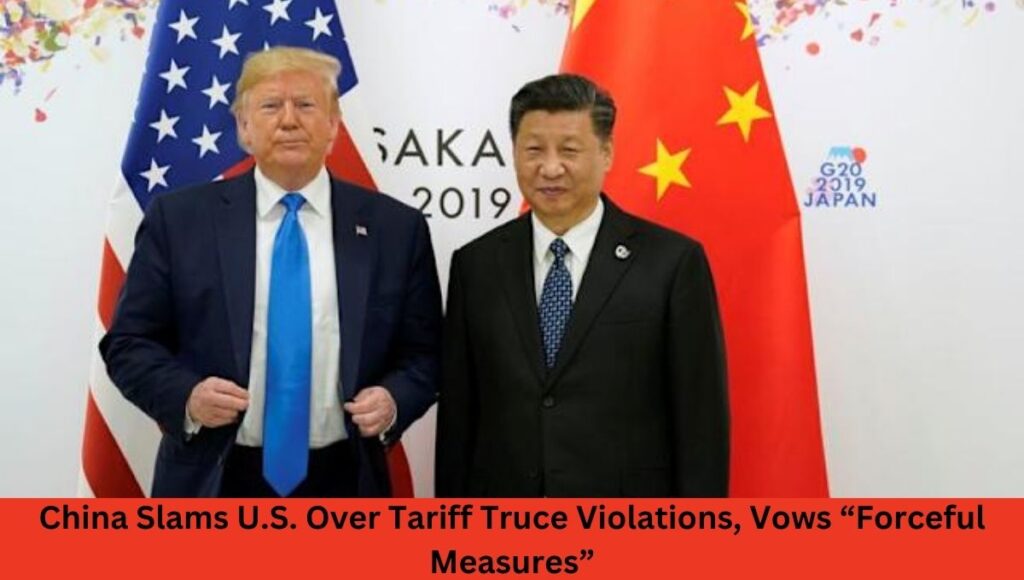
China Slams U.S. Over Tariff Truce Violations, Vows “Forceful Measures”
China Accuses U.S. of Breaking Trade Truce Commitments
According to Beijing’s Commerce Ministry, the United States has violated the spirit and the letter of the Geneva trade truce by introducing a series of discriminatory and restrictive measures. These include:
- Issuing guidance on AI chip export controls
- Halting the sale of chip design software to Chinese firms
- Revoking student visas for Chinese nationals studying in critical fields
These moves, China says, breach the consensus reached not only in Geneva but also during a phone call between President Xi Jinping and Donald Trump on January 17, 2025.
China further emphasized that the agreement to reduce mutual tariffs was contingent upon both parties refraining from implementing new trade barriers or political provocations.
Visa Revocations Add Political Weight to Trade Tensions
Perhaps the most politically sensitive of the U.S. actions is the decision to begin revoking student visas for Chinese nationals. Secretary of State Marco Rubio announced on May 29 that Chinese students, particularly those with ties to the Chinese Communist Party or studying in “critical fields,” would face visa restrictions.
With approximately 270,000 Chinese students currently studying in the United States, this measure has created shockwaves across academic and diplomatic circles.
Beijing expressed outrage that student visas were being bundled into a broader trade dispute, viewing it as a direct attack on its soft power and international standing.
A Truce That Was Supposed to Ease Tensions
The Geneva trade truce, signed just last month, temporarily paused escalating tit-for-tat tariffs for 90 days. Under this short-term agreement:
- The U.S. reduced tariffs on Chinese goods from 145% to 30%
- China slashed its retaliatory tariffs from 125% to 10%
- China also agreed to ease export restrictions on rare-earth minerals—crucial for semiconductors, defense technologies, and electric vehicle batteries
The truce had been hailed as a rare moment of progress in a trade relationship marked by volatility. However, China now argues that U.S. behavior post-Geneva shows a lack of sincerity in following through on the deal.
Washington Accuses Beijing of “Slow-Rolling” the Deal
On the American side, officials remain critical of Beijing’s pace and compliance. U.S. Commerce Secretary Howard Lutnick accused China of “slow-rolling the deal,” claiming that Beijing had not lifted non-tariff barriers or moved quickly enough on its trade commitments.
Meanwhile, U.S. Trade Representative Jamieson Greer said that China had failed to eliminate non-tariff barriers as agreed upon. Trump himself, in a post on TruthSocial, declared he would no longer be “Mr. Nice Guy,” vowing tougher measures against China.
Despite the criticism, no formal evidence has been provided publicly to support claims that China violated specific aspects of the agreement.
Steel and Aluminum Tariffs Add Fuel to the Fire
The Trump administration further escalated the situation by announcing a doubling of tariffs on steel and aluminum, raising duties from 25% to 50%, effective this Wednesday.
Although China is a major global exporter of these metals, its direct exports to the U.S. have already been heavily curtailed since the initial 2018 tariff wave.
Nevertheless, the timing of this move, just days after accusations against China, has added to the perception that the U.S. is not honoring the Geneva spirit of economic de-escalation.
Beijing Warns of Retaliation
In a strongly worded statement, China’s Commerce Ministry warned that it would take “resolute and forceful measures” to protect its legitimate rights and interests. While the ministry did not detail what those actions might include, experts suggest possible steps could involve:
- Renewed export restrictions on rare-earth minerals
- Targeted tariffs on key American industries
- Increased scrutiny on U.S. firms operating in China
China also reiterated its preference for resolving trade disputes through lower-level negotiations before involving the heads of state highlighting a key difference in diplomatic styles between the two nations.
Talks May Still Be on the Table
Despite the worsening rhetoric, there’s still a chance for dialogue. Treasury Secretary Bessent and National Economic Council Director Kevin Hassett both indicated that a phone call between Trump and Xi could happen “this week.”
Hassett remarked that “both sides have expressed a willingness to talk,” while Bessent suggested unresolved details from Geneva might still be ironed out once top-level talks resume.
Whether those conversations will lead to progress or further collapse remains uncertain.
Conclusion: A Fragile Trade Truce in Peril
The renewed war of words between Washington and Beijing serves as a stark reminder of how fragile the China-US trade truce truly is. With mutual accusations of bad faith and escalating retaliatory measures, the 90-day pause appears increasingly vulnerable.
If talks between President Trump and President Xi fail to materialize or yield new compromises, the global economy could once again be at the mercy of tariff wars, supply chain disruptions, and geopolitical tension.
For now, the world watches closely.
Also Read: US Lawmakers Target China and India with Proposed 500% Tariffs Over Russian Oil Trade
Also Read: Trump accuses China of violating trade deal, doubles steel and aluminum tariffs