7 Historic Shifts Powering Canada–China’s New Strategic Reset as Mark Carney visits China. Canadian Prime Minister Mark Carney’s visit to Beijing marks one of the most consequential moments in Canada–China relations in nearly a decade.
Against the backdrop of escalating global trade tensions, aggressive US tariffs, and geopolitical uncertainty, Ottawa and Beijing are attempting what both sides describe as a “new strategic partnership”—one promising historic gains if political hurdles can be managed. Carney’s trip, the first by a Canadian prime minister since 2017, is not simply symbolic.
It reflects a calculated recalibration of Canadian foreign and economic policy as Ottawa seeks to reduce its overwhelming dependence on the United States while navigating an increasingly fragmented global order.
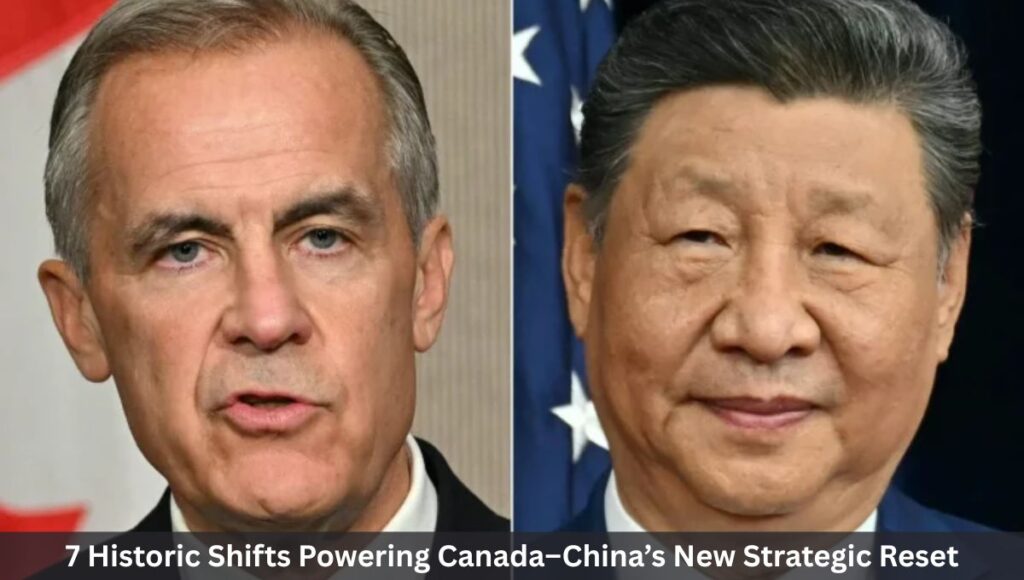
7 Historic Shifts Powering Canada–China’s New Strategic Reset
A Long-Frozen Relationship Begins to Thaw
Relations between Canada and China have been strained since 2018, when Canadian authorities arrested Huawei executive Meng Wanzhou at Vancouver International Airport on a US extradition request.
Beijing responded by detaining two Canadian citizens, triggering years of diplomatic standoffs, mutual mistrust, and escalating trade disputes.
While the two countries maintained limited engagement, political ties largely remained frozen. Trade relations also suffered, particularly after Canada imposed tariffs on Chinese electric vehicles in 2024, echoing similar measures by Washington.
Carney’s visit signals an explicit effort to move past this era.
“It is important to start this new strategic partnership at a time of division,” Carney told Chinese President Xi Jinping, emphasizing the potential for historic gains through cooperation in agriculture, energy, finance, and agri-food.
Why This Visit Matters Now
1. US Tariffs Reshape Canada’s Economic Calculus
Carney’s Beijing trip comes amid unprecedented strain in Canada–US relations. Since returning to the White House, US President Donald Trump has imposed sweeping tariffs on Canadian goods, including steel, aluminium, vehicles, and lumber.
He has also repeatedly suggested Canada could become the United States’ “51st state”—remarks that have sparked political backlash north of the border.
While the US remains Canada’s largest trading partner—absorbing roughly 75 percent of Canadian exports—the relationship has grown volatile. Carney has made diversification a core economic priority, pledging to double Canada’s non-US trade by 2035.
China, Canada’s second-largest single-country trading partner, is central to that strategy.
2. China Seeks Partners Amid Global Decoupling Pressures
China, too, faces pressure from US-led trade restrictions and tariffs. Beijing views engagement with a Group of Seven economy like Canada as strategically valuable—not only economically, but narratively.
Analysts say improved China–Canada relations could undermine Washington’s push for economic decoupling.
“If Ottawa takes a more pragmatic and autonomous economic policy toward China, Beijing can point to it as evidence that US-led decoupling is neither inevitable nor universally accepted,” said Sun Chenghao of Tsinghua University.
Economic Pillars of the New Partnership
Agriculture and Agri-Food
Agriculture remains one of the most promising—and contentious—areas of cooperation. China previously imposed tariffs on more than $2.6 billion worth of Canadian farm and food products, including canola oil, canola meal, and canola seed, in retaliation for Canada’s EV tariffs.
The impact was significant. China’s imports of Canadian goods fell by more than 10 percent in 2025. Tariff talks are now back on the table, with Canada’s industry minister confirming ongoing negotiations in Beijing.
Energy and the Green Economy
Energy cooperation is another cornerstone of the proposed partnership. Canada is eager to expand exports of energy products while also positioning itself as a leader in clean and green energy.
Chinese Premier Li Qiang highlighted opportunities for cooperation in clean energy, advanced manufacturing, and digital technology, framing collaboration as mutually beneficial amid global economic turbulence.
Finance and Investment
China has welcomed increased Canadian investment, while urging Ottawa to provide a fair and non-discriminatory environment for Chinese firms operating in Canada. Multiple cooperation documents covering trade, customs, energy, construction, and finance were signed during Carney’s visit.
Political Constraints and Strategic Limits
Despite warming rhetoric, analysts caution against overstating the depth of Canada’s pivot toward China.
Canada remains deeply embedded in US-led security, intelligence, and defence frameworks. Ottawa is a core NATO ally and a longstanding participant in the Five Eyes intelligence alliance.
“It is very unlikely that Canada will realign strategically away from Washington,” Sun said.
The challenge for Carney lies in striking a balance: expanding economic engagement with China without undermining security commitments or provoking further friction with the US.
Taiwan, Interference, and Red Lines
Sensitive political issues continue to loom over the relationship.
Beijing expects adherence to the one-China policy, and Canadian officials have reiterated that commitment during the visit. However, Ottawa has also accused China of political interference in Canadian elections—claims that remain unresolved.
In a telling development, two Canadian MPs cut short a visit to Taiwan ahead of Carney’s trip, citing the need to avoid “confusion” in Canada’s foreign policy.
Experts warn that such moves underscore the delicate balancing act Canada faces.
“China will portray this visit as Canada correcting mistakes of the past,” said Vina Nadjibulla of the Asia Pacific Foundation of Canada. “That creates expectations Beijing will want Ottawa to meet.”
USMCA Uncertainty Adds Pressure
The timing of Carney’s China visit coincides with a review of the US–Mexico–Canada Agreement (USMCA). While the agreement currently allows most Canadian goods to enter the US tariff-free, Trump has repeatedly dismissed it as “irrelevant.”
If the agreement is not renewed or modified, it could enter a cycle of annual reviews until its potential expiration in 2036—creating prolonged uncertainty for Canadian exporters.
Economists warn that a breakdown of USMCA would impose significant costs on North American trade and investment, further strengthening Ottawa’s case for diversification.
China’s Broader Strategic Narrative
From Beijing’s perspective, Carney’s visit is more than bilateral diplomacy—it is a geopolitical signal.
Chinese officials and state-affiliated experts have framed the engagement as a turning point that demonstrates resistance to unilateralism and support for free trade.
“Long-term cooperation between China and Canada is conducive to the stability of the global trade landscape,” said Liu Dan of Guangdong University of Foreign Studies.
China has also emphasized public support within Canada for closer economic ties, citing polling data showing more than half of Canadians favor expanded trade with China.
A Pragmatic Reset, Not a Full Reset
Carney has been careful to frame the partnership in pragmatic terms. His focus remains on specific economic deals rather than sweeping political alignment.
“Together we can build on the best of what this relationship has been in the past to create a new one adapted to new global realities,” he told Xi at the Great Hall of the People.
That language reflects both ambition and restraint.
What Comes Next
While cooperation documents have been signed and dialogue restored, major challenges remain:
- Tariffs on electric vehicles and agricultural products are still in place
- Political distrust has not fully dissipated
- Canada must manage US reactions carefully
- Beijing will expect tangible policy follow-through
Yet the visit has undeniably altered the tone of the relationship.
Chinese Foreign Minister Wang Yi described it as a “turning point”, while Canadian officials have acknowledged the need for a recalibrated China policy under Carney’s leadership.
Conclusion: A Strategic Gamble in Uncertain Times
Mark Carney’s China visit reflects a world in flux—where middle powers like Canada are forced to rethink long-standing assumptions amid trade wars, geopolitical rivalry, and economic volatility.
The emerging Canada–China strategic partnership is neither a wholesale realignment nor a symbolic gesture. It is a calculated gamble: one that seeks economic resilience without sacrificing strategic autonomy.
Whether it delivers the historic gains both sides envision will depend not only on trade talks and tariffs, but on Canada’s ability to walk a narrowing line between its most powerful ally and the world’s second-largest economy. For now, the reset has begun.
Also Read: 5 Bold Signals Mark Carney’s China Pivot as Canada Rewrites Trade Strategy
Also Read: Canada’s Carney hails warmer ties with China and signs energy pact
Related Posts:
- 7 Big Takeaways: Macron’s High-Stakes China Visit…

- 5 Bold Signals Mark Carney’s China Pivot as Canada…

- In 8 Moves, EU Targets China-Linked Refineries and…

- 5 Key Takeaways from Trump–Carney Meet: Trade,…
- ‘Dragon and Elephant Must Come Together’: PM Modi…
- China Hosts SCO Summit 2025 and Military Parade as…